

Managing sales tax in Massachusetts means navigating one of the nation’s more intricate retail tax systems. Whether you’re launching an e-commerce business, expanding into New England, or simply trying to understand your compliance obligations, Massachusetts sales tax creates both operational challenges and audit risks.
From economic nexus thresholds to industry-specific exemptions, the right compliance partner transforms confusion into clarity. Hands Off Sales Tax (HOST) specializes in multi-state sales tax management, handling everything from nexus analysis to automated filings. Understanding Massachusetts sales tax, what’s taxable, when collection starts, and how to avoid costly penalties, keeps you pricing correctly and filing accurately.
What Is Massachusetts Sales Tax?
Massachusetts sales tax is a 6.25% consumption tax on retail sales of tangible personal property and certain services. Businesses with nexus must collect this tax from customers at checkout, then remit it to the Massachusetts Department of Revenue (DOR).
Massachusetts also imposes a 6.25% use tax on items purchased from out-of-state vendors where no sales tax was collected. Businesses must remit use tax directly to the DOR on items used, stored, or consumed in Massachusetts.
Unlike many states with layered local taxes, Massachusetts maintains a single statewide rate. No county or city additions. This uniformity simplifies calculations but doesn’t eliminate complexity. Exemptions, taxable services definitions, and filing requirements still create administrative burden.
Massachusetts is a destination-based sales tax state. You collect based on where the customer receives the product, not your business location.
Current Massachusetts Sales Tax Rate
The Massachusetts sales tax rate is 6.25% statewide, which has remained unchanged since 2009. Whether selling in Boston, Springfield, or Cambridge, the rate stays constant across all 351 cities and towns.
However, specific categories vary:
- Restaurant meals and prepared food: 6.25%
- Marijuana and marijuana products: 17% total (6.25% sales tax + 10.75% excise tax on recreational marijuana)
- Short-term rentals and lodging: 5.7% state excise plus local option taxes up to 6.5%
For most e-commerce sellers, the standard 6.25% applies to taxable goods. Understanding exemptions determines whether you collect at all.
Massachusetts Sales Tax Holiday
Massachusetts offers an annual sales tax holiday in August (August 9-10, 2025) when the 6.25% tax is suspended on most retail items under $2,500. This two-day event provides consumer savings and boosts retail activity. Businesses must ensure their systems handle the holiday period correctly: no collection during the weekend, then resumption on Monday. HOST manages these temporary collection changes automatically.
When You Need to Collect Massachusetts Sales Tax
Economic Nexus Thresholds
After the 2018 South Dakota v. Wayfair decision, Massachusetts implemented an economic nexus requiring remote sellers to collect based on sales volume alone. No physical presence needed.
Massachusetts economic nexus triggers at:
- $100,000 in gross sales to Massachusetts customers in the current or previous calendar year
No transaction count threshold. Cross $100,000, and you must register, collect, and remit. This applies whether selling through your website, third-party platforms, or marketplace facilitators.
Physical Nexus Triggers
Physical presence also creates nexus, requiring registration regardless of sales volume:
- Offices, warehouses, or facilities in Massachusetts
- Employees, contractors, or sales representatives working in-state
- Inventory stored in Massachusetts fulfillment centers (including Amazon FBA)
- Trade shows or temporary selling activities exceeding 12 days annually
Store inventory at a Massachusetts Amazon FBA center? You have nexus immediately, even with zero sales to Massachusetts customers.
Marketplace Facilitator Rules
Massachusetts requires marketplace facilitators (Amazon, eBay, Etsy, Walmart) to collect sales tax on behalf of third-party sellers. Selling exclusively through these platforms? The marketplace typically handles collections.
However, track these sales for income tax and monitor economic nexus thresholds in other states. HOST’s nexus analysis identifies exactly where you have obligations across all 45 sales tax states.
What’s Subject to Massachusetts Sales Tax?
Massachusetts taxes most tangible personal property:
- Electronics: Computers, phones, tablets
- Clothing and footwear: Items over $175 (see exemption section)
- Furniture and appliances: Couches, refrigerators, washers
- Tools and equipment: Power tools, commercial machinery
- Books and printed materials: Physical copies
Motor vehicles and trailers follow different rules. Buyers pay sales tax directly to Massachusetts rather than to the seller at point of sale.
Taxable Services
Massachusetts taxes specific services but exempts most:
Taxable services:
- Telecommunications: Phone services, beeper services, cellular services (Note: Cable television and internet access are exempt)
- Motor vehicle repair: Labor charges for vehicle repairs
Exempt services include:
- Professional services (legal, accounting, consulting)
- Personal services (haircuts, dry cleaning)
- Real estate services
- Educational services
- Healthcare services
Massachusetts Sales Tax Exemptions
Clothing and Footwear Exemption
Individual items priced $175 or less are exempt. For items above $175, tax applies only to the amount exceeding $175.
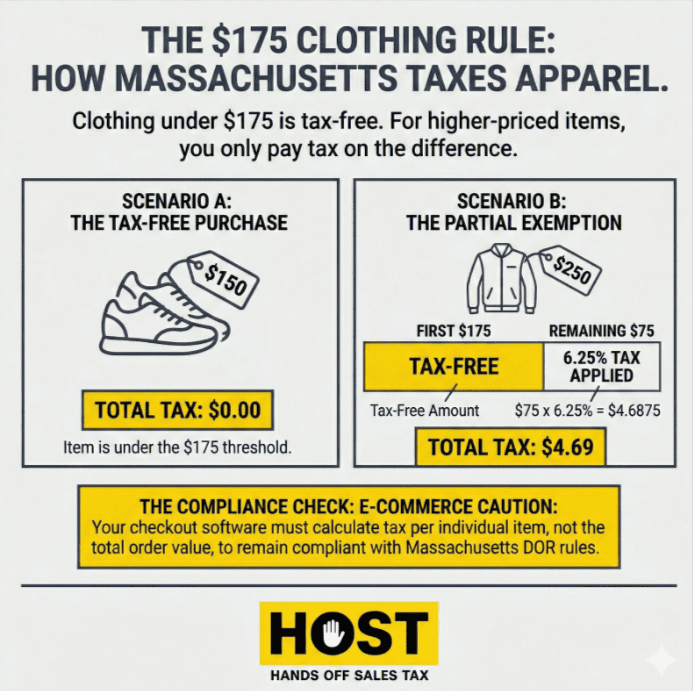
Examples:
- $150 jacket: No tax (fully exempt)
- $200 coat: Tax on $25 ($200 – $175 = $25 × 6.25% = $1.56)
- Two $100 shirts: No tax (each item under $175)
Excludes athletic uniforms, protective equipment, and formal wear rentals.
Food and Grocery Exemption
Most grocery food for home consumption is exempt:
- Fresh produce, meat, dairy, eggs
- Bread, cereal, canned goods
- Bottled water, milk, juice
Taxable food items:
- Restaurant meals and grocery hot bars
- Candy and soft drinks
- Alcoholic beverages
A cold deli sandwich? Typically exempt. Heated? Taxable. These nuances require careful categorization.
Other Key Exemptions
- Prescription medications: Fully exempt
- Manufacturing equipment: Machinery used directly in manufacturing
- Agricultural items: Farm equipment, feed, seed
- Residential utilities: Electricity and gas for homes
Selling to manufacturers or tax-exempt organizations? You’ll need systems to validate exemption certificates and maintain documentation. Accepting invalid certificates leaves you liable for uncollected tax.
Massachusetts Sales Tax Filing Requirements
Registration Process
Register with the Massachusetts DOR before collecting sales tax. Registration creates a permit and assigns your identification number.
Register online through MassTaxConnect. You’ll need:
- Business legal name and structure
- Federal EIN
- Expected sales volume
- Banking information for payments
Massachusetts charges no registration fee. Once approved, display your Certificate at physical retail locations.
HOST handles sales tax registration in Massachusetts and all required states, managing paperwork and state communications so you focus on operations.
Filing Frequency
Massachusetts assigns filing based on average monthly tax liability:
- Monthly filers: Average liability over $100/month
- Quarterly filers: Average liability under $100/month
Most e-commerce businesses are meeting the $100,000 threshold file monthly. Returns are due 30 days after the close of the reporting period for periods ending after April 1, 2021.
Example: January 2025 return (ending January 31) is due February 28 or March 2.
Massachusetts requires filing even in zero-activity months. No sales? File a zero return to avoid penalties.
Record Retention Requirements
Massachusetts requires businesses to maintain sales tax records for at least 3 years from the filing date. Records must be available for DOR inspection and should include all sales receipts, exemption certificates, and filed returns. Audits may extend to 6 years if you understate tax by more than 25%.
Penalties for Non-Compliance
Failing to collect, file, or remit triggers significant penalties:
- Late filing: 1% of tax due per month, up to 25%
- Late payment: 0.5% of tax due per month, up to 25%
- Interest: Federal short-term rate plus 4%, compounded daily
Massachusetts audits can examine four years of records, assessing back taxes, penalties, and interest. Multi-year audit liability can exceed six figures.
Common Massachusetts Sales Tax Mistakes
Incorrectly Taxing Exempt Clothing
Many businesses fail to program the $175 exemption correctly. Your system must identify clothing items, track individual prices, and apply tax only to amounts exceeding $175.
Common errors:
- Taxing all clothing regardless of price
- Applying exemption to total order vs. individual items
- Failing to categorize products correctly
Missing Economic Nexus Thresholds
E-commerce sellers frequently miss when they’ve crossed the $100,000 threshold. Without monitoring, you might discover nexus months or years later, creating retroactive liability.
HOST’s nexus analysis identifies exactly when and where you’ve triggered obligations.
Software Misconfiguration
TaxJar and Avalara calculate Massachusetts sales tax at checkout, but misconfiguration creates expensive errors:
- Treating all clothing as exempt (missing the $175 threshold)
- Applying tax to manufacturing equipment
- Double-taxing due to duplicate integrations
HOST offers a Free Sales Tax Software Review to audit your configuration and identify errors before they impact your bottom line.
HOST: Your Massachusetts Sales Tax Partner
Massachusetts sales tax creates complexity that consumes time and increases audit risk. Whether managing nexus in Massachusetts alone or across dozens of states, professional management eliminates errors.
What HOST Delivers:
- Nexus Analysis: We analyze your footprint to determine exactly where you’ve met Massachusetts and multi-state thresholds
- Sales Tax Registration: We handle Massachusetts DOR registration, managing all paperwork
- Automated Filing: We prepare and file your Massachusetts returns monthly, quarterly, or annually
- Software Optimization: We review TaxJar, Avalara, or other tools to calculate Massachusetts exemptions correctly
- Notice Management: We interpret and respond to Massachusetts DOR notices
- Audit Defense: We organize documentation and defend your position during audits
We’ve been 100% focused on sales tax since 1999. Over 25 years helping businesses navigate Massachusetts and multi-state compliance. Founded by Mike Espenshade, with parent company TaxMatrix serving North America’s largest companies, we bring enterprise expertise to e-commerce sellers of all sizes.
You handle the sales, we handle the tax.
Ready to Simplify Massachusetts Compliance?
Massachusetts sales tax compliance doesn’t have to drain your time or create constant worry. Every hour spent researching exemptions or filing returns is an hour not spent growing your business.
Whether you’ve just crossed the $100,000 threshold, discovered Massachusetts FBA inventory, or want to ensure clothing exemption calculations are correct, professional help eliminates guesswork.
Contact HOST today to discuss your Massachusetts sales tax needs or schedule a free consultation. Let us handle compliance so you can focus on growth.
Want to learn more? Get our “10 Sales Tax Mistakes E-Commerce Sellers Make” e-book and discover the most common errors that trigger audits, and how to avoid them.
Frequently Asked Questions
What is the Massachusetts sales tax rate?
The Massachusetts sales tax rate is 6.25% statewide. No local option sales taxes exist, so the rate stays uniform across all cities. Marijuana products face 17% total (6.25% sales tax + 10.75% excise tax), and lodging has separate excise taxes.
When do I need to collect Massachusetts sales tax?
Collect when you exceed $100,000 in sales to Massachusetts customers in the current or previous calendar year (economic nexus), or when you have physical presence through offices, employees, inventory, or other connections (physical nexus).
Are clothes taxable in Massachusetts?
Clothing and footwear priced $175 or less are exempt. For items above $175, tax applies only to the amount exceeding $175. A $200 jacket incurs tax on $25 ($200 – $175), resulting in $1.56 in sales tax.
Is food taxable in Massachusetts?
Most grocery food for home consumption is exempt, including produce, meat, dairy, and canned goods. Restaurant meals, prepared food, candy, soft drinks, and alcoholic beverages are taxable at 6.25%.
How often do I file Massachusetts sales tax returns?
Massachusetts assigns filing frequencies based on average monthly liability. Most businesses exceed the $100,000 threshold file monthly, with returns due 30 days after period close. Smaller sellers may qualify for quarterly filing.
What happens if I don’t collect Massachusetts sales tax when required?
Failing to collect and remit creates liability for back taxes plus penalties and interest. The Massachusetts DOR can audit four years of records, assess penalties up to 25%, and charge interest compounded daily. Professional compliance prevents these costly outcomes.
