

Hit $100,000 in District sales? That’s economic nexus, and D.C.’s tax authorities won’t wait for you to figure it out. For e-commerce sellers navigating the capital’s unique tax landscape, understanding when nexus activates and what compliance actually looks like separates smooth operations from expensive surprises.
That’s where Hands Off Sales Tax (HOST) makes the difference. With over 25 years managing multi-state compliance, we handle Washington D.C. economic nexus requirements so you focus on growth instead of tracking thresholds.
What Is Economic Nexus in Washington D.C.?
Economic nexus creates a tax obligation based purely on sales activity—no office space or warehouse required. After the 2018 Wayfair decision, states gained authority to require remote sellers to collect sales tax once they hit specific thresholds.
Washington D.C. established its rules effective January 1, 2019. Cross the threshold, and compliance becomes mandatory. Note that physical presence like offices, warehouses, inventory, employees, or even representatives taking orders also creates nexus independent of sales volume.
Washington D.C.’s Economic Nexus Threshold
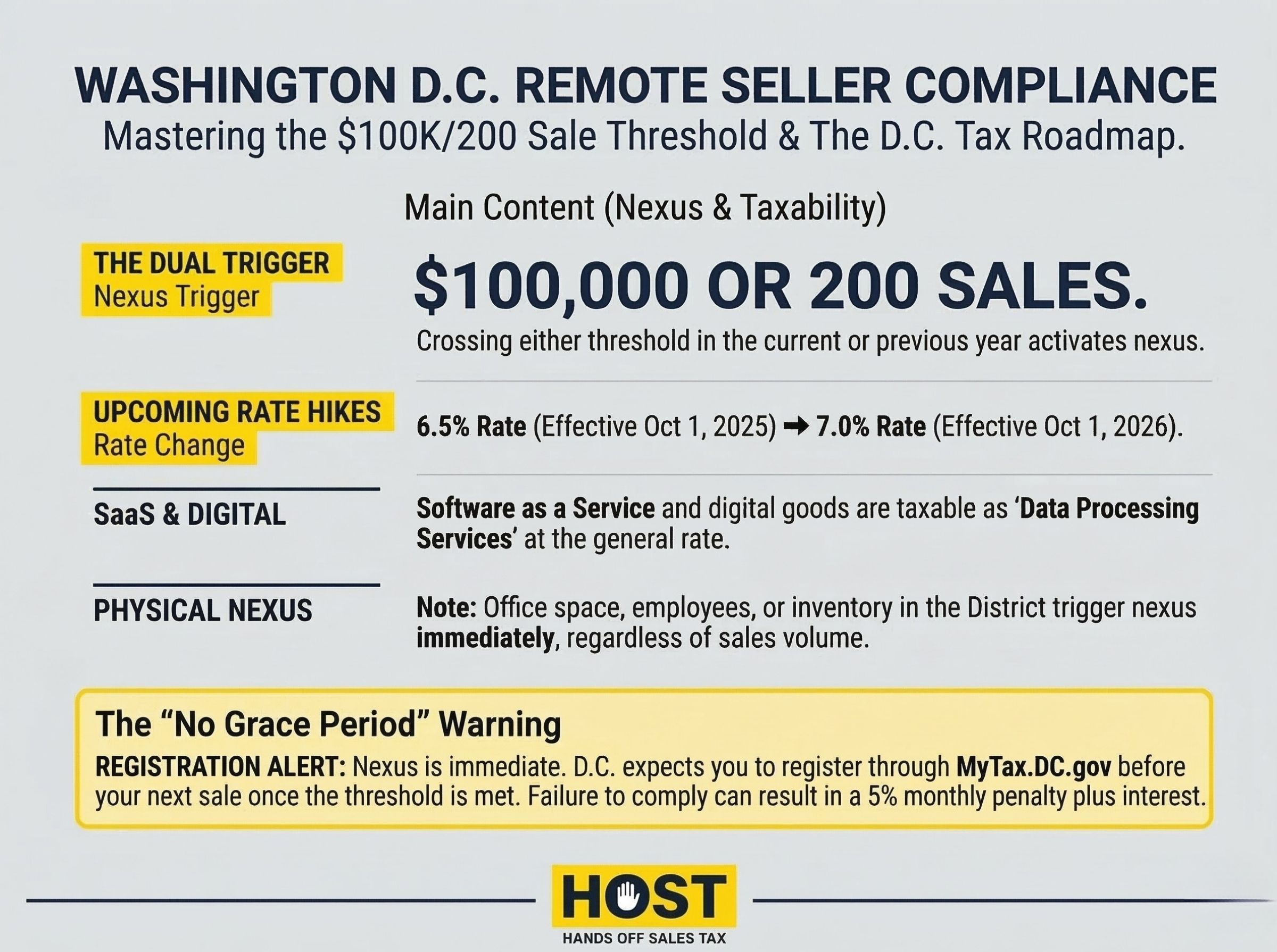
D.C. requires remote sellers to collect sales tax when they exceed $100,000 in gross receipts OR make more than 200 separate retail sales to District customers in the previous or current calendar year.
Hit either threshold ($100,001 in revenue or sale number 201) and you’ve triggered nexus. Unlike some states that eliminated transaction counts, D.C. maintains both metrics. High-volume, low-dollar sellers can trigger nexus on transactions alone, even below $100,000 in revenue.
When Nexus Takes Effect
Economic nexus activates the moment you cross either threshold. Register with the D.C. Office of Tax and Revenue (OTR) before your next District sale. There’s no grace period. The obligation begins immediately.
D.C. uses both current-year and prior-year lookbacks. Exceeded thresholds in 2024? You have nexus for all of 2025, regardless of 2025 volume. Cross thresholds mid-year? Nexus applies immediately for the remainder of that year.
Monitor both metrics continuously. A strong Q4 that pushes you over $100,000 or past 200 transactions triggers immediate obligations.
What’s Taxable in D.C.?
Washington D.C. currently imposes a 6% sales tax on most tangible personal property and certain services. The rate increases to 6.5% on October 1, 2025, and to 7% on October 1, 2026.
Most physical products are taxable: electronics, clothing, furniture, books. Prescription medications, most groceries, and residential utilities receive exemptions.
Digital products and SaaS matter: D.C. taxes Software as a Service and digital goods—cloud subscriptions, streaming services, downloaded music, e-books. The District categorizes these as data processing services subject to the general rate.
Registration Steps
You’ll need your FEIN or Social Security Number, business legal name and structure, physical address, responsible party information, and estimated monthly D.C. sales.
Register through MyTax.DC.gov. Create an account, select “Sales and Use Tax,” and complete the FR-500 Combined Business Tax Registration form. Once approved, D.C. OTR issues your sales tax number for invoices and returns.
D.C. assigns filing frequency based on estimated liability: monthly (over $200/month expected), quarterly ($50-$200/month), or annually (under $50/month). Most sellers with $100,000+ file monthly or quarterly.
HOST manages the entire registration process across all jurisdictions where you have nexus—handling paperwork, follow-up, and state communications so you stay compliant without diverting focus.
Filing Requirements
File according to your assigned frequency. Monthly filers: returns due the 20th of the following month. Quarterly filers: 20th of the month following quarter end. Annual filers: January 20 of the following year.
Missing deadlines triggers penalties and interest, even with no tax owed. Filing zero returns is required when you have a permit but no D.C. sales activity.
D.C. requires electronic filing and payment through MyTax.DC.gov. Options include ACH debit (free) or credit card (convenience fee applies).
Filing across multiple jurisdictions monthly or quarterly consumes 30+ hours per month. HOST prepares and files your returns in all required jurisdictions, handling calculations, deadlines, and remittances so you maintain compliance without operational drain.
Common Economic Nexus Mistakes
Ignoring nexus after crossing thresholds: Some sellers delay registration, assuming a grace period exists. D.C. provides none, but nexus is immediate. Continuing sales without registration creates exposure for uncollected tax, penalties, and interest from the date nexus was established.
Miscalculating gross receipts: The $100,000 threshold applies to gross receipts from sales into D.C., not net income. This includes all sales, even exempt items. The 200-transaction threshold counts all separate retail sales delivered into the District. Excluding exempt sales when calculating exposure leads to delayed registration.
Inconsistent collection: After registering, some sellers apply sales tax inconsistently. D.C. holds sellers liable for uncollected tax even when they failed to charge customers. This liability remains with the seller.
Missing deadlines: The 20th-of-month deadline arrives quickly. Missing it triggers penalties: 5% of tax due per month (up to 25%) plus interest. Filing on time with zero tax owed costs nothing. Failing to file costs significantly.
Ignoring ongoing monitoring: Nexus isn’t one-time. Sales fluctuate. Monitor both metrics continuously because a seller who barely exceeded thresholds one year might drop below the next, but nexus continues until formally dissolved.
Already Have Nexus But Haven’t Registered?
Discovering you should have registered months or years ago creates stress, but solutions exist.
Washington D.C. participates in Voluntary Disclosure Agreement programs, allowing businesses to come forward voluntarily before the District contacts them. VDAs typically limit the lookback period (often 3 years instead of the full statutory period) and reduce or eliminate penalties in exchange for registration and future compliance.
Coming forward proactively demonstrates good faith and substantially reduces financial exposure compared to being caught during an audit.
We file Voluntary Disclosure Agreements with Washington D.C. and other jurisdictions, negotiating on your behalf to limit lookback periods and minimize penalties.
How HOST Simplifies D.C. Economic Nexus Compliance
Sales tax compliance across 45+ jurisdictions demands specialized expertise and consistent execution.
Nexus Analysis: We analyze your sales data across all states and districts to determine exactly where you’ve triggered economic nexus, including Washington D.C. This comprehensive review identifies current obligations and potential future exposures.
Sales Tax Registration: We handle registration with D.C. OTR and every other jurisdiction where you have nexus, completing forms, providing documentation, communicating with authorities, and securing permits.
Automated Filing: HOST prepares and files your D.C. sales tax returns monthly, quarterly, or annually based on assigned frequency. We manage deadlines, calculations, and remittances across all jurisdictions.
Notice Management: Received a letter from D.C. OTR? We interpret what it means and respond appropriately. Whether it’s a routine inquiry, assessment, or audit notice.
Audit Defense: If D.C. initiates an audit, HOST acts as your trusted partner throughout the process: organizing documentation, responding to requests, and defending your position to minimize liability.
We’ve focused exclusively on sales tax since 1999. That’s over 25 years helping businesses navigate compliance while optimizing operations.
Ready to Handle D.C. Economic Nexus Correctly?
Economic nexus obligations don’t wait, and neither should your compliance strategy. Whether you’ve just crossed the threshold, operate with nexus in multiple jurisdictions, or discovered past obligations, the right partner ensures you collect correctly, file on time, and avoid costly mistakes.
At HOST, we combine deep technical expertise with personalized support and transparent communication. You handle the sales, we handle the tax.
Contact us today to discuss your Washington D.C. economic nexus situation and discover how we manage compliance so you can focus on growth.
Want to learn more? Get our “10 Sales Tax Mistakes E-Commerce Sellers Make” e-book.
Frequently Asked Questions
What is Washington D.C.’s economic nexus threshold?
Washington D.C. requires remote sellers to collect sales tax once gross receipts from District sales exceed $100,000 OR when they have more than 200 separate retail sales in the previous or current calendar year. Meeting either threshold triggers nexus.
Do I need a physical presence in D.C. to have economic nexus?
No. Economic nexus is based solely on sales volume into Washington D.C., regardless of physical presence. Exceed $100,000 in sales or 200 transactions to D.C. customers, and you have nexus without offices, warehouses, or employees in the District.
When do I need to register after crossing the threshold?
Immediately. Once you exceed $100,000 in D.C. sales OR 200 transactions, you must register before making your next sale into the District. There is no grace period or delayed effective date.
What happens if I don’t register after crossing the threshold?
Failure to register creates compliance exposure. You become liable for uncollected sales tax, plus penalties and interest from the date nexus was established. D.C. can assess back taxes for the full statutory period.
Are SaaS and digital products taxable in Washington D.C.?
Yes. Washington D.C. taxes Software as a Service (SaaS) and digital products, categorizing them as data processing services or digital goods subject to the general sales tax rate. This includes cloud-based software, streaming services, downloaded music, videos, and e-books.
Can I resolve past non-compliance without severe penalties?
Yes. Washington D.C. participates in Voluntary Disclosure Agreement programs, allowing businesses to come forward proactively. VDAs typically limit lookback periods and reduce or eliminate penalties in exchange for registration and future compliance.
