
A well-prepared sales tax audit checklist can mean the difference between a smooth audit process and costly penalties. Sales tax compliance is a critical responsibility for businesses of all sizes, yet even minor miscalculations or missing documentation can trigger audits and financial consequences. Tax authorities scrutinize records to ensure businesses have collected, reported, and remitted sales tax accurately, and any discrepancies can result in fines or legal issues.
With expert support from Hands Off Sales Tax (HOST), businesses can streamline tax processes, reduce risk, and confidently navigate sales tax audits. This guide provides a comprehensive checklist to help businesses stay compliant and audit-ready.
Understanding Sales Tax Audits
A sales tax audit is a formal examination conducted by state or local tax authorities to verify that a business has accurately collected, reported, and remitted sales taxes as required by law. Auditors review financial records, including sales invoices, tax returns, and exemption certificates, to ensure compliance. The primary objectives of these audits are to identify discrepancies, deter tax evasion, and ensure equitable tax collection across businesses.
Audit Frequency by Business Type
Understanding your audit risk helps prioritize compliance efforts. According to industry data:
- Small businesses (under $1M revenue): 2-3% audit rate annually
- Mid-sized businesses ($1M-$10M revenue): 5-7% audit rate annually
- Large businesses (over $10M revenue): 10-15% audit rate annually
- High-risk industries (cash-intensive businesses, restaurants, retail): 15-20% higher audit probability
Approximately 60% of sales tax audits result from automated matching programs that flag discrepancies, while 40% stem from targeted enforcement based on late filings or industry risk profiles.
Average Penalty Ranges
Understanding potential financial consequences emphasizes the importance of compliance:
- Late filing penalties: $50-$500 per return, plus 5-25% of tax due
- Late payment penalties: 5-10% of unpaid tax, increasing monthly
- Underreporting/underpayment: 10-25% penalty on the deficiency
- Negligence penalties: 10-20% of additional tax assessed
- Fraud penalties: 50-75% of tax due, plus potential criminal charges
- Missing exemption certificates: $5-$50 per certificate in some states, or full tax liability if certificate isn’t obtained within 60-90 days of request
The average sales tax audit assessment for small to mid-sized businesses ranges from $15,000 to $75,000, though complex cases can exceed $500,000.
Common Triggers for Audits
Several factors can prompt a sales tax audit:
Discrepancies in Reported Sales: Inconsistencies between a business’s sales tax returns and other financial filings, such as income tax returns, can raise red flags. For instance, if the sales reported to the state differ significantly from those reported to the IRS, it may trigger an audit. Even a 5-10% variance between reported gross sales and sales tax collected can flag automated review systems.
High Sales Volume or Rapid Growth: Businesses experiencing significant increases in sales or rapid expansion may attract attention, as the complexity of transactions can lead to unintentional errors or oversight. Companies crossing $1 million in annual revenue or expanding into multiple states face heightened scrutiny.
Frequent Late Filings or Payments: Consistently submitting tax returns or payments after deadlines can signal poor compliance practices, prompting further investigation. Three or more late filings within a 12-month period significantly increases audit probability in most states.
Industry-Specific Risks: Certain industries, such as cash-intensive businesses (restaurants, bars, convenience stores) or those with complex taxability rules (software/SaaS, construction, healthcare), are more prone to audits due to the higher risk of non-compliance.
Significant Changes in Business Structure: Events like mergers, acquisitions, or substantial shifts in business operations can lead tax authorities to initiate an audit to ensure continued compliance under new circumstances.
Understanding these triggers can help businesses implement proactive measures to maintain compliance and reduce the likelihood of an audit.
Comprehensive Sales Tax Audit Preparation Checklist
Preparing for a sales tax audit requires meticulous attention to documentation, internal controls, employee training, and the effective use of technology. The following comprehensive checklist is designed to guide businesses through essential preparation steps, ensuring compliance and readiness for an audit.
A. Documentation and Record-Keeping
Maintaining accurate and organized records is crucial for demonstrating compliance during a sales tax audit.
Sales Records
Detailed Invoices and Receipts: Ensure that all sales transactions are documented with comprehensive invoices and receipts, including information such as date, amount, items sold, customer details, and tax charged.
Accurate Recording: Regularly update your sales ledger to reflect all transactions accurately, minimizing discrepancies that could raise red flags during an audit.
Purchase Records
Comprehensive Documentation: Keep detailed records of all business-related purchases, including vendor invoices, purchase orders, and payment confirmations.
Proof of Payment: Maintain evidence of payments made for purchases, such as canceled checks or electronic payment records, to substantiate expenses.
Exemption Certificates
Collection and Storage: Obtain valid exemption certificates from customers who qualify for tax-exempt purchases and store them systematically. Key requirements vary by state:
- California: Accepts Resale Certificates with 60-day response window for auditors
- Texas: Requires Texas-specific exemption certificates; out-of-state forms often rejected
- Florida: Accepts Multistate Tax Commission (MTC) uniform certificates
- New York: Strict documentation requirements with short validation periods
Regular Review: Periodically verify that all exemption certificates are current and accurately completed to prevent issues during an audit. Most states require certificates to be refreshed every 3-5 years.
Tax Returns
Retention of Filed Returns: Keep copies of all filed sales tax returns for the period under audit.
Consistency Verification: Ensure that the information reported on tax returns aligns with your financial records to avoid discrepancies.
State-Specific Record Retention Requirements
Sales tax record retention periods vary significantly by state:
Minimum 3 Years:
- Arizona, Colorado, Idaho, Montana, New Mexico, Utah
4 Years:
- California, Illinois, Minnesota, New York, Texas, Washington
5 Years:
- Florida, Georgia, North Carolina, Pennsylvania
6+ Years:
- Kentucky (4 years, but 6 if fraud suspected), Louisiana (indefinite if no return filed)
Federal Standard: The IRS requires 3 years for income tax, but sales tax audits often look back 3-4 years as standard practice.
Practical Recommendation: Maintain sales tax records for at least 4 years from the due date of the return, with 6-7 years providing safer coverage across all states and potential fraud investigations.
Audit Lookback Periods
Understanding how far back auditors can examine your records is critical:
Standard Lookback: Most states audit 3-4 years of records as standard practice.
Extended Lookback Triggers:
- Substantial underreporting (typically 25%+ of tax due): Can extend lookback to 6 years in many states
- Fraud or intentional evasion: No statute of limitations in most states
- No return filed: Indefinite lookback period in most jurisdictions
- Late registration: Some states look back to economic nexus creation date
Voluntary Disclosure Agreements (VDAs): Can often limit lookback to 3-4 years and waive penalties, even when standard lookback would be longer. Learn more about VDAs.
B. Internal Controls and Procedures
Implementing robust internal controls helps prevent errors and ensures compliance with sales tax regulations.
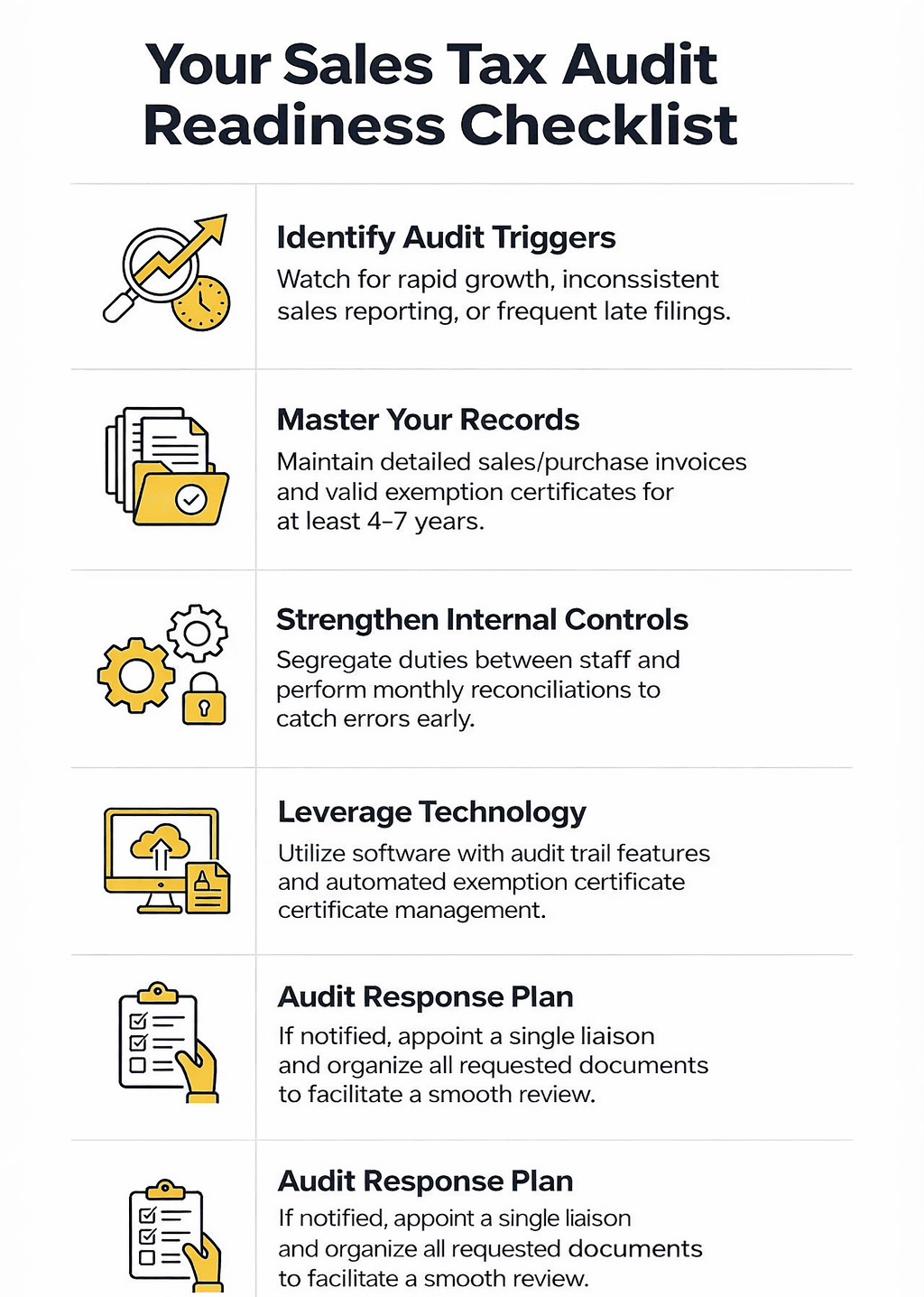
Segregation of Duties: Assign different staff members to handle sales tax collection, recording, and remittance processes to reduce the risk of errors or fraud.
Regular Reconciliations: Conduct regular reconciliations between sales records and tax returns to identify and address discrepancies promptly.
Policy Documentation: Develop and maintain comprehensive written policies outlining procedures for tax collection, recording, and remittance to ensure consistency and compliance.
C. Employee Training and Awareness
Educating employees on sales tax compliance is essential for preventing errors and ensuring adherence to regulations.
Training Programs: Conduct periodic training sessions for relevant staff to keep them informed about sales tax compliance requirements and procedures.
Updates on Tax Laws: Keep employees informed about changes in sales tax regulations that may affect business operations.
D. Technology and Automation
Leveraging technology can enhance accuracy and efficiency in managing sales tax obligations.
Accounting Software: Utilize reputable accounting software to accurately track sales and associated tax data, reducing the likelihood of manual errors.
Exemption Certificate Management Tools: Implement digital tools designed to manage exemption certificates efficiently, ensuring easy retrieval and validation during an audit.
Audit Trail Features: Ensure that your accounting systems have audit trail functionalities to track changes in financial records, providing transparency and accountability.
Software Configuration Review: Even the best automation tools can cause problems if misconfigured. HOST offers a Free Sales Tax Software Review to identify costly errors like overtaxing exempt items or double-taxing due to system overlaps.
By diligently following this comprehensive checklist, businesses can enhance their preparedness for a sales tax audit, demonstrate compliance, and minimize potential risks associated with the audit process.
State-Specific Compliance Variations
Sales tax rules vary dramatically by state, affecting how you prepare for audits:
Destination-Based vs. Origin-Based States
Destination-Based States (majority): Tax is based on buyer’s location. You must track and apply tax rates for thousands of jurisdictions.
- Examples: California, Texas, Florida, New York, Illinois
- Audit Focus: Proper customer address validation, correct jurisdiction assignment
Origin-Based States (minority): Tax is based on seller’s location. Simpler for in-state sellers.
- Examples: Arizona, Mississippi, Missouri, New Mexico, Ohio, Pennsylvania, Tennessee, Texas (mixed), Utah, Virginia
- Audit Focus: Consistent application of origin location, proper registration
State-Specific Checklist Variations
California:
- Requires district tax documentation (special district taxes are common)
- Quarterly returns for most businesses
- Strict resale certificate requirements with 60-day response window
- Average audit penalty: $25,000-$100,000 for mid-sized businesses
- Learn more about California sales tax compliance
Texas:
- Monthly returns for most businesses
- Texas-specific exemption certificate forms required (out-of-state forms often rejected)
- Franchise tax reporting must align with sales tax
- Heavy penalties for late filings (5% per month up to 50%)
- Average audit penalty: $15,000-$75,000
Florida:
- Discretionary sales surtax (county-level) tracking required
- Monthly filing for most businesses
- Accepts MTC uniform exemption certificates
- Communications services tax adds complexity
- Average audit penalty: $10,000-$50,000
New York:
- Quarterly returns common
- Strict local jurisdiction tracking (many NYC and surrounding area special districts)
- Short exemption certificate validation periods
- Certificate of authority required for all sellers
- Average audit penalty: $20,000-$80,000
Proactive Measures to Ensure Compliance
Maintaining compliance with sales tax regulations is essential for businesses to avoid audits and penalties. Implementing proactive measures can help ensure adherence to tax laws and promote financial integrity.
Regular Compliance Reviews
Conducting periodic internal audits is a proactive approach to assess and maintain sales tax compliance. These reviews involve examining sales transactions, tax calculations, and exemption certificates to identify and rectify discrepancies before they escalate into significant issues. Regular compliance reviews not only help in maintaining accurate records but also in uncovering potential overpayments, allowing businesses to claim refunds where applicable.
Recommended Frequency:
- Small businesses: Quarterly reviews
- Mid-sized businesses: Monthly reviews
- Large or multi-state businesses: Continuous monitoring with monthly deep reviews
HOST’s nexus analysis services help businesses identify all jurisdictions where they have sales tax obligations.
Staying Informed on Tax Law Changes
Sales tax regulations are subject to frequent changes across various jurisdictions. Subscribing to updates from tax authorities ensures that businesses remain aware of legislative modifications that may impact their operations. Staying informed enables timely adjustments to compliance strategies, reducing the risk of unintentional violations.
Consultation with Tax Professionals
Engaging with tax advisors provides businesses with expert guidance tailored to their specific circumstances. Tax professionals can navigate complex tax scenarios, offer insights into best practices, and assist in developing effective compliance strategies. Their expertise is invaluable in interpreting nuanced regulations and implementing measures to prevent compliance issues.
Schedule a consultation with HOST’s sales tax experts to discuss your specific compliance needs.
By integrating these proactive measures, businesses can strengthen their compliance framework, minimize the risk of audits, and uphold financial integrity.
Responding to a Sales Tax Audit
Receiving a sales tax audit notice can be daunting, but a structured response can facilitate a smoother process. Here’s how to effectively manage each phase:
Initial Steps Upon Notification
Review the Audit Notice: Carefully examine the audit notification to understand its scope, the specific periods under review, and the documentation required. This clarity will guide your preparation efforts.
Organizing Requested Documents
Gather Necessary Records: Promptly collect all documents specified by the auditor, such as sales invoices, purchase records, exemption certificates, and prior tax returns. Ensure these records are complete and well-organized to facilitate the auditor’s review.
Communication Protocols
Appoint a Liaison: Designate a knowledgeable individual within your organization to serve as the primary point of contact with the auditor. This approach ensures consistent communication and helps manage the flow of information.
Addressing Findings
Respond to Preliminary Results: If the auditor identifies discrepancies, provide supporting documentation or clarifications promptly. Engaging in open dialogue can often resolve issues before they escalate.
By following these steps, businesses can navigate the audit process more effectively, demonstrating a commitment to compliance and fostering a cooperative relationship with tax authorities.
Simplifying Sales Tax Audits with HOST’s Expert Support
Navigating a sales tax audit can be stressful, but Hands Off Sales Tax (HOST) provides businesses with the expertise and resources needed to streamline the process. From audit defense to proactive compliance solutions, HOST ensures businesses remain protected and prepared.
Comprehensive Audit Defense
Full Representation: HOST handles all communication with auditors, reducing the burden on business owners.
Document Preparation & Review: Their team ensures all necessary records, such as tax returns, exemption certificates, and invoices, are complete and accurate.
Dispute Resolution & Appeals: If an audit results in unfair assessments, HOST helps businesses file appeals and negotiate penalties.
Proactive Compliance Solutions
Sales Tax Registration & Filing: Assistance with multi-state tax obligations to prevent compliance gaps.
Nexus Analysis: Identifying where a business owes sales tax to avoid unexpected liabilities.
Exemption Certificate Management: Proper documentation tracking to minimize audit risks.
With HOST, businesses gain a proactive partner that not only defends against audits but also ensures long-term compliance.
Stay Audit-Ready and Protect Your Business
Sales tax compliance is a critical responsibility, and failing to prepare for an audit can lead to costly penalties. By maintaining accurate records, implementing internal controls, staying informed on tax laws, and leveraging automation, businesses can significantly reduce audit risks. A structured sales tax audit checklist ensures readiness and peace of mind.
When an audit arises, Hands Off Sales Tax (HOST) is the trusted partner businesses need. From audit defense to proactive compliance solutions, HOST provides expert guidance every step of the way. Don’t leave your sales tax compliance to chance. Contact HOST today for a consultation.
Want to learn more about common pitfalls? Explore HOST’s resources on multi-state sales tax compliance.
Frequently Asked Questions
How often do businesses get audited for sales tax?
Audit frequency varies by business size and industry. Small businesses face 2-3% annual audit rates, mid-sized businesses 5-7%, and large businesses 10-15%. High-risk industries like restaurants and retail see 15-20% higher audit probability. Approximately 60% of audits result from automated discrepancy detection systems.
How long should I keep sales tax records?
Retention periods vary by state, ranging from 3 to 6+ years. Best practice is maintaining records for at least 4 years from the return due date, with 6-7 years providing safer coverage across all jurisdictions. California, New York, and Texas require 4 years, while Florida requires 5 years. Fraud investigations have no time limit.
What are typical penalties for sales tax errors?
Late filing penalties range from $50-$500 per return plus 5-25% of tax due. Underreporting carries 10-25% penalties on the deficiency. Missing exemption certificates can result in $5-$50 per certificate or full tax liability. The average audit assessment for small to mid-sized businesses is $15,000-$75,000.
How far back can auditors examine my records?
Standard lookback periods are 3-4 years in most states. However, substantial underreporting (25%+ of tax due) can extend this to 6 years. Fraud or intentional evasion has no statute of limitations. Voluntary Disclosure Agreements can often limit lookback to 3-4 years and waive penalties.
Do sales tax rules vary by state?
Yes, significantly. States differ in whether they’re destination-based or origin-based, exemption certificate requirements, filing frequencies, and local jurisdiction complexity. For example, Texas requires state-specific exemption forms, while Florida accepts uniform MTC certificates. California has extensive district taxes, while origin-based states like Arizona are simpler for in-state sellers.
What’s the difference between destination-based and origin-based states?
Destination-based states (like California, Texas, Florida) calculate tax based on the buyer’s location, requiring sellers to track rates for thousands of jurisdictions. Origin-based states (like Arizona, Ohio, Pennsylvania) base tax on the seller’s location, simplifying compliance for in-state businesses. This distinction significantly affects audit focus and documentation requirements.
