

New Mexico sales tax nexus determines whether your business must collect and remit gross receipts tax in the state. For e-commerce sellers juggling compliance across multiple states, New Mexico’s approach is essential to understand before penalties start piling up.
Unlike most states with traditional sales tax, New Mexico levies a gross receipts tax directly on businesses, not consumers. That distinction reshapes everything from compliance to how you handle transactions. Whether economic nexus kicked in through online sales or you’ve established physical presence, navigating New Mexico’s requirements takes specialized knowledge.
That’s where Hands Off Sales Tax (HOST) steps in. From nexus analysis to registration and ongoing filings, we ensure you’re compliant in New Mexico and every other state where obligations exist—so you can focus on growth instead of tax codes.
Understanding New Mexico’s Gross Receipts Tax System
New Mexico doesn’t do sales tax. Instead, the state charges a gross receipts tax (GRT) on businesses for the privilege of conducting business within state lines. This distinction matters.
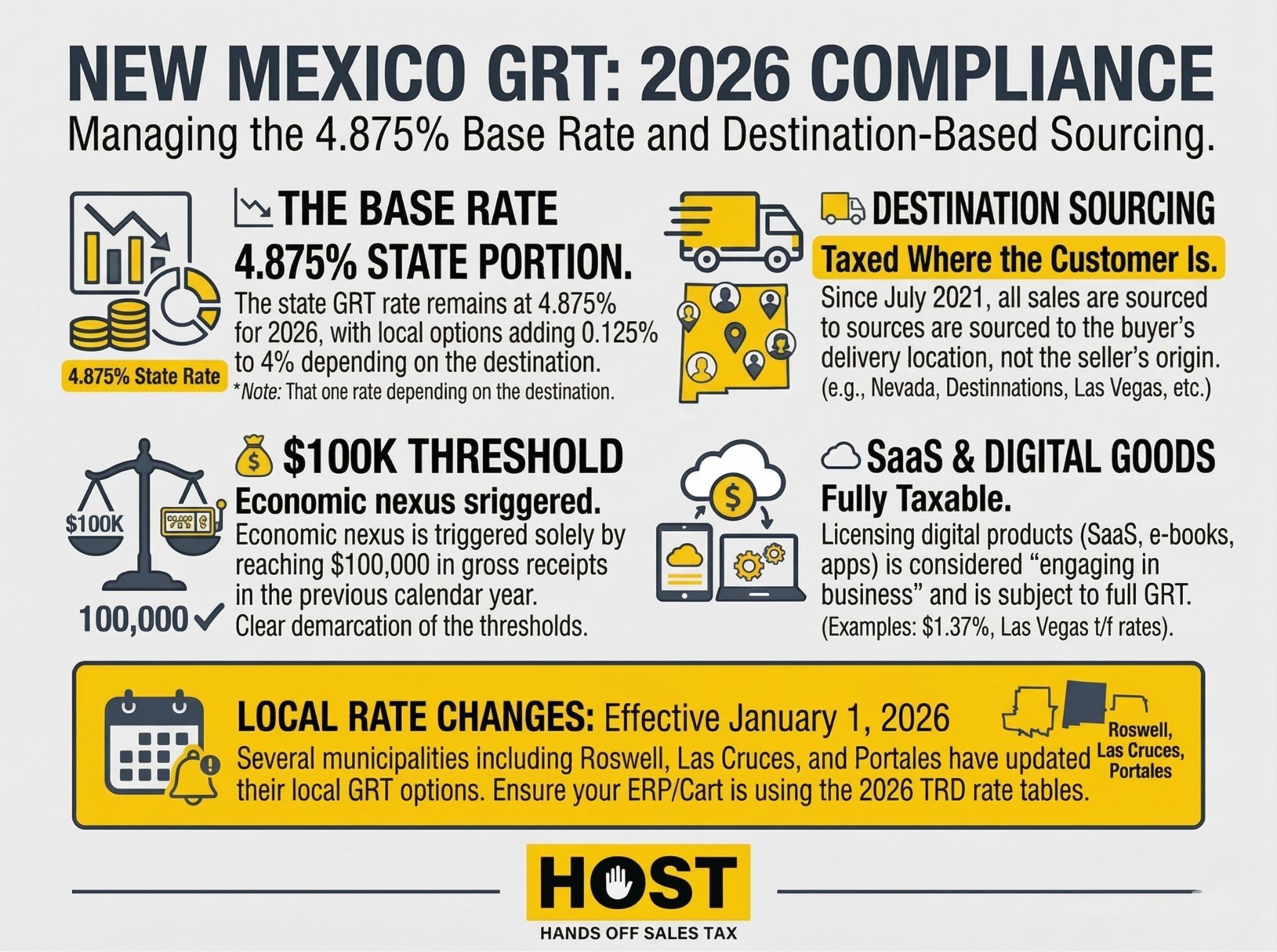
The gross receipts tax applies to total revenue from selling property, performing services, or leasing property in New Mexico. This includes digital products and services: software downloads, SaaS subscriptions, streaming services, e-books, and mobile apps all fall under GRT. If you’re selling digital goods to New Mexico customers, you’re subject to the same requirements as physical product sellers.
Businesses can pass this cost to customers, but legally, the tax obligation belongs to the seller, not the buyer. Combined state and local GRT rates range from 5.125% to over 9%, depending on location.
Since it’s a business tax rather than a consumer tax, you can’t simply add it to invoices like traditional sales tax. Many New Mexico businesses do pass the cost along as a separate line item, but if a customer doesn’t pay, the business still owes the tax.
For remote sellers, this creates genuine complexity. You must understand when nexus triggers collection obligations and how to properly calculate, collect, and remit GRT across New Mexico’s numerous municipal and county jurisdictions.
What Creates New Mexico Sales Tax Nexus?
Gross receipts tax nexus establishes when an out-of-state business must register and collect GRT. Two primary types exist: physical presence and economic nexus.
Physical Presence Nexus
Physical presence nexus triggers when your business maintains any tangible connection to the state:
- Office, warehouse, or retail location in New Mexico
- Employees, contractors, or sales representatives working in the state
- Inventory stored in New Mexico fulfillment centers (including third-party warehouses like Amazon FBA)
- Attending trade shows, conventions, or selling at events in New Mexico, even temporarily
- Owning property or equipment located in the state
- Regularly delivering property into New Mexico beyond common carriers
- Performing services outside New Mexico but using the product of those services in-state (like research and development)
Even temporary physical presence creates nexus. A single business trip where you conduct sales activities, or inventory stored for a few weeks, may trigger registration requirements.
Economic Nexus
New Mexico adopted economic nexus rules following the 2018 Wayfair decision. The state’s threshold is $100,000 in gross receipts from New Mexico customers during the previous calendar year.
Key points:
- Measurement period: Calendar year basis (January 1 – December 31)
- Threshold: $100,000 in total gross receipts sourced to New Mexico
- No transaction count: Unlike many states, New Mexico uses only a dollar threshold
- Immediate obligation: Once you exceed $100,000, you must register and begin collecting GRT
If your business sold $100,000 or more to New Mexico customers in 2024, you have economic nexus starting in 2025. There’s no grace period.
Economic nexus applies even with zero physical presence in New Mexico. Online sellers frequently cross this threshold without realizing it, then face back-tax assessments during audits.
Marketplace Facilitator Rules
If you sell through Amazon, eBay, Etsy, or similar platforms, the marketplace facilitator may already be collecting and remitting New Mexico GRT on your behalf. New Mexico requires marketplace facilitators meeting the $100,000 threshold to collect GRT for all third-party sales.
Here’s what matters for sellers:
- Marketplace sales don’t count toward your threshold: Sales facilitated through compliant marketplaces aren’t included when calculating whether you’ve exceeded $100,000
- You can claim deductions: If the marketplace provider is registered and remitting GRT, you can deduct those receipts from your own GRT obligations
- Get documentation: Obtain proof from the marketplace that they’re registered and remitting on your behalf
- You may still need to register: Direct sales outside the marketplace count toward your threshold separately
This distinction prevents double taxation, but tracking which sales are marketplace-facilitated versus direct requires careful record-keeping.
How to Determine If You Have New Mexico Nexus
Determining whether your business has New Mexico sales tax nexus requires systematic analysis.
Step 1: Review Physical Connections
Audit any physical presence in New Mexico. Do you have employees, offices, or facilities? Is inventory stored in the state, including at Amazon FBA or third-party logistics warehouses? Have you attended trade shows or used contractors operating in New Mexico?
If yes to any, you likely have physical presence nexus and must register immediately, regardless of sales volume.
Step 2: Calculate New Mexico Gross Receipts
Pull sales data for the previous calendar year. Include all product sales shipped to New Mexico addresses, digital products or services sold to New Mexico customers, subscription revenue, and any other revenue sourced to New Mexico.
Most e-commerce platforms provide sales-by-state reports. Review carefully. Even businesses focused elsewhere can inadvertently exceed New Mexico’s threshold through organic online sales.
Step 3: Monitor Ongoing Sales
Even below the $100,000 threshold currently, monitor New Mexico sales monthly. Once you cross the threshold, registration obligations begin immediately for the following year. Proactive monitoring prevents surprise obligations.
HOST’s nexus analysis service examines your complete sales footprint across all states, identifying exactly where you’ve triggered obligations, including New Mexico’s unique GRT system.
Registering for New Mexico Gross Receipts Tax
Once you’ve determined nexus exists, registration becomes mandatory before making taxable sales.
New Mexico requires businesses to obtain a Combined Reporting System (CRS) identification number through the Taxation and Revenue Department. Complete the Business Tax Registration Application (ACD-31015) online, providing your federal EIN, business structure, ownership details, and NAICS code. Registration typically processes within 7-10 business days.
Important considerations:
- Your registration becomes effective on the date specified, so ensure this aligns with when you first triggered nexus
- New Mexico has numerous local taxing jurisdictions with varying rates
- Businesses with multiple New Mexico locations may need separate location codes for each
Missing registration deadlines or registering incorrectly triggers penalties and back-tax assessments. New Mexico’s system is particularly complex due to local jurisdiction variations.
HOST handles New Mexico registrations as part of our comprehensive sales tax registration service, completing all paperwork and navigating jurisdiction requirements, eliminating guesswork and potential costly errors.
Filing New Mexico Gross Receipts Tax Returns
After registering, you must file periodic GRT returns and remit collected tax.
Filing Frequencies
New Mexico assigns filing frequencies based on tax liability:
- Monthly: Businesses with average monthly tax liability over $200
- Quarterly: Businesses with tax liability less than $600 per quarter (average under $200 monthly)
- Semi-annually: Businesses with tax liability less than $1,200 per six-month period
- Annually: Businesses with minimal tax liability (typically under $600 annually)
Most e-commerce sellers exceeding economic nexus thresholds file monthly.
Filing Requirements
New Mexico GRT returns require gross receipts broken down by location code and jurisdiction, applicable deductions, tax calculations at appropriate state and local rates, and payment by deadline (typically the 25th of the month following the reporting period).
Common Filing Challenges
New Mexico’s GRT filing presents unique difficulties. You must break out gross receipts by county and municipality, each with different rates.
Understanding which jurisdiction applies depends on sourcing rules. New Mexico made a fundamental change on July 1, 2021, switching from origin-based sourcing (where the seller is located) to destination-based sourcing (where the customer receives goods or services). This shift means you now calculate tax based on your customer’s location, not your business location.
For remote sellers, this destination-based approach requires determining the correct local jurisdiction for every New Mexico sale. A customer in Albuquerque pays different rates than one in Santa Fe, and you’re responsible for getting it right.
New Mexico also offers numerous deductions that vary by business type and transaction, adding another layer of complexity.
HOST manages ongoing New Mexico GRT filings as part of our sales tax filing service, preparing and filing your returns monthly, quarterly, or annually, handling jurisdiction breakdowns, rate calculations, and timely remittance so you stay compliant without the administrative burden.
Consequences of Non-Compliance
Failing to properly manage New Mexico sales tax nexus creates serious risks. The state actively pursues out-of-state sellers who should be collecting GRT but aren’t.
Penalties and Interest
New Mexico imposes penalties for non-compliance:
- Failure to register: 2% per month (up to 20%) of tax due
- Late filing: 2% per month (up to 20%) of tax due
- Late payment: 2% per month (up to 20%) of tax due
- Interest: Accrues on unpaid tax at rates set annually
These penalties stack. A business that fails to register, then files and pays late, faces multiple penalty layers, quickly escalating a manageable tax obligation into significant liability.
Audit Risk
New Mexico conducts regular audits of businesses with GRT obligations, reviewing whether you should have registered earlier based on nexus, accuracy of gross receipts reporting across jurisdictions, proper application of deductions, and timely filing history.
Audits can look back three years (longer if fraud is suspected). Businesses that failed to register face assessments for all back taxes, plus penalties and interest from when nexus was first triggered.
How to Protect Your Business
The best protection is proactive compliance. Understanding when you triggered New Mexico sales tax nexus, registering promptly, and maintaining accurate filing records prevents most compliance issues.
If you discover you have nexus but haven’t registered, acting quickly limits exposure. New Mexico offers Voluntary Disclosure Agreements (VDAs) that can limit lookback periods and abate some penalties for businesses that come forward voluntarily.
HOST provides audit defense services when New Mexico (or any state) initiates an audit, organizing documentation, communicating with tax authorities, and working to minimize liability.
HOST: Your Partner for New Mexico Sales Tax Compliance
At Hands Off Sales Tax, we’ve focused exclusively on sales tax compliance for over 25 years. We understand New Mexico’s gross receipts tax system inside and out, from economic nexus thresholds to multi-jurisdiction filing requirements.
What HOST Delivers
Nexus Analysis: We analyze your complete sales footprint to determine exactly where you have New Mexico sales tax nexus. Ensuring you know your obligations before the state comes knocking.
New Mexico Registration: We handle your CRS registration, completing all paperwork and navigating New Mexico’s jurisdiction requirements.
GRT Filing Management: We prepare and file your New Mexico gross receipts tax returns on time, every time. Handling jurisdiction breakdowns, rate calculations, and accurate reporting.
Multi-State Compliance: Beyond New Mexico, we manage your sales tax obligations across all 45+ states with sales tax.
Audit Defense: If New Mexico initiates an audit, we’re your trusted partner in organizing documentation and defending your position.
VDA Support: Discovered you should have been collecting in New Mexico but weren’t? We file Voluntary Disclosure Agreements to limit lookback periods and reduce penalties.
We’ve helped businesses navigate sales tax compliance since 1999. That’s over 25 years managing changing requirements. Through our parent company TaxMatrix, we’ve served some of North America’s largest companies. Now we bring that expertise to e-commerce sellers of all sizes.
Ready to Handle New Mexico Sales Tax Nexus Correctly?
Understanding New Mexico sales tax nexus is just the first step. Proper registration, accurate filing across multiple jurisdictions, and ongoing compliance require specialized expertise and time, which are resources better spent growing your business.
Whether you’re expanding into New Mexico for the first time, just discovered you’ve exceeded economic nexus thresholds, or struggling with the state’s complex GRT filing requirements, professional help eliminates guesswork and prevents costly mistakes.
When you’re ready to ensure your New Mexico sales tax nexus is handled correctly with accurate registration, timely filings, and expert management across all jurisdictions, we’re ready to help.
Contact HOST today to discuss your New Mexico compliance needs or schedule a free consultation. Let us handle the tax so you can focus on sales.
Want to learn more? Get our “10 Sales Tax Mistakes E-Commerce Sellers Make” e-book to discover other compliance pitfalls to avoid.
Frequently Asked Questions
What is the New Mexico sales tax nexus threshold for out-of-state sellers?
New Mexico’s economic nexus threshold is $100,000 in gross receipts from New Mexico customers during the previous calendar year. Once you exceed this amount, you must register for gross receipts tax collection. There is no transaction count threshold. Only the dollar amount matters.
How is New Mexico’s gross receipts tax different from sales tax?
New Mexico charges a gross receipts tax on businesses rather than a traditional sales tax on consumers. The tax is legally the business’s responsibility, not the customer’s. While many businesses pass the cost to customers, the seller remains liable if payment isn’t collected.
Do I need to register for New Mexico sales tax if I only sell online?
Yes. Economic nexus rules require out-of-state sellers to register once they exceed $100,000 in New Mexico gross receipts, regardless of physical presence. Online-only businesses with significant New Mexico sales must register and collect GRT just like businesses with physical locations in the state.
What happens if I’ve been selling to New Mexico customers but haven’t registered?
You face potential back-tax assessments, penalties, and interest for the period you should have been collecting. New Mexico can audit back three years (longer if fraud is suspected). Filing a Voluntary Disclosure Agreement (VDA) before the state discovers non-compliance can limit lookback periods and reduce penalties.
How often do I need to file New Mexico gross receipts tax returns?
Filing frequency depends on your tax liability. Most e-commerce sellers exceeding economic nexus file monthly. Businesses with lower liabilities may file quarterly, semi-annually, or annually. New Mexico assigns your filing frequency based on reported gross receipts and may adjust it annually.
Can I use sales tax automation software for New Mexico?
Yes, but with caution. Sales tax software can calculate New Mexico GRT rates and handle collection at checkout. However, New Mexico’s system is complex due to multiple local jurisdictions and unique sourcing rules. Professional review of your software setup helps avoid costly configuration errors that lead to under-collection or over-collection.
