
Montgomery County sales tax hits differently depending on which state you’re talking about. With 18 Montgomery Counties scattered across America, each imposing its own rates and rules, e-commerce businesses face a compliance puzzle that demands precision. A single miscalculation creates audit exposure that can cost thousands.
Hands Off Sales Tax (HOST) cuts through this complexity. With over 25 years focused exclusively on sales tax compliance, we pinpoint your exact obligations across all Montgomery Counties, handle registrations, and manage filings so you stay compliant without the headaches.
Which Montgomery County? Understanding the Geography
Montgomery County appears in 18 U.S. states, each with distinct sales tax structures. The most commercially significant:
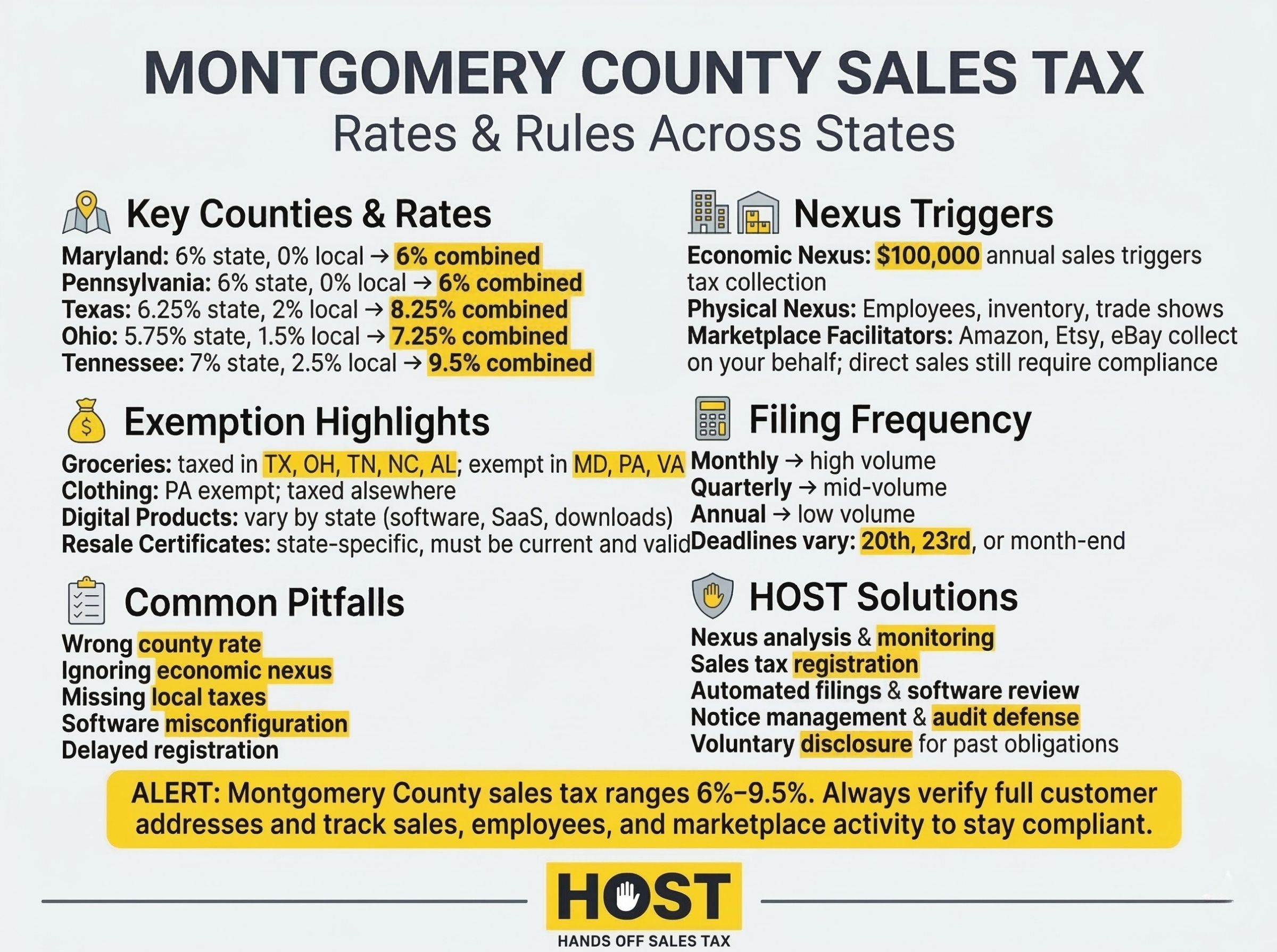
Montgomery County, Maryland – Over 1 million residents in the Washington D.C. metro area make this an e-commerce hotspot. Maryland imposes 6% statewide with no local additions. Straightforward but still requiring proper nexus determination.
Montgomery County, Pennsylvania – Philadelphia metro region, approximately 850,000 residents. Pennsylvania charges 6% state sales tax. While Philadelphia adds 2% locally (hitting 8%), Montgomery County itself levies no additional local tax, keeping most locations at 6%.
Montgomery County, Texas – North of Houston, exceeding 600,000 residents in one of America’s fastest-growing regions. Texas runs 6.25% state sales tax with local jurisdictions adding up to 2%. Montgomery County typically reaches 8.25% combined.
Montgomery County, Ohio – Dayton metro area, roughly 535,000 residents. Ohio charges 5.75% state rate, with Montgomery County adding 1.5% for a 7.25% combined rate in Dayton and surrounding cities.
Montgomery County, Tennessee – Near the Kentucky border, approximately 220,000 residents. Tennessee levies 7% state sales tax (highest base rate nationally), with Montgomery County adding 2.5% for a 9.5% combined rate, among the steepest in America.
Each operates under different state rules for taxability, exemptions, filing frequencies, and economic nexus thresholds. Selling into multiple Montgomery Counties means juggling multiple compliance obligations simultaneously.
Rate Breakdown: State by State
| State | County Location | State Rate | Local Rate | Combined Rate |
| Maryland | Washington D.C. metro | 6% | 0% | 6% |
| Pennsylvania | Philadelphia metro | 6% | 0% | 6% |
| Texas | Houston metro | 6.25% | 2% | 8.25% |
| Ohio | Dayton metro | 5.75% | 1.5% | 7.25% |
| Tennessee | Clarksville area | 7% | 2.5% | 9.5% |
| North Carolina | Various | 4.75% | 2.25% | 7% |
| Virginia | Roanoke area | 5.3% | 1% | 6.3% |
| Alabama | Montgomery metro | 4% | 5% | 9% |
Rate variation spans from 6% to 9.5%—a spread that dramatically impacts pricing strategy. On a $1,000 purchase, Tennessee customers pay $95 in tax versus $60 in Maryland.
When Nexus Triggers Collection Obligations
Economic nexus determines collection requirements. After the 2018 South Dakota v. Wayfair decision, states can require remote sellers to collect tax based on sales volume, regardless of physical presence.
$100,000 threshold – Maryland, Pennsylvania, Texas, Ohio, Tennessee, North Carolina, Virginia, and Alabama all use this benchmark. Once your sales into any state exceed $100,000 annually, you’ve triggered nexus statewide, including that state’s Montgomery County.
Physical presence still creates nexus. Inventory in a Montgomery County warehouse (including Amazon FBA), employees working remotely from the county, or attending trade shows there likely triggers physical nexus requiring registration even below economic thresholds.
Marketplace facilitator laws shift some obligations. Amazon, eBay, Etsy, and Walmart Marketplace typically collect and remit on your behalf. However, you remain responsible for direct sales through your website or other channels.
HOST’s nexus analysis examines your footprint across all jurisdictions, identifying exactly where you’ve crossed thresholds.
Exemptions That Vary Dramatically by State
Groceries – Pennsylvania, Maryland, and Virginia exempt most unprepared food. Texas, Ohio, Tennessee, North Carolina, and Alabama tax groceries at standard or reduced rates.
Clothing – Pennsylvania exempts most clothing and footwear. The other seven Montgomery County states tax clothing at regular rates.
Digital Products – Maryland taxes digital goods like software and streaming. Pennsylvania generally exempts canned software but taxes customized versions. Each state treats SaaS, downloads, and digital media differently.
Resale Certificates – All states honor resale exemption certificates for inventory purchases, but requirements and expiration vary. Some demand annual renewal; others stay valid until revoked.
Understanding which exemptions apply prevents overcharging (damaging customer relationships) or undercharging (creating audit liability).
Filing Requirements: Monthly, Quarterly, Annual
Filing frequency depends on sales volume in each state:
Monthly – High-volume sellers typically file monthly. States often require monthly reporting above $1,000 in collected tax.
Quarterly – The most common frequency for small to mid-sized e-commerce businesses with moderate volume.
Annual – Low-volume sellers may qualify, though increasingly rare as states push for frequent reporting.
Due Dates – Most states require returns by the 20th of the following month. Some use the 23rd or month-end. Missing deadlines triggers penalties and interest.
Local Breakdown – States like Texas require separate reporting for each local jurisdiction, detailing exactly how much tax came from each city or county. Others handle distribution automatically.
HOST manages filing across all jurisdictions where you have nexus, handling local breakdowns, rate changes, and jurisdiction-specific reporting so you never face penalties.
Common Compliance Pitfalls
Wrong County Rate – Using Pennsylvania’s rate for Texas sales because both have Montgomery Counties. Address-level validation prevents this error.
Ignoring Economic Nexus – Assuming you only collect in your home state. Exceeding $100,000 in Maryland sales requires registration and collection, even without ever visiting the state.
Missing Local Taxes – Collecting only state tax while missing the local component. In Texas or Ohio Montgomery Counties, this creates 2% or 1.5% undercharges and audit liability.
Software Misconfiguration – Sales tax tools require proper setup. Common errors: wrong sourcing rules, incorrect product tax codes, outdated rate tables.
Delayed Registration – Waiting months after crossing nexus thresholds. States can assess back taxes, penalties, and interest from the date you should have registered.
Each mistake creates audit exposure. State tax authorities deploy sophisticated data analytics identifying non-compliant businesses.
HOST’s free sales tax software review identifies configuration errors before they cost money, catching issues like incorrect tax codes, double-taxation, or missing jurisdictions.
How HOST Eliminates Montgomery County Complexity
Managing sales tax across multiple Montgomery Counties drains time without generating revenue. The average business burns 30+ hours monthly on sales tax administration.
Nexus Analysis – We analyze your sales data, determining exactly where you’ve triggered nexus and which Montgomery Counties require registration.
Sales Tax Registration – We handle paperwork with every applicable state, following up on applications and securing permits in all required Montgomery Counties.
Automated Filing – We file returns monthly, quarterly, or annually based on each state’s requirements, including local and special district returns.
Rate Management – We track rate changes across all jurisdictions, ensuring correct Montgomery County rates regardless of state.
Notice Management – We interpret and respond to state notices, protecting you from penalties while resolving issues efficiently.
Audit Defense – We organize documentation, prepare responses, and defend your position to minimize liability.
Voluntary Disclosure Agreements – If you discover past obligations, we file VDAs to limit lookback periods and abate penalties.
We’ve been 100% focused on sales tax since 1999. Over 25 years helping businesses navigate compliance so you can keep your hands on your business.
Take Sales Tax Off Your Plate
Sales tax doesn’t have to consume your bandwidth. Whether selling into one Montgomery County or managing obligations across multiple states, the right partner ensures correct collection, timely filing, and audit protection.
At HOST, we combine deep expertise with transparent communication and personalized support. Through our parent company TaxMatrix, we’ve helped North America’s largest companies manage sales tax requirements. Now we bring that expertise to e-commerce sellers of all sizes.
You handle the sales, we handle the tax. Contact HOST today to discuss your multi-state compliance needs or schedule a free consultation.
Get our “10 Sales Tax Mistakes E-Commerce Sellers Make” e-book.
Frequently Asked Questions
What is the sales tax rate in Montgomery County?
Montgomery County sales tax ranges from 6% to 9.5% depending on which state. Maryland and Pennsylvania charge 6%, Texas charges 8.25%, Ohio charges 7.25%, and Tennessee charges 9.5%. Always verify the customer’s complete address to apply the correct rate.
Do I need to collect sales tax in every Montgomery County?
Only in states where you’ve established nexus through physical presence or by exceeding economic nexus thresholds (typically $100,000 in annual sales). If you haven’t sold into a particular state or haven’t reached the threshold, no collection obligation exists.
How do I know which Montgomery County rate to charge?
Use address-level tax validation based on the customer’s complete shipping address: street, city, state, ZIP. Never rely solely on county name, as 18 different Montgomery Counties exist with different rates.
What happens if I charge the wrong Montgomery County rate?
Undercharging creates liability. You owe the state the difference plus penalties and interest. Overcharging damages customer relationships and may violate state laws against excessive tax collection. Both scenarios create problems demanding precision.
Can HOST handle Montgomery County sales tax for my business?
Yes. HOST manages compliance across all states and jurisdictions where you have nexus, including all Montgomery Counties. We determine obligations, register correctly, calculate proper rates, and file returns so you stay compliant without the complexity.
Are groceries taxed in Montgomery County?
Depends on the state. Pennsylvania, Maryland, and Virginia Montgomery Counties generally exempt groceries. Texas, Ohio, Tennessee, North Carolina, and Alabama Montgomery Counties tax groceries at standard or reduced rates. Product-specific rules vary significantly by state.
