

Mississippi sales tax nexus is the line between compliant growth and unexpected liability. Cross $250,000 in state sales or store inventory in a Memphis warehouse, and you’ve triggered collection obligations that begin immediately.
The rules are clear, but the consequences of missing them aren’t small. Back taxes, penalties stacking monthly, audits pulling years of records. These aren’t abstract risks for businesses that discover nexus too late.
That’s where Hands Off Sales Tax (HOST) eliminates the guesswork. We analyze where you stand, handle registration, manage filings, and keep you audit-ready while you focus on what actually grows revenue.
What Is Sales Tax Nexus?
Sales tax nexus is the connection between your business and Mississippi that creates a legal obligation to collect and remit tax. This connection comes in two forms.
Physical nexus means tangible presence: an office, warehouse, employee, or inventory in the state. A single remote worker in Jackson establishes nexus. Products stored in a Tupelo fulfillment center? That’s nexus. Even attending a trade show creates temporary obligations.
Economic nexus ignores physical presence entirely. It’s based purely on sales volume into Mississippi, regardless of where your business operates. After the 2018 Wayfair decision, states gained authority to require collection based on customer location alone.
Once nexus exists, you register with Mississippi Department of Revenue, collect tax at the correct rate, and file returns on schedule, even with zero sales to report.
Mississippi’s $250,000 Economic Threshold
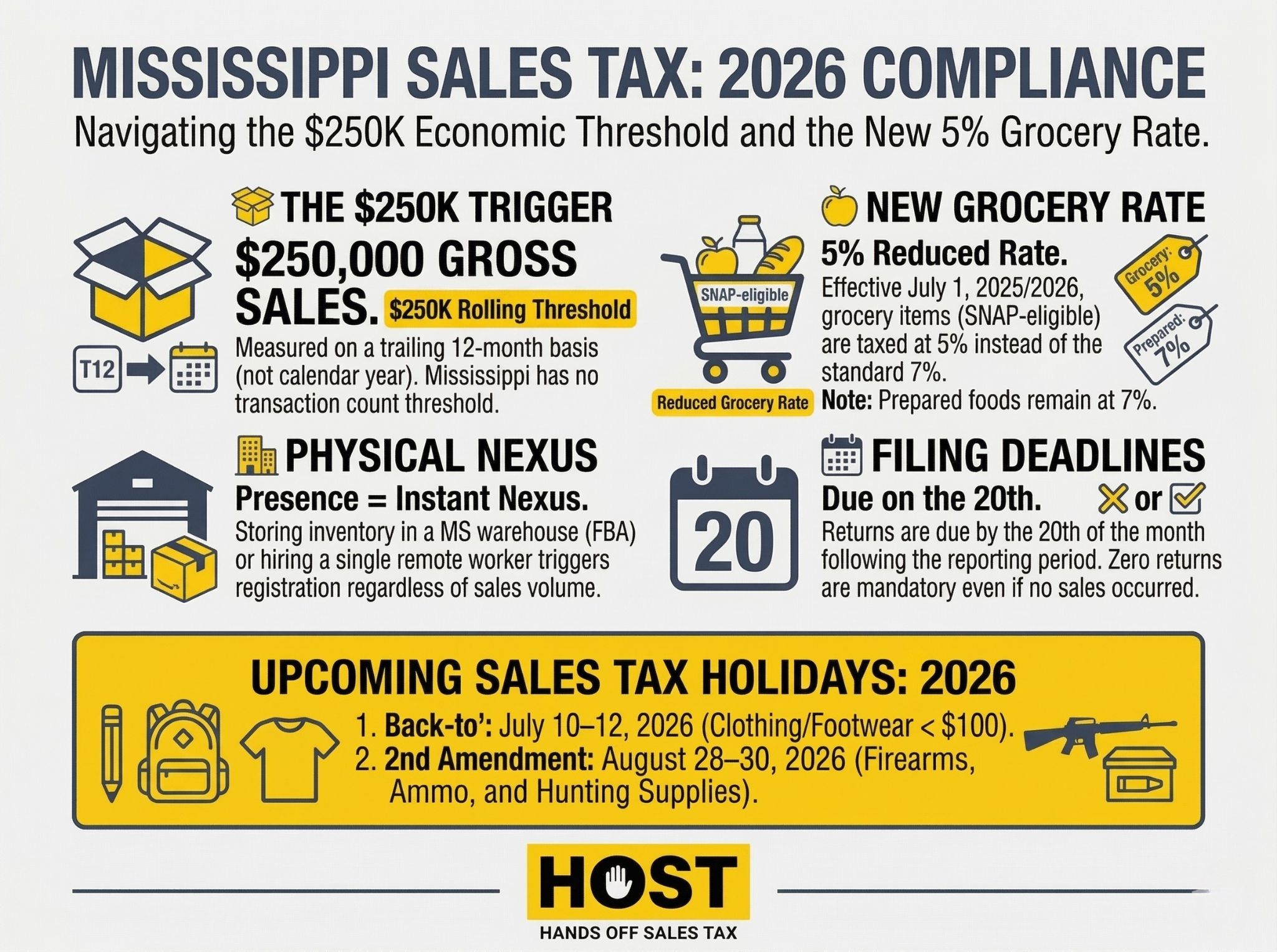
Mississippi enforces economic nexus when you exceed $250,000 in total sales delivered into the state during any trailing 12-month period. Hit that number, and collection obligations begin with your next transaction.
Critical details:
- Measurement: Rolling 12 months (not calendar year)
- Threshold: $250,000 in gross sales
- Transaction count: None (sales only)
- Effective: September 1, 2018
Mississippi counts total gross sales toward the threshold, including both taxable and non-taxable transactions. However, sales made through marketplace facilitators (where the facilitator collects tax) are excluded from your personal threshold calculation. If you exceed $250,000 through any combination of direct sales (taxable or exempt) you trigger registration requirements.
Example: A Colorado outdoor gear retailer generates $275,000 in Mississippi sales over the past 12 months through their Shopify store. No employees, no property, no visits to the state. They’ve triggered economic nexus and must register immediately.
Physical Nexus Still Matters
Physical presence creates instant nexus, regardless of sales volume. Mississippi considers these connections sufficient:
- Retail location, office, warehouse, or storage facility
- Inventory in third-party fulfillment centers (Amazon FBA creates nexus when your products land in Mississippi)
- Employees, contractors, or sales representatives. Even remote workers based in Mississippi
- Trade shows, conventions, or temporary events in the state
FBA sellers, pay attention: Amazon moves inventory across fulfillment centers based on operational efficiency. Your products might spend weeks in Mississippi without your knowledge, creating nexus you’re unaware of until a notice arrives.
Contractors count: Hire a freelance customer service rep working from their home in Biloxi? That’s physical nexus. The scope doesn’t matter, presence does.
Marketplace Facilitators Handle Their Share
Sales through Amazon, eBay, Etsy, and Walmart Marketplace don’t count toward your $250,000 economic nexus threshold. These platforms collect and remit Mississippi sales tax on behalf of third-party sellers.
What this means practically:
- Amazon sales to Mississippi customers: excluded from your threshold
- Your Shopify store sales to Mississippi: count toward your threshold
- Direct sales through any channel you control: always counted
If you sell exclusively through marketplaces, you likely won’t trigger economic nexus based on those sales alone. But physical nexus like FBA inventory still creates obligations independently of sales volume.
Registration Process
Once nexus exists, register immediately via Mississippi’s Taxpayer Access Point (TAP) portal. Remote sellers register for a “seller’s use tax permit” (Mississippi’s technical term for out-of-state businesses collecting tax). The state requires:
- Legal business name and structure
- Federal EIN or Social Security Number
- Physical and mailing addresses
- Business activity description
- Bank account information for payments
There’s no registration fee. Out-of-state businesses without permanent Mississippi locations may need to post a sales tax bond before the permit issues.
Permits typically arrive within two weeks. You can begin collecting immediately after submitting your application, though you’ll need the official permit before displaying it.
HOST handles Mississippi registration as part of our comprehensive nexus analysis and registration services, ensuring proper setup without the administrative burden.
Sales Tax Rates: Simpler Than Most States
Mississippi charges 7% state sales tax with minimal local complications. Only two cities impose additional taxes: Jackson adds 1% (total 8%), and Tupelo adds 0.25% (total 7.25%).
Mississippi is origin-based for in-state sellers, meaning you charge the rate at your business location. Remote sellers without Mississippi presence collect the flat 7% statewide rate. No need to track customer-specific rates across jurisdictions.
What’s taxable: Mississippi taxes tangible personal property and many services, including pest control, plumbing, electrical work, HVAC, software services, dry cleaning, parking, and contracting services. If you’re selling taxable items, shipping charges are also taxable when included in the transaction.
This simplicity is rare. Most states force remote sellers to navigate hundreds of local tax jurisdictions. Mississippi’s straightforward approach reduces compliance complexity significantly.
Filing Requirements
Mississippi assigns filing frequency during registration based on your sales volume: monthly for high-volume sellers, quarterly for mid-volume, annually for low-volume.
Non-negotiable rule: File every period, even with zero sales. Mississippi requires “zero returns” when you’ve collected no tax. Skipping a filing—regardless of amount owed—triggers penalties.
Returns and payments are due by the 20th of the month following your reporting period. Everything submits electronically through the TAP system. Paper filing exists as a backup option but isn’t recommended.
Common Nexus Triggers E-Commerce Businesses Miss
Drop shipping: If your drop shipper maintains Mississippi facilities, you may create physical nexus even when you never touch the inventory yourself.
Trade show attendance: Displaying products at a Mississippi convention creates temporary nexus. Collection obligations apply to orders taken during the event.
Remote team members: Hiring Mississippi-based remote workers—even part-time contractors—establishes physical nexus for your entire business.
Service provision: Offering installation, training, maintenance, or repair services in Mississippi creates nexus, even if your products ship from elsewhere.
Affiliate relationships: Partnering with Mississippi-based affiliates or resellers who promote your products can establish nexus through their in-state activities.
Expanding product lines: Previously sold only exempt items? Adding taxable products triggers collection obligations, even if your total Mississippi sales previously exceeded $250,000.
Penalties Hit Hard
Mississippi imposes 10% of tax due or $50 minimum for late filing, whichever is greater. Interest accrues on unpaid balances.
The real cost goes beyond initial penalties. Non-compliance creates:
- Back tax liability covering all periods you should have been collecting
- Penalties compounding monthly on missed filings
- Audit exposure potentially spanning multiple years
- Time and resources diverted to resolving compliance issues
Voluntary disclosure agreements (VDAs) can limit lookback periods and reduce penalties when you discover past obligations. The sooner you address non-compliance, the better the outcome.
Staying Audit-Ready
Audits test preparation, not luck. Mississippi Department of Revenue examines compliance regularly, and readiness determines whether you face minor adjustments or major assessments.
Essential practices:
- Maintain detailed records for four years minimum (invoices, receipts, exemption certificates, sales documentation)
- Monitor sales monthly to identify when you cross $250,000
- Collect valid resale certificates from wholesale customers
- File on time every period, including zero returns
- Review software configurations to prevent systematic errors
Audit triggers: Large discrepancies between reported sales and payment processor data, frequent late filings, high volumes of exempt sales without documentation, or software errors causing under-collection.
HOST’s Free Sales Tax Software Review identifies costly configuration mistakes before they become audit problems. We also manage ongoing compliance like filings, remittances, and notice responses, keeping you audit-ready without diverting internal resources.
HOST: Managing Mississippi Compliance Without the Burden
Sales tax nexus across physical presence, economic thresholds, and filing requirements creates complexity that pulls focus from growth. Whether you’re a remote seller crossing $250,000 or managing Mississippi employees, compliance demands attention you’d rather spend elsewhere.
What HOST delivers:
- Nexus Analysis: We analyze your sales data and footprint to pinpoint exactly where Mississippi obligations exist, physical or economic
- Mississippi Registration: We handle TAP portal applications, document preparation, and state follow-up
- Sales Tax Filings: We prepare and file returns on your assigned schedule: monthly, quarterly, or annually, including zero returns
- Notice Management: We interpret Mississippi DOR correspondence and respond appropriately
- Audit Defense: We organize documentation and defend your position during examinations
- VDA Support: We file voluntary disclosures to limit lookback periods and reduce penalties
We’ve focused exclusively on sales tax since 1999. That’s over 25 years managing compliance for businesses like yours. Through parent company TaxMatrix, we’ve served North America’s largest companies. Now we bring that expertise to e-commerce sellers of all sizes.
Ready to Resolve Mississippi Compliance?
Understanding nexus rules matters. Partnering with experts who handle operational execution matters more.
Whether you’re crossing economic thresholds, managing FBA inventory, or expanding with Mississippi team members, professional support eliminates guesswork and prevents expensive mistakes.
Contact HOST today to discuss your Mississippi sales tax situation or schedule a free consultation. Let us handle the tax while you handle the sales.
Want to learn more? Get our “10 Sales Tax Mistakes E-Commerce Sellers Make” e-book.
Frequently Asked Questions
What is Mississippi’s economic nexus threshold?
Mississippi requires remote sellers exceeding $250,000 in total sales delivered into the state during any trailing 12-month period to register and collect sales tax. This threshold includes both taxable and non-taxable transactions.
Do Amazon FBA sales count toward Mississippi economic nexus?
Sales through marketplace facilitators like Amazon are excluded from your economic nexus calculation. However, storing inventory in Mississippi FBA warehouses creates physical nexus, triggering collection obligations regardless of sales volume.
Is there a fee to register for a Mississippi sales tax permit?
No. Mississippi charges no registration fee. Out-of-state businesses without permanent Mississippi locations may need to post a sales tax bond before the permit issues.
What sales tax rate should remote sellers collect in Mississippi?
Remote sellers without physical Mississippi presence collect the flat 7% state rate on all Mississippi sales. In-state sellers charge rates based on their business location: 7% statewide, 8% in Jackson, or 7.25% in Tupelo.
Do I need to file returns if I had no Mississippi sales?
Yes. Every business with a valid seller’s permit must file “zero returns” each period, even when no tax was collected. Failure to file, regardless of tax owed, results in penalties.
How long does Mississippi registration take?
Most permits are processed and mailed within two weeks after submitting your application through the TAP portal. You can begin collecting sales tax immediately after submission, though you’ll need the official permit before displaying it.
Does Mississippi have sales tax holidays?
Yes. Mississippi offers an annual back-to-school sales tax holiday in July for clothing and footwear under $100, and a Second Amendment sales tax holiday (August 29-31, 2025) for firearms, ammunition, and hunting supplies. These periods exempt qualifying purchases from sales tax collection.
How does Mississippi handle resale certificates?
Mississippi doesn’t use formal resale certificates. Instead, resellers registered to collect Mississippi sales tax provide vendors with their Mississippi sales tax permit number for tax-exempt wholesale purchases. Keep this number documented for all wholesale transactions.
