

Michigan’s economic nexus threshold requires remote sellers to collect sales tax once they exceed $100,000 in sales or 200 transactions to Michigan customers within the previous calendar year. Understanding exactly when this threshold triggers, what it includes, and how to comply prevents costly gaps that snowball into audits, penalties, and unexpected tax bills.
For e-commerce businesses managing sales across dozens of states, Michigan represents just one piece of an increasingly complex compliance puzzle. Hands Off Sales Tax (HOST) specializes in nexus analysis across all jurisdictions, ensuring you collect in the right places at the right time, without the 30+ hours monthly that sales tax typically consumes.
What Is Economic Nexus in Michigan?
Economic nexus creates a sales tax obligation based on your economic activity in Michigan, regardless of physical presence. Before the 2018 South Dakota v. Wayfair Supreme Court decision, only businesses with physical presence (stores, warehouses, employees) had to collect sales tax.
Wayfair changed everything. States gained authority to require out-of-state sellers to collect tax based solely on sales volume or transaction counts.
Michigan implemented its economic nexus law effective October 1, 2018. Remote sellers must register and collect Michigan’s 6% sales tax once they cross $100,000 in gross sales OR complete 200 separate transactions to Michigan customers in the previous calendar year.
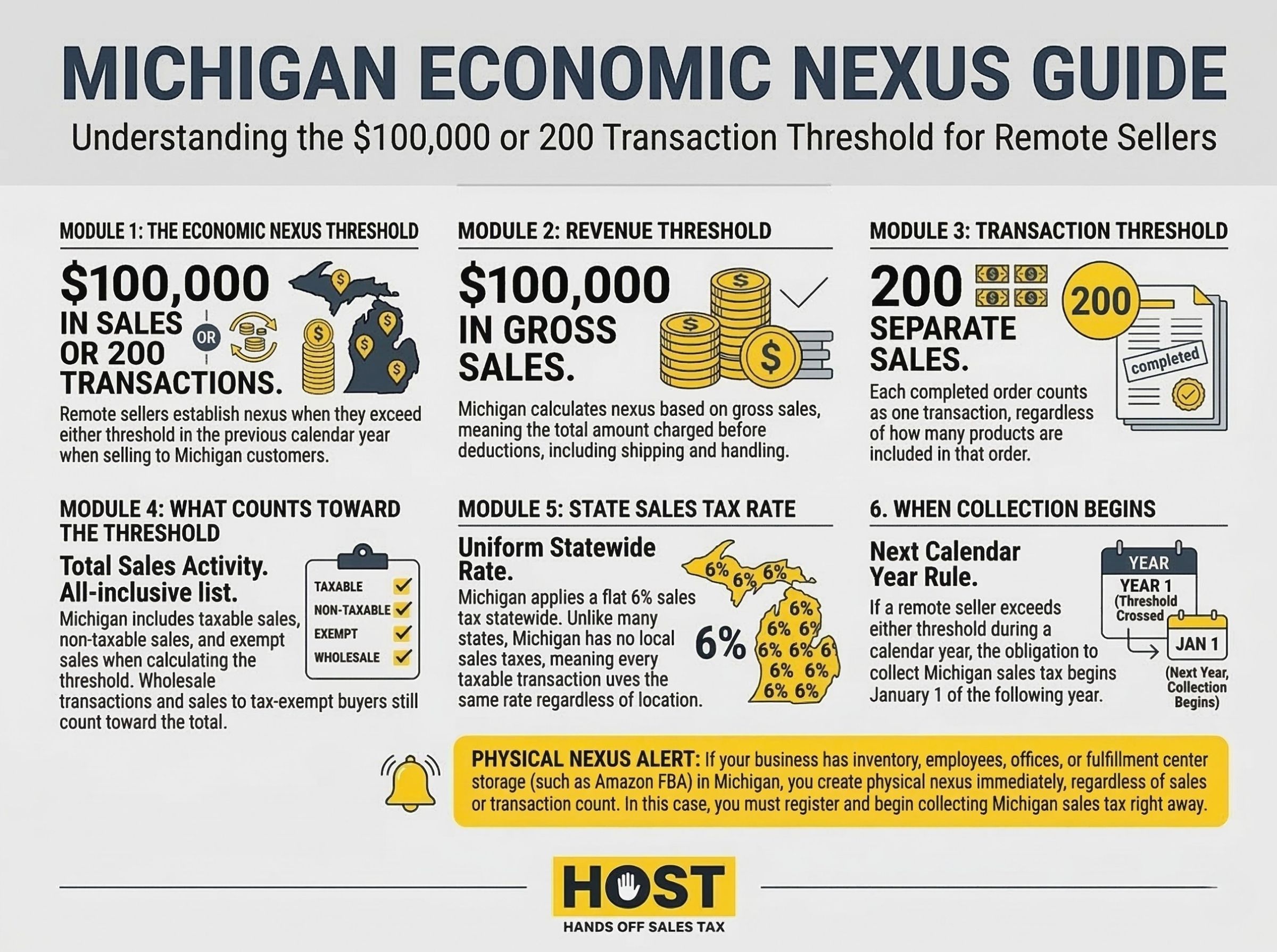
The “or” matters critically. You don’t need both. A business with $150,000 in sales but only 50 transactions has nexus. A seller with 250 transactions totaling $75,000 also has nexus.
How Michigan Calculates the Thresholds
The $100,000 Sales Threshold
Michigan measures based on gross sales to Michigan customers during the previous calendar year, so January 1 through December 31. Gross sales include the total amount charged before deductions: retail price plus shipping, handling, and other fees.
Critical detail: Gross sales include taxable sales, non-taxable sales, AND exempt sales. Even wholesale transactions count toward your threshold calculation. A pure wholesaler with $150,000 in wholesale-only sales has nexus, though they wouldn’t need to register since none of their sales are taxable.
Sales tax itself is excluded since you wouldn’t have been collecting it yet. But everything else counts.
If you crossed $100,000 in Michigan sales anytime during 2024, you have nexus starting January 1, 2025. The obligation continues until you fall below both thresholds for an entire calendar year.
The 200 Transaction Count
Each individual sale counts as one transaction regardless of dollar amount. Selling a $5 item and a $500 item both count as one transaction each.
One customer order containing 10 products counts as one transaction, not ten. Like the revenue threshold, transactions are measured over the previous calendar year.
For new businesses that didn’t exist in the prior calendar year, Michigan applies a current-year test. You establish nexus when you exceed $100,000 or 200 transactions in the current calendar year. Once crossed, register immediately and begin collecting.
Physical Nexus vs. Economic Nexus
Economic nexus represents just one trigger. Physical nexus in it’s traditional form still applies and creates immediate collection obligations regardless of sales volume.
Physical nexus in Michigan is triggered by:
- Inventory: Storing products in Michigan warehouses, fulfillment centers, or third-party logistics facilities including Amazon FBA.
- Employees: Having sales representatives, remote workers, or any employees working from Michigan.
- Office or Retail Locations: Owning or leasing business space.
- Temporary Presence: Trade shows, pop-up shops, or temporary selling events can create nexus.
Physical nexus supersedes economic nexus. There’s no minimum sales requirement when you have a physical presence.
Many e-commerce sellers unknowingly create physical nexus through FBA. When Amazon stores your inventory in a Michigan fulfillment center, you have physical nexus immediately.
HOST’s comprehensive nexus analysis examines both physical and economic factors across all states, identifying every obligation including the FBA nexus traps that catch sellers off guard.
Marketplace Facilitator Laws
Michigan’s marketplace facilitator law, effective January 1, 2020, shifts collection responsibility to online platforms for sales they facilitate. Marketplaces meeting the economic nexus threshold must collect and remit sales tax on behalf of third-party sellers.
Major platforms like Amazon, eBay, Etsy, and Walmart Marketplace collect Michigan sales tax automatically. Sales made through these platforms don’t count toward your individual threshold, and you shouldn’t collect tax again. That would be double taxation.
However, you remain responsible for:
- Direct Sales Channels: Sales through your Shopify store, WooCommerce site, or other direct channels still count toward your thresholds.
- Non-Facilitating Platforms: Some platforms only provide listing services. If you handle payment and fulfillment directly, those sales may count.
- Wholesale Sales: Business-to-business wholesale transactions aren’t covered by marketplace facilitator laws.
This complexity underscores why professional nexus analysis matters. Mixing marketplace sales, direct sales, wholesale transactions, and multi-state obligations creates a landscape that’s genuinely difficult to navigate alone.
Registration and Compliance Requirements
Once you establish nexus in Michigan, registration and collection become mandatory.
Register for a Michigan Sales Tax License
Apply through Michigan Treasury Online (MTO). Registration requires your EIN or Social Security Number, business structure details, physical business address, estimated Michigan sales volume, and bank account information.
Michigan doesn’t charge a registration fee. Processing typically takes 7-10 business days.
Collect Michigan Sales Tax
Michigan’s statewide sales tax rate is 6%. Unlike many states, Michigan has no local sales taxes! Every transaction within Michigan is taxed at exactly 6%, regardless of customer location.
This uniform rate simplifies calculation significantly. Calculate tax on the total sale price including shipping charges when separately charged.
File Michigan Sales Tax Returns
Filing frequency depends on your tax liability:
- Monthly filers: Businesses with more than $720 annual tax liability
- Quarterly filers: Businesses with $180-$720 annual tax liability
- Annual filers: Businesses with less than $180 annual tax liability
Returns are due the 20th day of the month following the reporting period. All taxpayers must also file an annual return by the last day of February in the year following the taxable period.
Late filing triggers penalties: 5% of tax due, plus an additional 5% for each additional month, up to 25% maximum. Interest accrues at a variable rate set quarterly.
Maintain Records
Michigan requires sales tax records retention for at least four years. Keep documentation of all Michigan sales, exemption certificates for tax-exempt sales, and filed returns with payment confirmations.
Complete records demonstrating proper collection, exemption verification, and timely remittance protect you during audits.
Common Michigan Nexus Mistakes
Ignoring FBA Physical Nexus: Sellers assume only their home state matters until discovering FBA created nexus in multiple states including Michigan. Years of unfiled returns create serious liability.
Miscounting Marketplace Sales: Including Amazon sales in threshold calculations when Amazon already collects the tax creates false nexus determinations.
Missing the Current-Year Rule: New sellers wait for a full calendar year before evaluating nexus, not realizing the current-year threshold applies immediately.
Forgetting Shipping Tax: Michigan requires tax on shipping charges for taxable goods. Failing to tax shipping undercharges customers and creates shortfalls.
Letting Returns Lapse: Registering and collecting tax but failing to file returns. Michigan doesn’t forget, and that means unfiled returns trigger notices, penalties, and potential license suspension.
These mistakes are exactly why businesses turn to HOST. We analyze your complete situation, register you in all required states, configure your software correctly, and file every return on time so nothing falls through the cracks.
HOST: Your Partner for Michigan Nexus Compliance
Managing Michigan economic nexus is just one piece of a 45-state compliance puzzle. Between tracking thresholds, registering in new states, configuring software, and filing returns across multiple jurisdictions, sales tax consumes 30+ hours monthly, which is time that generates zero revenue.
At Hands Off Sales Tax, we’ve focused exclusively on sales tax for over 25 years. Our comprehensive services eliminate the burden:
Nexus Analysis: We analyze your sales footprint across all states, identifying exactly where you’ve triggered economic or physical nexus, including Michigan and the 44 other states with nexus rules.
Sales Tax Registration: We handle Michigan registration and all other required state registrations, completing applications, following up with tax authorities, and ensuring you’re properly licensed.
Automated Filing: We file your Michigan returns (and all other state returns) on schedule: monthly, quarterly, or annually based on each state’s requirements, including local and special district returns.
Software Optimization: We review and optimize your TaxJar, Avalara, or other automation tools to ensure correct Michigan calculations and prevent costly software mistakes.
Notice Management: We interpret and respond to Michigan Department of Treasury notices, protecting you from penalties while resolving issues efficiently.
Audit Defense: We’re your trusted partner in resolving audits, organizing documentation and defending your position throughout the process.
Founded by Mike Espenshade with parent company TaxMatrix serving North America’s largest companies, we bring enterprise expertise to e-commerce businesses of all sizes. You handle the sales, we handle the tax.
Ready to Ensure Michigan Compliance?
Understanding Michigan’s economic nexus threshold is step one. Step two is ensuring you’re compliant in Michigan and every other state where you’ve triggered obligations, without spending your entire week managing tax filings.
Whether you’re crossing Michigan’s threshold for the first time, discovering FBA created physical nexus years ago, or simply overwhelmed by multi-state compliance, professional help eliminates guesswork and prevents costly mistakes.
Contact HOST today to discuss your Michigan nexus situation and multi-state compliance needs, or schedule a free consultation. Let us handle the complexity so you can focus on growing your business.
Want to learn more? Get our “10 Sales Tax Mistakes E-Commerce Sellers Make” e-book.
Frequently Asked Questions
What is Michigan’s economic nexus threshold?
Michigan’s economic nexus threshold is $100,000 in gross sales OR 200 separate transactions to Michigan customers during the previous calendar year. Exceeding either threshold requires registration and collection of Michigan’s 6% sales tax.
Do marketplace sales count toward Michigan’s threshold?
No. Sales facilitated through marketplace platforms like Amazon, eBay, or Etsy don’t count toward your individual economic nexus threshold because these platforms collect and remit Michigan sales tax on your behalf under marketplace facilitator laws.
When does Michigan economic nexus take effect?
For established businesses, nexus takes effect January 1 of the year following the year you exceeded thresholds. For new businesses, nexus triggers immediately when you cross either threshold during your first calendar year of operation.
Does Michigan have local sales taxes?
No. Michigan has a uniform 6% statewide sales tax with no additional local taxes. Every Michigan transaction is taxed at exactly 6% regardless of customer location within the state, which significantly simplifies collection and compliance.
What happens if I don’t collect Michigan sales tax after crossing the threshold?
Failure to register and collect triggers back taxes, penalties, and interest on uncollected tax. Michigan can assess you for up to four years of past sales, plus penalties of 5-25% and accrued interest, potentially resulting in five-figure liabilities.
How does FBA inventory affect Michigan nexus?
If Amazon stores your FBA inventory in a Michigan fulfillment center, you have physical nexus regardless of sales volume or transaction count. Physical nexus requires immediate registration and collection with no minimum threshold requirement.
