

Understanding Massachusetts economic nexus threshold requirements can feel like decoding another language, especially when you’re managing sales across multiple states. One day you’re shipping to Boston customers, the next you’re wondering if you’ve triggered collection obligations without realizing it.
Massachusetts requires remote sellers to collect sales tax once they exceed $100,000 in annual sales to Massachusetts customers. No transaction count exists, just the revenue number. Cross that line, and you’re responsible for registration, collection, and filing.
Hands Off Sales Tax (HOST) specializes in navigating these exact scenarios. From nexus analysis that pinpoints where you’ve triggered obligations to handling Massachusetts registration and ongoing filings, we manage the complexity so you can focus on growth.
What Is Economic Nexus?
Economic nexus establishes a state’s authority to require sales tax collection based on your sales volume within that state regardless of physical presence. Before the 2018 South Dakota v. Wayfair Supreme Court decision, only businesses with physical presence had to collect sales tax.
Wayfair changed everything. States can now impose collection obligations based purely on economic activity. For Massachusetts, this means hitting the revenue threshold triggers nexus even if you’ve never set foot in the state.
Physical nexus still exists and creates immediate obligations. Triggers include:
- Inventory stored in Massachusetts (including FBA warehouses)
- Employees working from Massachusetts locations
- Affiliate partnerships with Massachusetts businesses
- Click-through advertising relationships with in-state partners
- Delivery services through Massachusetts-based couriers
Economic nexus differs because it’s threshold-based. Physical nexus activates the moment you establish presence. One employee working remotely from Boston creates instant sales tax obligations, regardless of sales volume.
Critical distinction: Don’t confuse sales tax nexus ($100,000 threshold) with corporate income tax nexus. Massachusetts presumes corporate excise tax nexus at $500,000 in annual Massachusetts sales under separate regulations (830 CMR 63.39.1). You can trigger sales tax obligations at $100k while remaining below corporate tax thresholds, or vice versa. Track both separately.
Massachusetts Economic Nexus Threshold: The $100,000 Rule
Massachusetts’s threshold is straightforward: $100,000 in gross receipts from sales to Massachusetts customers in the current or prior calendar year. Once exceeded, you must register and begin collecting.
Key details:
$100,000 in Annual Sales: Calculate total sales delivered to Massachusetts customers. If you sold $105,000 worth of products to Massachusetts buyers in 2024, you triggered nexus.
No Transaction Count: Massachusetts removed its transaction threshold in 2019. You could make 50 sales totaling $101,000 or 5,000 sales totaling $101,000. Both trigger nexus.
Current or Prior Year: Massachusetts looks at both the current calendar year and the immediately preceding year. Hit $100,000 in 2024? You have nexus in 2025 even if 2025 sales drop. Conversely, cross $100,000 in October 2025, and nexus begins immediately.
Gross Receipts Count: Include all sales to Massachusetts customers, even exempt sales. The threshold calculation uses gross receipts, not just taxable transactions.
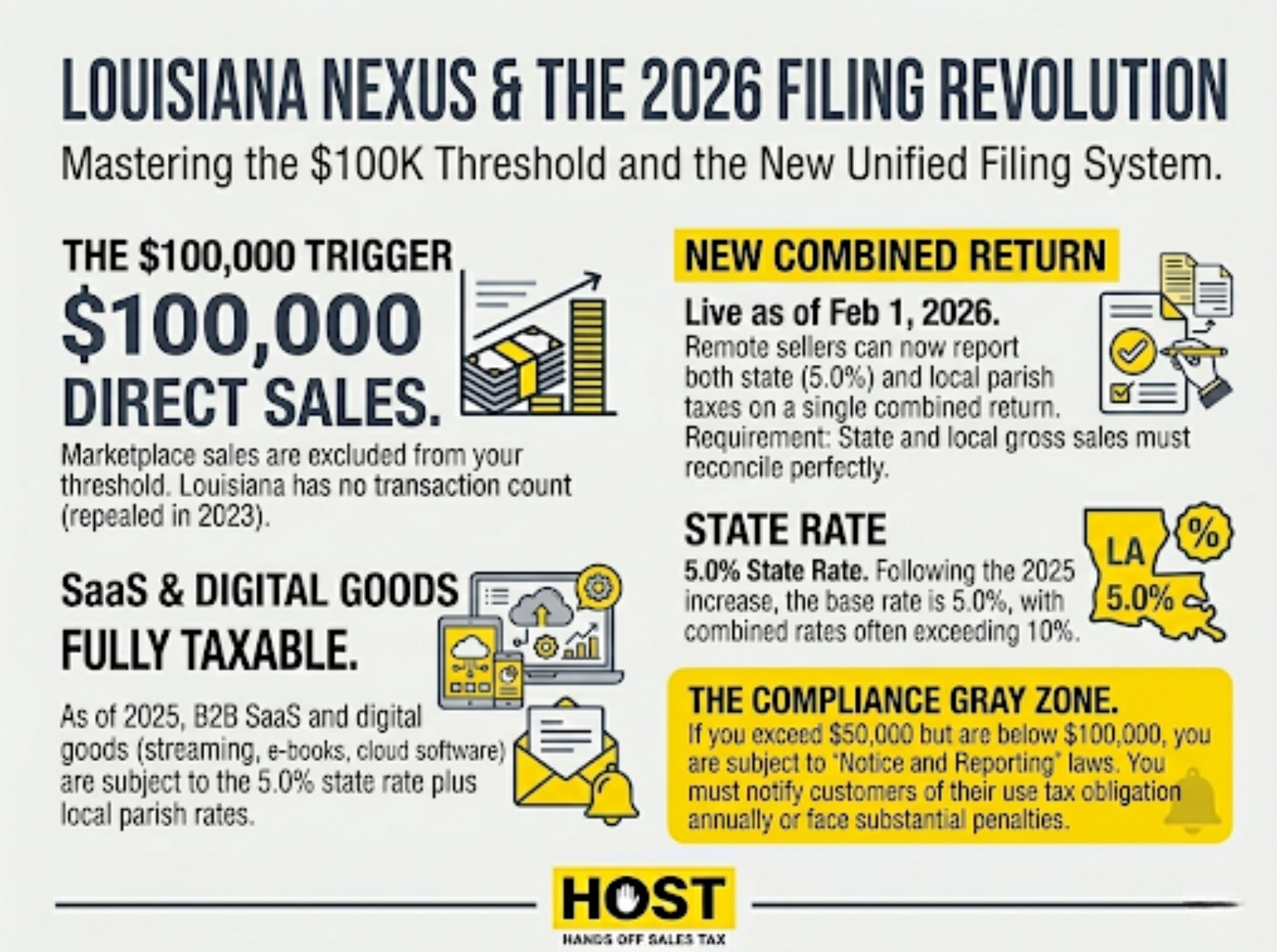
Marketplace Facilitator Impact: Sales through Amazon, eBay, or Etsy typically don’t count toward your threshold. The marketplace collects tax on your behalf, and Massachusetts excludes facilitator-collected sales from your threshold calculation.
When Does Massachusetts Nexus Start?
The moment you exceed $100,000 in Massachusetts sales, nexus begins, but collection timing depends on when you cross the threshold.
Mid-Year Threshold Crossing: If you exceed $100,000 during the year, you must begin collecting sales tax on the 1st of the month that is two months after crossing the threshold. Cross $100,000 on August 15? Start collecting November 1.
Prior Year Threshold: If you exceeded $100,000 before November 1 of the previous year, you must collect starting January 1. Cross the threshold in October or later? You have until the two-month rule kicks in.
Practical example: You track sales monthly. By September 15, 2025, you realize year-to-date Massachusetts sales reached $103,000. You must register immediately and begin collecting tax on all orders starting November 1, 2025.
This monitoring burden falls entirely on sellers. Unlike income tax withholding, sales tax is self-assessed. Many businesses discover they triggered nexus months earlier, often incurring potential liabilities for uncollected tax.
HOST’s nexus analysis service reviews your complete sales footprint, identifying exactly where and when you triggered obligations. We calculate thresholds using your sales data, determine effective dates, and handle registration immediately.
What Triggers Economic Nexus in Massachusetts?
Taxable and Exempt Sales Both Count: The $100,000 calculation includes everything: taxable items, exempt items, all sales to Massachusetts customers. Even clothing Massachusetts exempts up to $175 per item counts toward your threshold.
Delivery Location Determines Nexus: Sales trigger Massachusetts nexus based on delivery address, not billing address. A New Hampshire customer providing a Massachusetts shipping address? That sale counts toward your Massachusetts threshold.
Wholesale Sales Included: Massachusetts counts wholesale transactions in threshold calculations. Sell $100,000 wholesale to Massachusetts retailers? You’ve triggered nexus, even though you wouldn’t collect tax on those resale transactions.
Shipping Charges: While Massachusetts generally doesn’t include shipping in the sales price for tax purposes, shipping charges do count toward the $100,000 threshold calculation.
Massachusetts Sales Tax Basics: What You’ll Collect
Once registered, you’ll collect 6.25% sales tax on most tangible personal property. The state has no local sales taxes. Everywhere in Massachusetts uses the same rate, simplifying calculation compared to states with hundreds of local jurisdictions.
Common exemptions include:
Clothing Under $175: Individual clothing items priced at $175 or less are exempt. For a $200 item, you collect tax on $25 (the amount over $175).
Groceries: Food products for human consumption off-premises are generally exempt. Prepared foods and restaurant meals remain taxable.
Prescription Drugs and Medical Devices: Exempt when sold on prescription.
Sales for Resale: With valid resale certificates, wholesale transactions to registered Massachusetts retailers are exempt.
Digital Products and SaaS: Massachusetts treats software as tangible property. Prewritten software, SaaS subscriptions, and cloud-based applications are fully taxable at 6.25%, regardless of delivery method. If you sell software or digital services, you’re collecting tax on every subscription. Custom software developed specifically for a client may be exempt as a service rather than property.
These exemptions create compliance complexity. Charging tax on exempt clothing frustrates customers. Not charging tax on taxable items, or missing that your SaaS product is taxable, leaves you liable during audits.
Massachusetts Sales Tax Filing Requirements
After registration, Massachusetts assigns filing frequency based on expected tax liability:
Monthly Filing: Required when annual sales tax collected exceeds $1,200 (roughly $100+ per month). Due on or before the 20th of the following month.
Quarterly Filing: Assigned when annual sales tax collected is between $100-$1,200. Due on or before the 20th of the following quarter end.
Annual Filing: Rarely assigned, only when annual sales tax collected is under $100.
Massachusetts automatically assigns frequency at registration but can adjust based on actual collection amounts. Growing businesses often start quarterly and move to monthly as sales increase.
Each return requires reporting gross sales, exempt sales, taxable sales, and tax collected. You’ll remit any tax due. Late filing triggers penalties (1% per month up to 25% of tax due) plus interest. Even owing zero tax, you must file if registered.
Managing monthly or quarterly obligations across Massachusetts and 20+ other states quickly becomes overwhelming. Deadlines don’t align. Rates and rules change constantly. One missed deadline triggers compounding penalties.
HOST files your returns on time, every time. We pull sales data, calculate obligations, prepare returns, and handle remittance: monthly, quarterly, or annually based on each state’s requirements.
Common Massachusetts Nexus Mistakes
Assuming Marketplace Sales Create Direct Nexus: Amazon and eBay collect Massachusetts tax on your behalf. Those sales generally don’t count toward your threshold. However, direct sales through your own website do count.
Ignoring Prior Year Sales: Massachusetts considers both current and prior year sales. Many businesses check only current year data, missing that last year’s $110,000 means they already have nexus this year.
Waiting for a Notice: Massachusetts doesn’t send friendly reminders when you’ve triggered nexus. The obligation is self-assessed. Waiting for state contact means you’re already non-compliant.
Misconfiguring Sales Tax Software: Automation tools calculate tax at checkout but require correct configuration. Common errors include not enabling Massachusetts exemptions for clothing under $175, double-taxing due to overlapping settings, or treating wholesale as retail.
Collecting Before Registration: Some businesses begin collecting Massachusetts tax before receiving their registration number. This creates complications: you’re collecting without authority, and remittance becomes unclear.
HOST’s free sales tax software review identifies configuration errors before they impact your bottom line.
Nexus Beyond Massachusetts: The Multi-State Challenge
Massachusetts isn’t unique. Forty-five states plus DC impose sales tax, and most have economic nexus thresholds between $100,000-$250,000:
- New York: $500,000 and 100 transactions
- California: $500,000
- Texas: $500,000
- Florida: $100,000
- Pennsylvania: $100,000
Monitoring thresholds across 45+ states, tracking when each is exceeded, registering in each state, configuring software correctly, and filing returns on varying schedules creates compliance complexity that scales impossibly for small teams.
This is precisely why HOST exists. We’ve focused exclusively on sales tax for over 25 years. Our team monitors your nexus across all states, handles registrations wherever you’ve triggered obligations, and files returns everywhere on time.
When to Get Professional Help
Consider professional sales tax support when:
You’ve Crossed Thresholds in Multiple States: Managing compliance in 5+ states consumes 30+ hours monthly.
You’re Unsure Where You Have Nexus: Without comprehensive analysis, you’re guessing. Professional nexus analysis provides certainty.
You’ve Received State Notices: Notices from Massachusetts DOR require expert interpretation and response.
Your Software Configuration Is Uncertain: If you’re not confident your tax engine correctly handles Massachusetts clothing exemptions or other state-specific rules, you’re likely making costly errors.
HOST provides comprehensive sales tax management:
Nexus Analysis: We analyze your complete sales footprint across all states. including Massachusetts and beyond.
Sales Tax Registration: We handle registration paperwork and state correspondence in Massachusetts and every other state where nexus exists.
Automated Filing: We prepare and file your returns monthly, quarterly, or annually, ensuring on-time compliance everywhere.
Software Optimization: We review and optimize your automation tools to calculate correctly and avoid overcharging customers.
Audit Defense: We’re your trusted partner in resolving sales tax audits, organizing documentation and defending your position.
We’ve been 100% focused on sales tax since 1999. That’s over 25 years helping businesses navigate compliance. Founded by Mike Espenshade, with parent company TaxMatrix serving North America’s largest companies, we bring enterprise expertise to e-commerce sellers of all sizes.
Take Massachusetts Nexus Off Your Plate
Massachusetts economic nexus threshold rules are clear: $100,000 in sales triggers collection obligations. But clarity on one state’s rules doesn’t make multi-state compliance manageable. When you’re tracking thresholds in 45+ states, registration becomes administrative quicksand.
Whether you’ve just crossed Massachusetts’s threshold, discovered nexus in multiple states, or want proactive monitoring to catch obligations before they become problems, professional support ensures compliance supports growth rather than hindering it.
Contact HOST today to discuss your Massachusetts compliance needs and discover how we handle the complexity so you can focus on growth.
Want to learn more? Get our “10 Sales Tax Mistakes E-Commerce Sellers Make” e-book.
Frequently Asked Questions
What is Massachusetts’s economic nexus threshold?
Massachusetts requires remote sellers to collect sales tax once they exceed $100,000 in annual sales to Massachusetts customers. There’s no transaction count threshold, only the revenue amount. Once exceeded in the current or prior calendar year, you must register and begin collecting.
Do marketplace sales count toward Massachusetts nexus?
Generally no. Sales through Amazon, eBay, Etsy, and other marketplace facilitators don’t count toward your economic nexus threshold because the marketplace collects and remits tax on your behalf. However, direct sales through your own website do count.
When should I register after exceeding the threshold?
Immediately. Massachusetts requires registration as soon as you cross the $100,000 threshold. There’s no grace period. Register promptly and begin collecting tax on new orders.
Does Massachusetts have local sales taxes?
No. Massachusetts has a uniform 6.25% state sales tax rate with no local taxes. Every location uses the same rate, significantly simplifying calculation.
What items are exempt from Massachusetts sales tax?
Common exemptions include clothing items priced at $175 or less (with tax only on amounts exceeding $175 per item), groceries for off-premises consumption, prescription drugs, and certain medical devices. Prepared foods, restaurant meals, and alcohol remain taxable.
How often do I need to file Massachusetts sales tax returns?
Filing frequency depends on expected tax liability. Monthly filing applies when you expect to remit $100+ per month (due by the 20th of the following month). Quarterly filing applies for lower volumes. Massachusetts assigns frequency at registration but can adjust based on actual remittance.
