

Maryland’s sales tax filing frequency is a high-stakes compliance puzzle where missteps can bleed your bottom line with penalties as steep as 10% of unpaid taxes. Picture this: one missed deadline, one misfiled form, and suddenly you’re staring down audits, fines, and hours wasted untangling red tape. For small businesses already juggling razor-thin margins, that administrative burden could be existential.
This guide provides a clear breakdown of Maryland’s filing frequency rules, due dates, and best practices for compliance. Hands Off Sales Tax (HOST) simplifies tax obligations by helping businesses determine the correct filing frequency and manage tax reporting seamlessly, ensuring full compliance without unnecessary stress.
How Maryland Assigns Your Filing Frequency
Maryland doesn’t leave your sales tax filing frequency to chance. It’s calculated using strict thresholds based on your tax liability, business type, and compliance history. Here’s how the state determines your schedule and what you need to know to avoid surprises.
Understanding Filing Frequency Thresholds
Important Note: Maryland assigns filing frequency based on your average monthly tax liability (not gross sales). The Comptroller of Maryland evaluates your account and notifies you of your assigned frequency. While general guidelines exist, your specific assignment may vary.
Typical Filing Frequency Assignment:
- Low tax liability: Annual filing (File by January 20)
- Moderate tax liability: Quarterly filing (Due April 20, July 20, October 20, January 20)
- Higher tax liability: Monthly filing (Due the 20th of the following month)
For precise threshold amounts applicable to your business, contact the Comptroller’s Office at 410-260-7980 or review your account on Maryland Tax Connect.
Example: A bookstore with consistent moderate sales files quarterly. If holiday season sales spike significantly, they may receive notification to switch to monthly filing for the following year.
Business Type: Rules Vary by Industry
- Retailers: Standard thresholds apply based on tax collected
- Service Providers: Taxable if selling tangible goods (e.g., a salon selling hair products)
- Remote Sellers: Must comply if exceeding Maryland’s economic nexus threshold (details below)
- Seasonal Businesses: May qualify for annual filing if operational ≤ 3 months/year
Economic Nexus for Remote Sellers (As of 2025)
Since October 1, 2018, Maryland requires remote sellers to register and collect sales tax if they meet economic nexus thresholds:
- $100,000 in gross revenue from Maryland sales, OR
- 200 or more separate transactions with Maryland customers
Key Points:
- It’s $100,000 OR 200 transactions, meeting either threshold triggers nexus
- Measured over the previous or current calendar year
- Applies to remote sellers with no physical presence in Maryland
- Marketplace facilitators (Amazon, Etsy, eBay) collect tax on behalf of third-party sellers
Calculation Note: The $100,000 threshold includes gross sales (before exemptions), not just taxable sales. Once you meet either threshold, you must register within 30 days.
State-Initiated Changes: Stay Alert for Adjustments
Maryland can force a frequency change mid-year if:
- Your tax liability significantly increases or decreases for consecutive periods
- You’ve repeatedly filed late (triggering closer scrutiny)
- Your business circumstances change substantially
What Happens:
- You’ll receive a notice via mail or your Maryland Tax Connect portal
- Compliance is immediate. No grace period
- The change typically takes effect the following filing period
Pro Tip: Monitor tax liability trends using Maryland Tax Connect to anticipate changes before the state intervenes. Proactive communication with the Comptroller can help you request adjustments on your timeline.
Filing Due Dates & Penalties
Miss a Maryland sales tax deadline, and the state will hit your wallet with fines that compound faster than interest on a payday loan.
Due Dates at a Glance
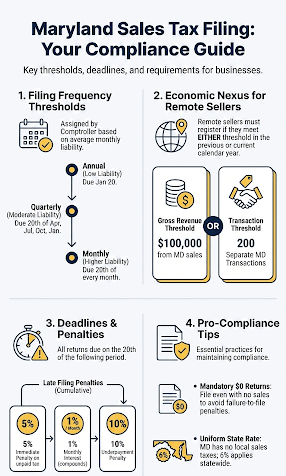
Weekend/Holiday Rule: If the 20th falls on a weekend or holiday, the deadline extends to the next business day.
Penalties: The Cost of Non-Compliance
Maryland’s penalties are unforgiving and compound quickly:
Late Filing Penalty Structure:
- 5% of unpaid tax immediately upon late filing
- 1% monthly interest on unpaid balance (compounds monthly)
- Minimum penalty may apply even for small amounts
Detailed Penalty Examples:
30-Day Late Payment ($5,000 owed):
- Initial penalty (5%): $250
- Interest (1% × 1 month): $50
- Total due: $5,300
60-Day Late Payment ($5,000 owed):
- Initial penalty (5%): $250
- Interest (1% × 2 months): $100
- Total due: $5,350
90-Day Late Payment ($5,000 owed):
- Initial penalty (5%): $250
- Interest (1% × 3 months): $150
- Total due: $5,400
Underpayment Penalties:
- 10% penalty on the shortfall amount
- Plus interest on the underpaid balance
- Applies when you file but don’t pay the full amount
Repeat Offenses: Chronic late filers risk:
- Increased audit scrutiny
- Forced frequency changes (monthly filing requirement)
- Account freezes or liens
- Potential criminal penalties for willful non-compliance
Grace Periods & Negotiating Relief
Maryland offers limited flexibility for genuine hardship:
Penalty Abatement Options:
- Reasonable Cause Exception: Natural disasters, medical emergencies, death in family, or other circumstances beyond your control
- First-Time Penalty Abatement: May be available if you have a clean compliance history
- Request Process: Submit written explanation with documentation to the Comptroller’s Office
Payment Plans:
- Available for balances over $5,000
- Requires formal installment agreement
- Interest continues to accrue during payment period
- Contact 410-260-7980 to arrange
Pro Tip: File $0 returns even if you had no sales. It keeps your account in good standing and avoids “failure to file” penalties. Many businesses mistakenly think they can skip filing if there’s no tax to remit, but Maryland requires returns regardless.
How to Register & File in Maryland
Registration Process
New businesses must register before making taxable sales:
- Visit Maryland Tax Connect
- Create an account (if you don’t have one)
- Complete Combined Registration Application including:
- Business identification information
- Federal EIN or SSN
- Business structure (LLC, Corporation, Sole Proprietor)
- Expected tax liability
- Business activities and NAICS codes
- Receive your Sales and Use Tax License Number
- Display your certificate at your business location (if applicable)
Processing Time: Typically 5-10 business days for online applications.
Filing Process
Electronic Filing (Required for Most):
- Log into Maryland Tax Connect
- Select “File a Return”
- Choose Sales and Use Tax Return (Form 202 or 202D)
- Enter your sales data:
- Gross sales
- Exempt sales
- Taxable sales
- Tax collected
- Review and submit
- Make payment electronically (ACH debit recommended)
Paper Filing:
- Generally discouraged but available
- Use Form 202 (Sales and Use Tax Return)
- Mail to: Comptroller of Maryland, Revenue Administration Division, Annapolis, MD 21411-0001
- Payment must accompany return (check or money order)
How to Change Your Filing Frequency
Your Maryland sales tax filing frequency isn’t set in stone, but changing it requires strategy and proper communication with the Comptroller.
Voluntary Changes: Proactive Adjustments
To request a change in your filing frequency:
- Contact the Comptroller’s Office at 410-260-7980
- Explain your situation: Demonstrate sustained changes in tax liability over 3-6 months
- Await Review: The Comptroller evaluates your history and current liability
- Receive Notification: You’ll be notified in writing of approval or denial
- Adjust Your Process: If approved, begin filing on the new schedule immediately
Example: A boutique with previously high sales experiences a sustained downturn. After six months of reduced tax liability, they contact the Comptroller and successfully request a switch from monthly to quarterly filing.
State-Mandated Changes: When Maryland Forces Your Hand
The Comptroller may override your frequency if you:
- Miss Deadlines: 2+ late filings in 12 months trigger review
- Significantly Exceed Thresholds: Sustained increases in tax liability
- Significantly Fall Below Thresholds: Consistent decreases in tax liability
What Happens Next:
- Automatic notification via Maryland Tax Connect and mail
- Change takes effect immediately or at the start of the next filing period
- No appeal process for frequency changes
- Failure to comply with new frequency results in standard penalties
Special Cases & Exceptions
Maryland’s sales tax rules aren’t universal! Some businesses dance to a different beat.
Seasonal Businesses
Operate ≤3 months/year? You may qualify for annual filing regardless of tax liability.
Requirements:
- Document seasonal operation pattern
- Request seasonal status designation
- File annual return by January 20
- Notify Comptroller when reopening each season
Example: A beachside ice cream shop open in June-August files once annually by January 20, avoiding quarterly filing burden during closed months.
Marketplace Sellers
Platforms like Amazon, Etsy, and eBay collect Maryland sales tax on behalf of third-party sellers if they meet economic nexus thresholds.
Your Responsibilities:
- Marketplace-Facilitated Sales: No collection required (marketplace handles it)
- Direct Sales: You must collect and remit tax on sales not through marketplaces
- Filing Requirement: File returns showing marketplace-facilitated sales separately from direct sales
- $0 Returns: Required if ALL sales are marketplace-facilitated
Pro Tip: Keep detailed records separating marketplace vs. direct sales to avoid double-taxation or gaps in coverage.
Non-Profits & Tax-Exempt Organizations
Tax-exempt status doesn’t eliminate filing requirements:
- Must register for sales tax license if making retail sales
- File $0 returns if no taxable sales occurred
- Maintain exemption certificates for exempt purchases
- Document exempt status for audit purposes
Maryland’s Competitive Advantage: No Local Sales Taxes
Unlike states such as California, New York, or Illinois, Maryland has NO local sales taxes. The state rate of 6% applies uniformly statewide (with rare exceptions for alcohol).
What This Means for Businesses:
- Simpler compliance: One rate, one jurisdiction, one return
- Easier software configuration: No address-level tax rate lookups
- Reduced audit risk: Fewer calculation errors
- Competitive advantage: Simpler than multi-jurisdictional states
This makes Maryland significantly more business-friendly for sales tax purposes compared to states with hundreds of local tax jurisdictions.
Streamlining Maryland Sales Tax Compliance with HOST
Navigating Maryland’s sales tax filing frequency and requirements can be overwhelming, but Hands Off Sales Tax (HOST) simplifies the process with expert-driven solutions.
Comprehensive Sales Tax Solutions
- Sales Tax Registration: Assistance with obtaining permits in Maryland and any other required states
- Nexus Assessment & Compliance: Determine tax obligations in Maryland and ensure adherence to state regulations
- Exemption Certificate Management: Proper collection and validation to prevent compliance risks
- Filing & Remittance: Accurate sales tax return filing and timely remittance to avoid penalties
- Audit Support & Resolution: Professional representation during sales tax audits to minimize business disruptions
- Free Sales Tax Software Review: A free review of your existing tax software to ensure efficiency and accuracy
HOST delivers tailored solutions for businesses of all sizes, removing the burden of sales tax compliance. With expert guidance and automation, businesses can focus on growth while maintaining compliance.
Effortless Sales Tax Compliance for Maryland Businesses
Keeping up with Maryland’s sales tax filing requirements is crucial for avoiding penalties and ensuring smooth operations. Staying compliant means maintaining accurate records, following best practices, and adapting to tax law changes. Yet, managing these obligations can quickly become overwhelming.
That’s where Hands Off Sales Tax (HOST) simplifies the process. From tax filing and nexus determination to audit defense and exemption certificate management, HOST offers expert guidance and seamless solutions.
Don’t let sales tax complexities hold your business back! Contact HOST today for a consultation and stay confidently compliant.
Frequently Asked Questions
How does Maryland determine my sales tax filing frequency?
Maryland assigns filing frequency based on your average monthly tax liability, not gross sales. The Comptroller of Maryland evaluates your account and notifies you of your assigned schedule (annual, quarterly, or monthly). Contact 410-260-7980 for your specific assignment.
What is Maryland’s economic nexus threshold for remote sellers?
As of October 1, 2018, remote sellers must register and collect Maryland sales tax if they have $100,000 OR more in gross revenue from Maryland sales, OR 200 or more separate transactions with Maryland customers in the previous or current calendar year.
Can I change my filing frequency if my tax liability decreases?
Yes. Contact the Comptroller’s Office to request a voluntary frequency change. The state will review your account history and current liability. Demonstrate sustained changes over 3-6 months for the best chance of approval.
What happens if I miss a filing deadline?
Maryland imposes a 5% penalty on unpaid taxes immediately, plus 1% monthly interest that compounds. Repeat offenders risk audits, forced frequency changes, or account freezes. File $0 returns if you had no sales to avoid “failure to file” penalties.
Do I need to file if I had no taxable sales in Maryland?
Yes. Maryland requires $0 returns to maintain your account status and avoid penalties. Filing $0 returns shows the state you’re actively monitoring your obligations, even during slow periods.
Does Maryland have local sales taxes?
No. Maryland has NO local sales taxes (with rare exceptions for alcohol in certain counties). The state rate of 6% applies uniformly statewide, making compliance significantly simpler than multi-jurisdictional states.
How can HOST help with Maryland sales tax compliance?
HOST provides comprehensive Maryland sales tax services including registration, nexus analysis, filing management, audit defense, and software optimization. Our experts handle the complexity so you can focus on growing your business without compliance stress.
