

Selling on Amazon, eBay, or Etsy simplified sales tax compliance for millions of online sellers. Marketplace facilitator laws shifted collection responsibility from individual sellers to the platforms themselves, fundamentally changing how sales tax works for e-commerce businesses.
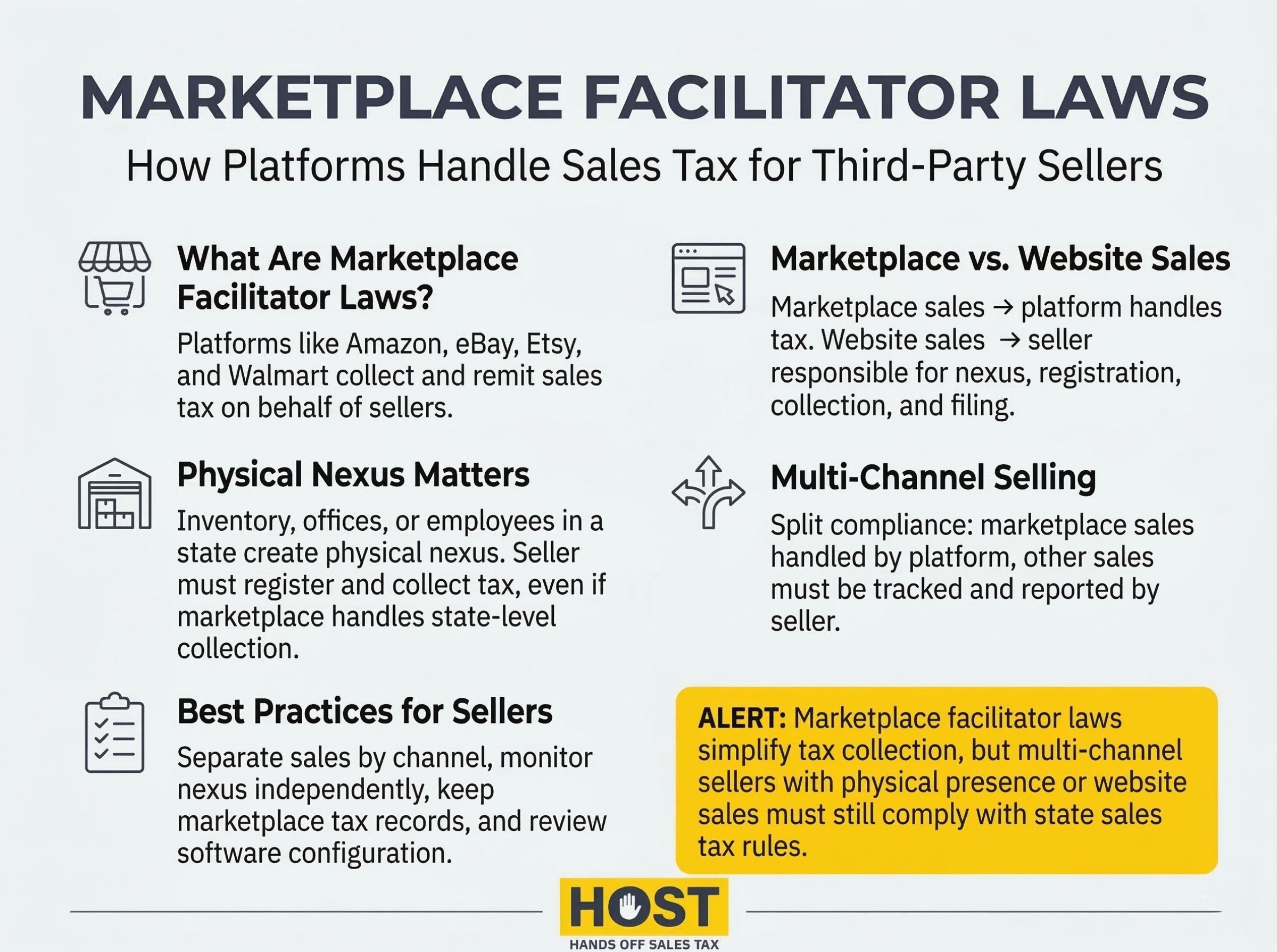
Understanding these laws determines whether you need to register, collect, and file sales tax returns yourself, or whether the platform handles it for you. For sellers operating across multiple channels, the split can create unexpected complexity.
Hands Off Sales Tax (HOST) specializes in helping e-commerce businesses navigate exactly where they have obligations, whether selling through marketplaces, their own websites, or both. With comprehensive nexus analysis and multi-state filing services, HOST ensures compliance across every sales channel.
What Are Marketplace Facilitator Laws?
Marketplace facilitator laws require online platforms to collect and remit sales tax on behalf of third-party sellers using their platforms. Rather than each individual seller handling tax compliance, the marketplace takes on that responsibility.
A marketplace facilitator is any platform that facilitates retail sales by listing products, processing payments, or handling fulfillment for third-party sellers. Amazon, eBay, Etsy, Walmart Marketplace, and similar platforms qualify.
Before these laws existed, third-party sellers bore individual responsibility. A seller on Amazon would need to track sales in every state, determine where they had nexus, register in those states, collect the correct tax rates, and file returns. That system created massive compliance gaps. Many small sellers didn’t understand their obligations or lacked resources to comply across dozens of states.
States realized they had a problem: while Amazon collected tax on its direct sales, third-party marketplace sales (representing over half of Amazon’s total transactions) went largely untaxed. Rather than chase thousands of individual sellers, states decided to make the platforms responsible.
Marketplace facilitator laws solved this by consolidating responsibility. Now the platform collects tax on all transactions flowing through it, regardless of where the seller is located. The seller’s compliance burden drops dramatically for marketplace sales.
All states with sales tax have now enacted marketplace facilitator laws. Implementation dates varied, with most states enacting laws between 2018-2020. Missouri was the last state to implement marketplace facilitator requirements in January 2023.
How Marketplace Facilitator Laws Work
When you sell through a marketplace like Amazon or eBay, the platform automatically calculates sales tax based on the customer’s location. The platform adds tax at checkout, collects it from the customer, and remits it to the appropriate state.
The marketplace files returns and pays tax to each state on behalf of all its sellers. Individual sellers don’t file returns for those marketplace sales, and states look to the platform, not the seller, for compliance.
This happens regardless of whether you as the seller have nexus in the customer’s state. Even if you’ve never sold there before, the marketplace still collects tax because the platform itself has nexus everywhere.
However, this only applies to sales made through the marketplace. If you also sell through your own website, at craft fairs, or via other channels, you remain fully responsible for sales tax compliance on those non-marketplace sales.
Which Platforms Are Affected?
Major platforms covered include:
Amazon: Collects sales tax on all third-party seller transactions nationwide. Amazon began collecting for third-party sellers in Washington state in January 2018, then gradually rolled out nationwide as states enacted marketplace facilitator laws.
eBay: Collects sales tax on applicable transactions in all states with marketplace facilitator laws.
Etsy: Collects and remits sales tax for U.S. orders in states with marketplace facilitator laws.
Walmart Marketplace: Collects sales tax on behalf of third-party sellers in states with marketplace facilitator laws.
Shopify: Operates differently. Shopify provides tools to calculate and collect tax, but sellers generally remain responsible for filing and remittance unless using Shopify’s managed tax services or selling through Shop Pay.
Smaller niche marketplaces may not qualify as facilitators in all states, depending on their role in the transaction.
What This Means for Third-Party Sellers
If you only sell on Amazon or eBay, those platforms handle all sales tax compliance for those sales. You don’t need to register for sales tax permits, collect tax at checkout, file returns, or track economic nexus thresholds for marketplace sales.
The marketplace provides annual tax documents showing total sales and tax collected, which you use for income tax purposes. But you don’t interact with state tax authorities for marketplace sales.
This simplified compliance for millions of small sellers who previously struggled with multi-state obligations or operated without proper compliance.
However, complications arise when you sell through multiple channels.
Multi-Channel Selling Creates Complexity
Many e-commerce businesses sell through marketplaces and their own websites. This creates a split compliance situation where different rules apply to different sales.
Marketplace sales: Platform collects tax; you don’t file returns for those transactions.
Website sales: You’re responsible for determining nexus, registering, collecting, and filing returns.
You need to track where you have nexus based on your non-marketplace sales. If your website sales into Texas exceed $500,000 annually, you’ve triggered Texas nexus and must register, collect, and file returns for website sales, even though Amazon handles your marketplace sales in Texas.
The complexity increases with inventory storage. If you use Fulfillment by Amazon (FBA), your inventory stored in Amazon warehouses creates physical nexus in those states. This triggers nexus for all your sales in those states. Marketplace and non-marketplace.
Suppose Amazon stores your inventory in California, Texas, and New Jersey. You now have nexus in all three states. For marketplace sales, Amazon collects tax. For website sales, you must collect tax yourself and file returns in all three states.
HOST’s nexus analysis service identifies exactly where your business has triggered collection obligations across all channels, ensuring you’re compliant without over-registering in states where you don’t need permits.
Common Misconceptions About Marketplace Laws
“If I only sell on Amazon, I don’t need to worry about sales tax at all.”
Mostly true, with exceptions. Amazon handles collection and remittance, but you may still need permits in states where you have physical nexus for reporting purposes.
“Marketplace facilitator laws eliminated economic nexus.”
False. Economic nexus still exists and matters for non-marketplace sales. If your website exceeds a state’s threshold, you must register and collect tax for those transactions.
“I can ignore sales tax completely if marketplaces handle it.”
Dangerous assumption. If you sell through your own website, at physical events, or through wholesale channels, you’re fully responsible for compliance on those sales.
When You Still Need to Register and Collect
Several scenarios require independent compliance:
Your own website or sales channels: Any sales not processed through a facilitator marketplace require traditional compliance. This includes Shopify stores (in most cases), WooCommerce sites, direct sales, and wholesale transactions.
Physical nexus in a state: If you have employees, offices, warehouses, or significant physical presence in a state, you may need to register there even if the marketplace collects tax on your behalf. Many states require businesses with physical nexus to maintain permits for reporting purposes.
Zero-dollar return requirements: Even when marketplaces handle all your sales tax collection, some states still require you to file returns showing $0 in direct sales. Failing to file these zero-dollar returns can trigger penalties despite owing no tax. Check with each state where you have nexus to determine filing requirements.
Local tax gaps: Some marketplaces collect state-level sales tax but not local or municipal taxes. In home-rule jurisdictions (where cities and counties administer their own sales tax separately from the state), you may remain responsible for local portions even when the marketplace handles state tax.
B2B wholesale transactions: If you sell to businesses for resale, these transactions should be tax-exempt with proper resale certificates. Marketplaces don’t typically handle this nuance well.
Understanding your specific obligations across all channels prevents compliance gaps that could trigger audits or penalties.
Your registration requirements also depend on how you sell. States categorize sellers differently:
Remote marketplace-only sellers: If you exclusively sell through marketplaces and have no physical presence, many states don’t require registration.
Remote multi-channel sellers: If you sell through marketplaces and your own website (or other channels) without physical presence, you typically must register and collect tax on non-marketplace sales once you exceed thresholds.
Sellers with physical presence: If you have inventory, employees, or offices in a state, you generally must register regardless of your sales channels or volume.
HOST’s comprehensive sales tax registration service handles the paperwork, follow-up, and state communications for every jurisdiction where you need a permit.
How to Verify Marketplace Collection
Most platforms make it easy to confirm they’re collecting tax on your behalf. Review your transaction reports periodically. The “tax collected” column should show amounts for all applicable orders. If you notice orders without tax in states that require it, investigate immediately.
For smaller or niche platforms, explicitly ask whether they qualify as marketplace facilitators in all states. Don’t assume, verify.
Best Practices for Multi-Channel Sellers
Separate sales data by channel: Maintain clear records distinguishing marketplace sales from website sales.
Monitor nexus independently: Track website sales separately to determine where you’ve exceeded thresholds.
Keep marketplace tax records: Save annual tax documents from platforms showing sales and tax collected.
Review software configuration: If using Shopify or similar platforms, ensure tax settings properly distinguish between marketplace-facilitated sales and direct sales. Misconfiguration can lead to double taxation or missed collections.
HOST’s free sales tax software review audits your tax software configuration to ensure marketplace vs. non-marketplace sales are properly categorized and taxed.
HOST’s sales tax filing service manages your returns across all jurisdictions where you have non-marketplace obligations, preparing and filing monthly, quarterly, or annual returns so you stay current everywhere.
HOST: Navigating Multi-Channel Sales Tax Complexity
Marketplace facilitator laws simplified compliance for many sellers, but they didn’t eliminate the need for expertise. Multi-channel businesses, growing companies, and sellers with physical presence still face significant obligations.
What HOST Delivers:
Nexus Analysis: We determine exactly where you have collection obligations based on your complete sales footprint. Marketplace sales, website sales, physical presence, and inventory locations across all states.
Sales Tax Registration: We handle registrations in every state where you need permits, managing paperwork and state communications so you’re properly licensed.
Multi-Channel Filing: We prepare and file returns for your non-marketplace sales in all required jurisdictions (monthly, quarterly, or annually), keeping everything current.
Software Review: We audit your tax software configuration to ensure marketplace vs. non-marketplace sales are properly categorized and taxed.
Notice Management: We interpret and respond to state notices, including those questioning marketplace vs. seller responsibility.
Audit Defense: We’re your partner in resolving sales tax audits, organizing documentation and defending your position when states question multi-channel compliance.
We’ve focused exclusively on sales tax for over 25 years, helping e-commerce businesses navigate the evolving compliance landscape. Whether you’re expanding from marketplaces to your own website, or managing inventory across multiple fulfillment centers, HOST ensures every channel is properly covered.
Ready to Simplify Your Multi-Channel Compliance?
Marketplace facilitator laws handle part of your sales tax picture, but growing businesses need comprehensive coverage across all channels. Understanding exactly where you’re responsible (and where the marketplace handles it), prevents costly gaps and audit exposure.
Whether you’re launching your own website, storing inventory in new states, or simply want peace of mind that everything’s handled correctly, HOST provides the expertise to keep your business compliant as you grow.
Contact HOST today to discuss your multi-channel sales tax needs, or schedule a free consultation to review your current compliance situation. We handle the complexity so you can focus on growing sales across every channel.
Want to learn more? Get our “10 Sales Tax Mistakes E-Commerce Sellers Make” e-book.
Frequently Asked Questions
What is a marketplace facilitator?
A marketplace facilitator is any platform that facilitates retail sales by listing products, processing payments, or handling fulfillment for third-party sellers. Examples include Amazon, eBay, Etsy, and Walmart Marketplace. These platforms collect and remit sales tax on behalf of sellers under state marketplace facilitator laws.
Do I need to register for sales tax if I only sell on Amazon?
Generally no, if you exclusively sell on Amazon and have no physical presence anywhere. Amazon collects and remits sales tax on your behalf in all states. However, if you also sell through your own website or have inventory stored in FBA warehouses, you may need to register in states where you have nexus.
How do marketplace facilitator laws affect my own website sales?
Marketplace facilitator laws don’t affect your website sales at all. You remain fully responsible for determining nexus, registering, collecting, and filing returns for any sales made outside of marketplace platforms. This creates a split compliance situation for multi-channel sellers.
Can I get audited for sales tax if marketplaces handle collection?
Yes, states can audit your non-marketplace sales or question whether transactions were properly classified. If you sell through your own website or other channels, those sales are subject to audit. Additionally, states may audit to verify you’re not improperly classifying taxable sales as marketplace-facilitated to avoid compliance.
What happens if a marketplace fails to collect tax correctly?
The state looks to the marketplace, not the individual seller, for any uncollected tax on marketplace-facilitated sales. Sellers are generally protected from liability for marketplace collection errors. However, keep records proving sales occurred through the marketplace in case questions arise.
