

Louisiana’s nexus threshold determines when out-of-state sellers must collect and remit sales tax in the Pelican State. Cross that $100,000 line, and you’re on the hook immediately.
For e-commerce businesses juggling sales across state lines, Louisiana’s rules hit different than most. The state changed its rate in January 2025, eliminated its transaction count threshold back in 2023, and operates one of the messiest parish-level tax systems in America.
At Hands Off Sales Tax (HOST), we’ve helped hundreds of online sellers cut through Louisiana’s complexity. From nexus analysis to registration and ongoing filings, we handle what you don’t have time for.
What Is Sales Tax Nexus?
Nexus is the connection between your business and a state that creates tax obligations. Think of it as a tripwire. Once you cross it, collection begins.
Before 2018, nexus meant physical presence. Warehouses, offices, employees. The South Dakota v. Wayfair Supreme Court decision rewrote everything.
Now economic nexus rules. Sell enough to Louisiana customers from anywhere, and you’re collecting Louisiana tax. Physical presence optional.
Louisiana’s Economic Nexus Threshold
Louisiana requires remote sellers to collect sales tax once they exceed:
$100,000 in retail sales from Louisiana customers in the current or previous calendar year
No transaction count. Just revenue. Louisiana simplified that part in August 2023 when it dropped the old 200-transaction alternative.
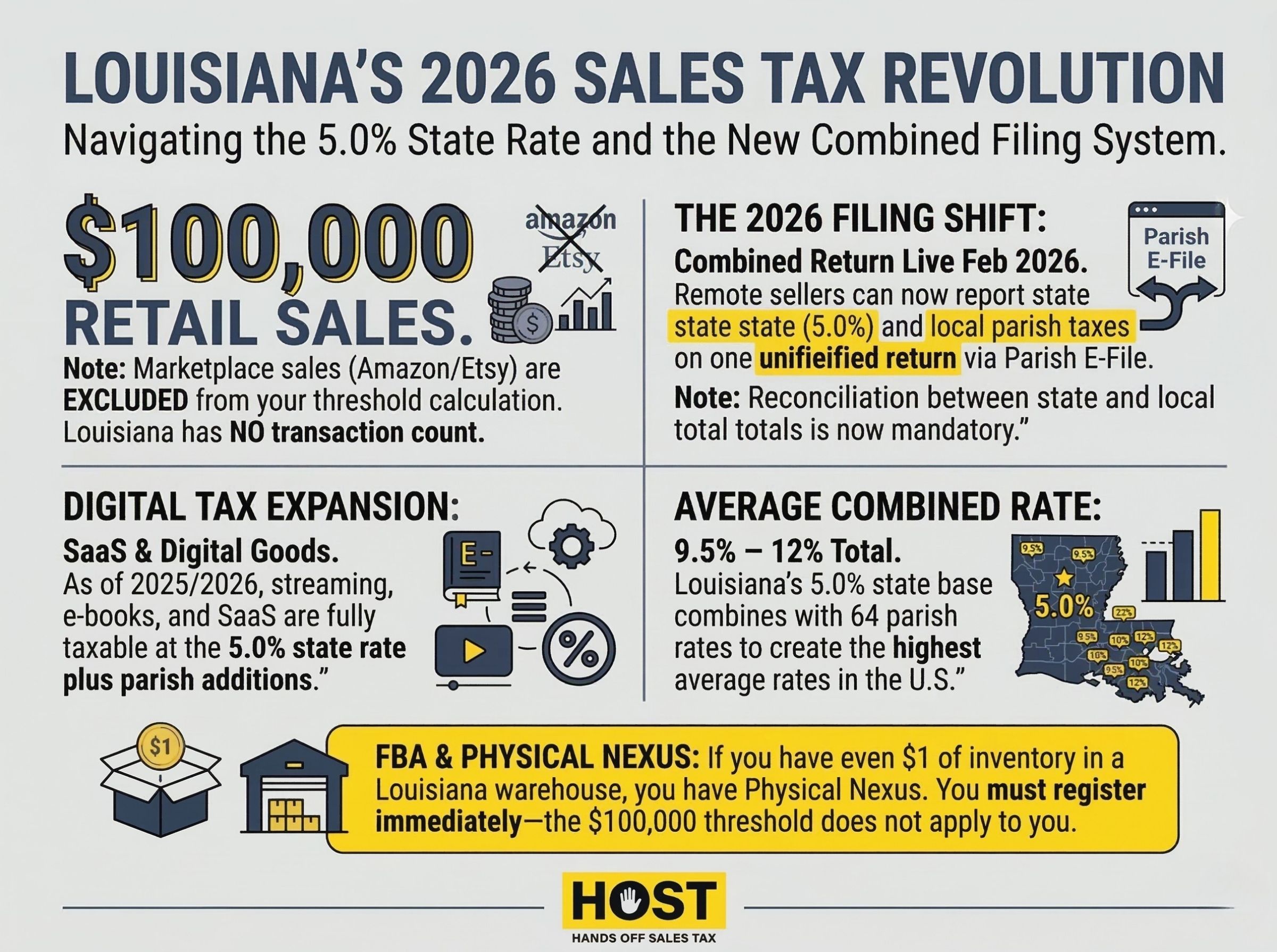
Here’s a critical distinction: Louisiana uses retail sales, not gross revenue. Wholesale transactions and sales for resale don’t count toward your threshold. This changed in August 2023, and it matters. Selling $150,000 to Louisiana with $60,000 being wholesale means you’re still under the threshold.
Marketplace Sales Don’t Count Toward Your Threshold
If you sell through Amazon, eBay, Etsy, or other marketplace facilitators that collect Louisiana tax on your behalf, those sales don’t count toward your $100,000 threshold.
Example: You make $75,000 in direct Louisiana sales through your Shopify store, plus $40,000 through Amazon FBA. You haven’t met the threshold because only your direct sales count. Amazon’s $40,000 counts toward Amazon’s threshold, not yours.
This exclusion only applies when the marketplace facilitator is already registered and collecting Louisiana tax. Verify your platform’s registration status.
When the Obligation Starts
Louisiana requires you to register within 30 days of crossing the $100,000 threshold. Once the Louisiana Sales and Use Tax Commission for Remote Sellers approves your registration, you must begin collecting tax no later than 60 days after exceeding the threshold.
Hit $100,001 on September 15th? Register by October 15th. Start collecting once approved, but no later than November 14th.
That timeline catches sellers off guard. By the time you realize you’ve crossed the threshold, compliance deadlines are already ticking.
Physical Nexus Still Exists
Economic nexus isn’t the only trigger. Physical presence creates nexus at any sales level, even $1.
You have physical nexus in Louisiana if you maintain:
- Warehouses, offices, or retail locations
- Inventory stored anywhere in Louisiana (including third-party warehouses)
- Employees, contractors, or sales representatives operating in the state
- Property or equipment physically located there
For e-commerce sellers, inventory creates the biggest surprises. Amazon FBA stores your products wherever logistics optimize delivery. You might have inventory in 15 states without knowing, including Louisiana.
Physical nexus requires immediate registration with the Louisiana Sales and Use Tax Commission for Remote Sellers. No $100,000 threshold to wait for.
Louisiana’s Tangled Tax Rates
Louisiana has one of the most complex sales tax structures in the United States. The state base rate is 5% (as of January 1, 2025), but local jurisdictions add their own rates.
Combined state and local rates in Louisiana range from 5% to over 11% in some parishes. Louisiana has no uniform local rate: every parish (Louisiana’s equivalent of counties) and municipality sets its own.
This creates significant compliance headaches. You must calculate the correct rate based on the customer’s specific delivery address. Two customers in the same ZIP code but different municipalities can owe different rates.
Louisiana is origin-based for in-state sellers, destination-based for out-of-state sellers. As a remote seller, you always use the customer’s destination address, which means tracking hundreds of local jurisdictions.
What’s Taxable in Louisiana
Most tangible personal property is taxable. Physical products, manufactured goods, retail merchandise.
Groceries are taxable in Louisiana, though at reduced rates in some areas. Prescription drugs are exempt.
Digital products became taxable January 1, 2025 including SaaS, streaming services, e-books, and downloadable software.
Registering for a Louisiana Sales Tax Permit
Remote sellers register through the Louisiana Sales and Use Tax Commission for Remote Sellers, a separate entity from the Louisiana Department of Revenue. This commission specifically handles remote seller registrations and compliance.
Access registration through the Louisiana Taxpayer Access Point (LaTAP) portal. You’ll need:
- Business legal name and DBA
- Federal EIN or Social Security Number
- Business structure (LLC, corporation, sole proprietorship)
- Physical and mailing addresses
- Description of business activities
- Estimated monthly Louisiana sales
- Bank account information
Louisiana typically processes registrations within 5-10 business days. No registration fee.
HOST handles Louisiana registration for clients, ensuring accuracy from the start. We track your nexus across all states and register you everywhere obligations exist.
Filing Frequency and Deadlines
Louisiana assigns filing frequency based on your tax liability:
- Monthly filers: Businesses with higher average monthly tax liability
- Quarterly filers: Businesses with moderate monthly tax liability
- Annual filers: Businesses with minimal monthly tax liability
Most remote sellers start quarterly or annual. As Louisiana sales grow, the state may move you to monthly filing.
Returns are due on the 20th of the month following the reporting period. If the 20th falls on a weekend or holiday, the deadline extends to the next business day.
Payment must accompany your return. Louisiana requires electronic filing and payment for most businesses.
Penalties Hit Hard
Louisiana imposes penalties for late filing, late payment, and underpayment:
- Late filing penalty: 5% of the tax due for initial failure, with additional 5% for each subsequent 30-day period, up to 25% total
- Late payment penalty: 0.5% per 30-day period on unpaid tax, up to 25% total
- Interest: Accrues on unpaid balances at state-set rates
Penalties compound. Missing a single filing can cost you big, especially with significant Louisiana sales.
Managing Multi-State Nexus
Louisiana is rarely your only state. Most growing e-commerce businesses trigger nexus in 10-20+ states.
Each state has different thresholds, rates, filing frequencies, and taxability rules. Tracking where you have nexus, when you crossed thresholds, and what obligations exist becomes overwhelming.
This is where the 30+ monthly hours come from! Businesses managing sales tax in-house spend enormous time maintaining compliance with zero revenue generated.
HOST’s comprehensive nexus analysis examines your sales data across all states, identifies exactly where you’ve triggered obligations, and manages ongoing compliance across every jurisdiction.
We file your returns, monthly, quarterly, and annually across all states where you have nexus, handling rate updates, rule changes, and filing deadlines automatically.
What Happens During an Audit
Louisiana conducts audits to verify compliance. The state typically examines 3-4 years of records.
Common triggers: large discrepancies between reported sales and income tax returns, consistent late filings, significant revenue changes, industry-specific compliance initiatives, random selection.
During an audit, Louisiana requests sales records, invoices, bank statements, exemption certificates, prior returns, and business formation documents.
If the audit finds underpayment, Louisiana assesses back taxes, penalties, and interest. Total liability can exceed double the original tax when penalties and interest compound over multiple years.
HOST offers audit defense services. We handle communications with Louisiana tax authorities, prepare documentation, organize records, and work to minimize liability.
Voluntary Disclosure Agreements
Discovered you had Louisiana nexus for past periods but weren’t collecting? You have options beyond waiting for an audit.
Louisiana offers Voluntary Disclosure Agreements (VDAs) that let businesses come forward, pay back taxes for a limited lookback period, and receive penalty abatement.
A typical Louisiana VDA:
- Limits lookback to 3-4 years (instead of unlimited)
- Waives penalties (though interest still applies)
- Provides anonymity during application
- Requires prospective compliance going forward
VDAs are powerful. Instead of facing an audit with unlimited lookback and full penalties, you proactively resolve the issue on favorable terms.
HOST files VDAs with Louisiana and other states for clients who discover past nexus. We handle the application, negotiate terms, and ensure maximum benefit.
Why Compliance Matters
Non-compliance creates serious risks:
Financial: Back taxes, penalties, and interest reaching six figures for businesses with significant multi-year Louisiana sales.
Operational: Audits consume time and resources, diverting focus from running your business.
Legal: Willful failure to collect can result in criminal charges in extreme cases.
Business Value: Unresolved tax liabilities are deal-killers. Buyers conduct due diligence. Undisclosed sales tax exposure tanks deals or reduces your sale price.
HOST: Your Louisiana Compliance Partner
Sales tax compliance doesn’t have to consume your time or create constant stress.
What HOST Delivers:
- Nexus Analysis: We analyze your sales data to determine exactly where you’ve met nexus thresholds across all states, correctly excluding marketplace sales from Louisiana calculations
- Louisiana Registration: We handle registration with the Louisiana Sales and Use Tax Commission for Remote Sellers, completing all paperwork within the required 30-day window
- Filing Services: We prepare and file your Louisiana returns so everything stays current
- Multi-State Management: We file returns across all states where you have nexus
- Notice Response: We interpret and respond to Louisiana notices, protecting you from penalties
- Audit Defense: We’re your trusted partner in resolving audits
- VDA Support: We file voluntary disclosure agreements to limit lookback periods
We’ve been 100% focused on sales tax since 1999. Over 25 years helping e-commerce businesses navigate compliance.
Founded by Mike Espenshade, with parent company TaxMatrix serving North America’s largest companies, we bring enterprise expertise to online sellers of all sizes.
Ready to Get Louisiana Right?
Every hour spent researching Louisiana parish rates, calculating whether marketplace sales count toward your threshold, or filing returns is an hour not spent growing your business.
When you’re ready to hand off Louisiana sales tax compliance, we’re ready to help.
Contact HOST today to discuss your Louisiana nexus situation or schedule a free consultation.
Want to learn more? Get our “10 Sales Tax Mistakes E-Commerce Sellers Make” e-book.
Frequently Asked Questions
What is Louisiana’s economic nexus threshold for sales tax?
Louisiana’s economic nexus threshold is $100,000 in retail sales (excluding wholesale and resale transactions) from Louisiana customers in the current or previous calendar year. The 200-transaction threshold was eliminated August 1, 2023. Sales made through marketplace facilitators like Amazon don’t count toward your threshold if the marketplace is collecting Louisiana tax.
Do marketplace sales count toward Louisiana’s $100,000 threshold?
No. Sales made through marketplace facilitators (Amazon, eBay, Etsy) that are already collecting Louisiana tax don’t count toward your $100,000 threshold. Only your direct sales to Louisiana customers count. This means you could have $150,000 total Louisiana sales but remain under the threshold if $60,000 came through marketplaces.
How long do I have to register after crossing Louisiana’s nexus threshold?
You must register within 30 days of exceeding the $100,000 threshold. Once the Louisiana Sales and Use Tax Commission for Remote Sellers approves your registration, you must begin collecting tax no later than 60 days after crossing the threshold.
Do I need to collect Louisiana sales tax with no physical presence?
Yes, if you exceed $100,000 in retail sales from Louisiana customers. However, any physical presence (inventory, employees, property) requires immediate collection, even below $100,000. Remember that wholesale and resale transactions don’t count toward the threshold.
Does Amazon FBA create nexus in Louisiana?
Yes. If Amazon stores your inventory in a Louisiana fulfillment center, you have physical nexus and must collect sales tax immediately, regardless of sales volume. Amazon dynamically moves inventory across its network, potentially creating nexus in 15+ states without notification.
Where do I register for Louisiana sales tax as a remote seller?
Remote sellers register through the Louisiana Sales and Use Tax Commission for Remote Sellers (not the Department of Revenue). Access registration through the Louisiana Taxpayer Access Point (LaTAP) portal. HOST handles this registration process for clients, ensuring accurate filing within the required 30-day window.
