

Understanding Kentucky economic nexus means knowing exactly when your online business must start collecting sales tax in the Bluegrass State. For e-commerce sellers shipping products across state lines, Kentucky’s thresholds can sneak up faster than expected, triggering registration requirements, monthly filings, and potential penalties if ignored.
Since the 2018 Wayfair decision, remote sellers face a patchwork of state-specific nexus rules. Kentucky acted quickly, passing HB 487 in April 2018 and beginning enforcement October 1, 2018. The state adopted the same thresholds as South Dakota’s Wayfair case, requiring out-of-state businesses to collect tax once they cross specific thresholds.
Important timing change: As of July 1, 2021, Kentucky extended the registration deadline. Once you exceed either threshold, you must register and begin collecting tax by the first day of the calendar month that is at most 60 days after crossing the threshold. This gives sellers a brief window to get compliant, but penalties start immediately if you miss that deadline.
Hands Off Sales Tax (HOST) specializes in Kentucky economic nexus analysis, registration, and ongoing compliance. We determine exactly when you’ve triggered obligations, handle the registration paperwork, and file your returns. So you stay compliant without the administrative burden.
What Is Economic Nexus?
Economic nexus establishes a state’s right to require sales tax collection based on your business activity within that state, regardless of physical presence. Before Wayfair, only businesses with warehouses, employees, or offices in a state had nexus obligations.
Now, crossing dollar or transaction thresholds creates nexus automatically. Kentucky economic nexus triggered a fundamental shift for online retailers. Suddenly, shipping products to Kentucky customers meant potential tax obligations, even without ever visiting the state.
Kentucky Economic Nexus Threshold
Kentucky economic nexus triggers when you meet either of these thresholds during the previous or current calendar year:
- $100,000 in gross receipts from sales into Kentucky, OR
- 200 or more separate transactions into Kentucky
You only need to meet one threshold to establish nexus. Gross receipts include all sales delivered into Kentucky, whether taxable or exempt. If you sell both taxable electronics and exempt groceries, both count toward the $100,000 threshold. All transactions including exempt sales count toward the 200-transaction threshold.
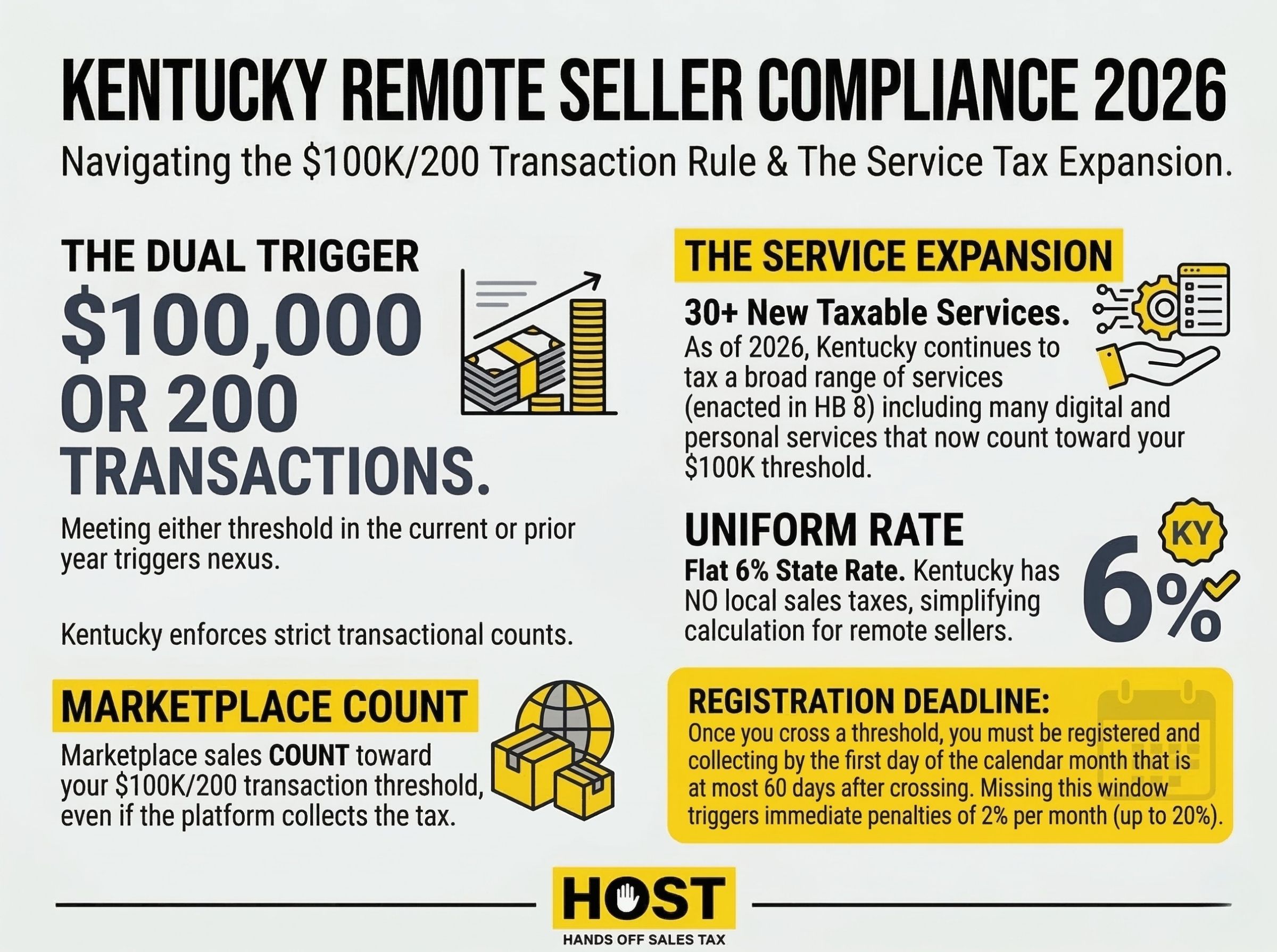
Critical note: Prior to January 1, 2023, only sales of tangible personal property and digital products counted toward thresholds. Kentucky expanded taxation to include 30+ service categories in 2023 (through HB 8), and now taxable services also count toward your nexus thresholds. This significantly broadened who triggers nexus.
Once you cross either threshold, nexus takes effect immediately. You must register and begin collecting tax by the first day of the calendar month that is at most 60 days after exceeding either threshold. While this provides a brief compliance window, waiting increases your exposure to back taxes and penalties.
How Kentucky Calculates the Thresholds
Kentucky measures both thresholds on a calendar year basis. The Department of Revenue examines both the previous calendar year and the current calendar year when determining nexus.
If you exceeded $100,000 or 200 transactions in 2024, you have nexus throughout 2025. Even if your 2025 numbers drop below the thresholds. Similarly, crossing either threshold in March 2025 triggers nexus immediately for the remainder of 2025.
This lookback and current-year structure means you need continuous monitoring. Many sellers cross thresholds mid-year without realizing they’ve triggered immediate collection obligations.
Who Must Register for Kentucky Sales Tax?
Any remote seller meeting the Kentucky economic nexus threshold must register for a sales tax permit. This includes e-commerce businesses, Amazon FBA sellers (for transactions where Amazon doesn’t collect on your behalf), marketplace sellers on platforms without facilitator collection, B2B wholesalers, and SaaS providers delivering digital products to Kentucky customers.
Marketplace Facilitator Rules
Kentucky’s marketplace facilitator law requires platforms like Amazon, Walmart, and eBay to collect and remit sales tax on behalf of third-party sellers. If a marketplace collects tax for your sales, you generally don’t have direct collection obligations for those specific transactions.
Critical exception: Even though the marketplace collects tax on your behalf, those sales still count toward your economic nexus thresholds in Kentucky. This differs from some states. If you have $80,000 in marketplace sales (where Amazon collects) plus $30,000 in direct website sales, you’ve crossed the $100,000 threshold and must register, even though you only collect tax on your direct sales.
You remain responsible for any sales not covered by marketplace collection: direct sales through your website, sales on platforms without facilitator laws, or exempt transactions.
Kentucky Sales Tax Registration Process
Once you’ve crossed the Kentucky economic nexus threshold, registration must happen before your next sale. The Kentucky Department of Revenue handles registrations through their online portal.
You’ll need your Federal EIN, business legal name, business structure, physical business address, and details about your business activities. Access the Kentucky One Stop Business Portal, complete the application indicating you’re registering due to economic nexus, and submit. Processing typically takes 5-7 business days.
Common registration mistakes include selecting the wrong effective date (creating exposure for back taxes), incorrectly identifying your entity type, assuming local tax requirements exist when Kentucky has none, and failing to track exempt sales that still count toward thresholds.
HOST handles Kentucky registration completely. We determine your effective date, complete all paperwork accurately, and ensure your permit is active before you need to file your first return.
Kentucky Sales Tax Rates and Taxability
Kentucky has a 6% state sales tax rate with no local sales taxes. This uniform rate simplifies calculation compared to states with hundreds of local jurisdictions adding varying percentages.
Kentucky taxes most tangible personal property: electronics, clothing, furniture, appliances, and general merchandise. Digital products face complex rules: software delivered electronically, digital books, music downloads, and streaming services are generally taxable, though specific exemptions exist for certain educational or business software.
Services are generally not taxable unless specifically enumerated. Repair services, personal services, and most professional services remain exempt. However, telecommunications services and certain fabrication services are taxable.
Kentucky exemptions include groceries and unprepared food for home consumption, prescription drugs, manufacturing equipment under the industrial exemption, items purchased for resale with valid Kentucky resale certificates, and certain farm equipment and agricultural inputs.
Filing Requirements and Deadlines
Kentucky assigns filing frequencies based on tax liability. New registrants typically receive monthly filing requirements, though this can adjust based on your tax collected.
Monthly filing deadline: The 20th of the month following the reporting period. January sales tax is due February 20th. Kentucky requires payment by the filing deadline and mandates filing even if you made no Kentucky sales during the period (zero returns). Failing to file creates penalties even with zero tax due.
Penalties for Late Filing
Kentucky imposes serious penalties for late filing and late payment:
Late filing penalty: 2% of the tax due for the first month, plus additional 2% for each subsequent month, up to 20% maximum.
Late payment penalty: Similar structure. 2% per month up to 20% maximum.
Interest: Compounding interest on unpaid balances accrues from the due date until payment.
A $5,000 tax liability filed two months late could incur $400 in penalties plus interest making timely filing essential.
HOST files Kentucky returns on schedule every month. We pull your sales data, calculate tax correctly, file the return, and ensure payment reaches Kentucky before the deadline, eliminating penalty risk entirely.
Staying Compliant with Kentucky Economic Nexus
Maintaining compliance means more than registration and filing. Track monthly sales to ensure you remain above or below thresholds for future years. Stay current with rate and law updates. Kentucky occasionally adjusts tax policy.
When selling to Kentucky businesses claiming resale exemptions, collect and retain valid exemption certificates. Invalid certificates create audit exposure. Accurately calculate tax on shipping charges, handling fees, and discounts. Kentucky requires tax on shipping charges when the shipped items are taxable.
Kentucky requires businesses to maintain sales records for at least four years. Audits can request documentation going back multiple years.
Voluntary Disclosure Agreements
If you discover you’ve had Kentucky economic nexus for past years without collecting tax, Kentucky offers Voluntary Disclosure Agreements (VDAs). These agreements limit lookback periods (typically 3-4 years instead of the full statute of limitations) and often waive penalties.
HOST facilitates VDAs regularly. We negotiate with Kentucky on your behalf, calculate historical liability, and structure payment plans when necessary. Coming forward voluntarily through a VDA is always preferable to being caught in an audit.
How Hands Off Sales Tax Helps with Kentucky Compliance
Kentucky economic nexus creates real administrative burden. Between threshold monitoring, registration timing, monthly filing deadlines, and rate updates, compliance consumes hours that generate zero revenue.
Nexus Analysis: We analyze your sales data across all states, determining exactly where you’ve triggered Kentucky economic nexus and other state obligations.
Registration Management: We complete Kentucky registration, handle all paperwork, follow up with the Department of Revenue, and secure your active permit.
Monthly Filing: We file your Kentucky returns on time every month, including zero returns when necessary, ensuring you never face late penalties.
Notice Response: When Kentucky sends notices, whether informational, billing, or audit-related, we interpret them and respond appropriately.
Audit Defense: If Kentucky initiates an audit, we’re your trusted partner throughout the process, organizing documentation and defending your position.
We’ve been 100% focused on sales tax since 1999. That’s over 25 years managing compliance so you can focus on growing your business instead of decoding tax codes.
Ready to Handle Kentucky Economic Nexus?
Kentucky economic nexus obligations won’t resolve themselves. Every sale into Kentucky after crossing thresholds creates potential liability and penalties compound monthly when you’re non-compliant.
Whether you’ve just crossed the threshold, discovered past obligations, or simply want experts managing the ongoing burden, HOST provides comprehensive Kentucky sales tax solutions.
Contact us today to discuss your Kentucky nexus situation or schedule a free consultation. We’ll analyze your exposure, handle registration if needed, and ensure your Kentucky compliance stays current while you focus on sales.
Want to learn more? Get our “10 Sales Tax Mistakes E-Commerce Sellers Make” e-book to understand common pitfalls that create costly problems.
Frequently Asked Questions
What is Kentucky’s economic nexus threshold for remote sellers?
Kentucky economic nexus triggers when you meet either of these thresholds during the previous or current calendar year: $100,000 in gross receipts from sales into Kentucky OR 200 or more separate transactions into Kentucky. Meeting either threshold creates immediate nexus.
Do marketplace sales count toward Kentucky’s nexus threshold?
Sales made through marketplace facilitators like Amazon (where the marketplace collects tax) generally don’t create nexus obligations for you. However, direct sales through your website or on platforms that don’t collect tax do count toward the thresholds.
When do I need to register after crossing Kentucky’s threshold?
Kentucky requires registration and collection starting immediately after crossing either threshold. You should register before making your next sale into the state to avoid penalties on uncollected tax.
Does Kentucky have local sales taxes I need to collect?
No. Kentucky has a uniform 6% state sales tax with no local sales taxes, simplifying rate calculation and filing compared to states with varying local jurisdictions.
What happens if I didn’t know about Kentucky economic nexus?
If you discover past Kentucky nexus without collecting tax, Kentucky offers Voluntary Disclosure Agreements (VDAs) that limit lookback periods and typically waive penalties. Coming forward voluntarily is always preferable to being caught in an audit.
How often do I need to file Kentucky sales tax returns?
Most e-commerce businesses file monthly, with returns and payment due by the 20th of the following month. Kentucky may adjust your frequency to quarterly or annual filing if your tax liability remains consistently low.
