

Selling to Illinois customers means navigating one of America’s most complex sales tax systems. After the 2018 Wayfair decision, Illinois implemented economic nexus rules requiring remote sellers to collect and remit sales tax once they cross specific thresholds. No physical presence needed.
Understanding Illinois economic nexus isn’t optional. The state aggressively pursues uncollected sales tax. Mistakes trigger audits, penalties, and years of back taxes. From calculating combined state and local rates to managing quarterly filings across multiple jurisdictions, Illinois compliance demands expertise most e-commerce businesses lack.
That’s where Hands Off Sales Tax (HOST) comes in. We’ve spent over 25 years helping businesses navigate multi-state sales tax obligations, including Illinois’s intricate requirements. Whether you’re crossing the nexus threshold for the first time or drowning in ongoing compliance, we handle the complexity while you focus on growth.
What Is Economic Nexus?
Economic nexus creates a tax collection obligation based on your sales activity in a state, not physical presence. Before the Supreme Court’s 2018 South Dakota v. Wayfair ruling, states could only require sales tax collection from businesses with physical locations, employees, or inventory within their borders.
Wayfair changed everything. States can now require remote sellers to collect sales tax once they exceed state-specific economic thresholds. For e-commerce businesses, this means monitoring sales activity across all 45 states with sales tax.
Cross the threshold in Illinois? You’re required to register, collect the correct rates, and file returns. Miss this obligation, and you’re exposed to audits, penalties, and the nightmare of calculating years of back taxes.
Illinois Economic Nexus Thresholds
Illinois established economic nexus rules effective October 1, 2018. Currently, the state requires remote sellers to collect sales tax once they exceed either threshold in the preceding 12 months:
$100,000 in gross receipts from sales delivered to Illinois customers, OR 200 or more separate transactions delivered to Illinois customers.
However, effective January 1, 2026, Illinois eliminates the 200-transaction threshold entirely. After that date, economic nexus is based solely on the $100,000 gross receipts threshold. This change, passed as House Bill 2755, simplifies compliance for businesses with high transaction volumes but lower dollar amounts.
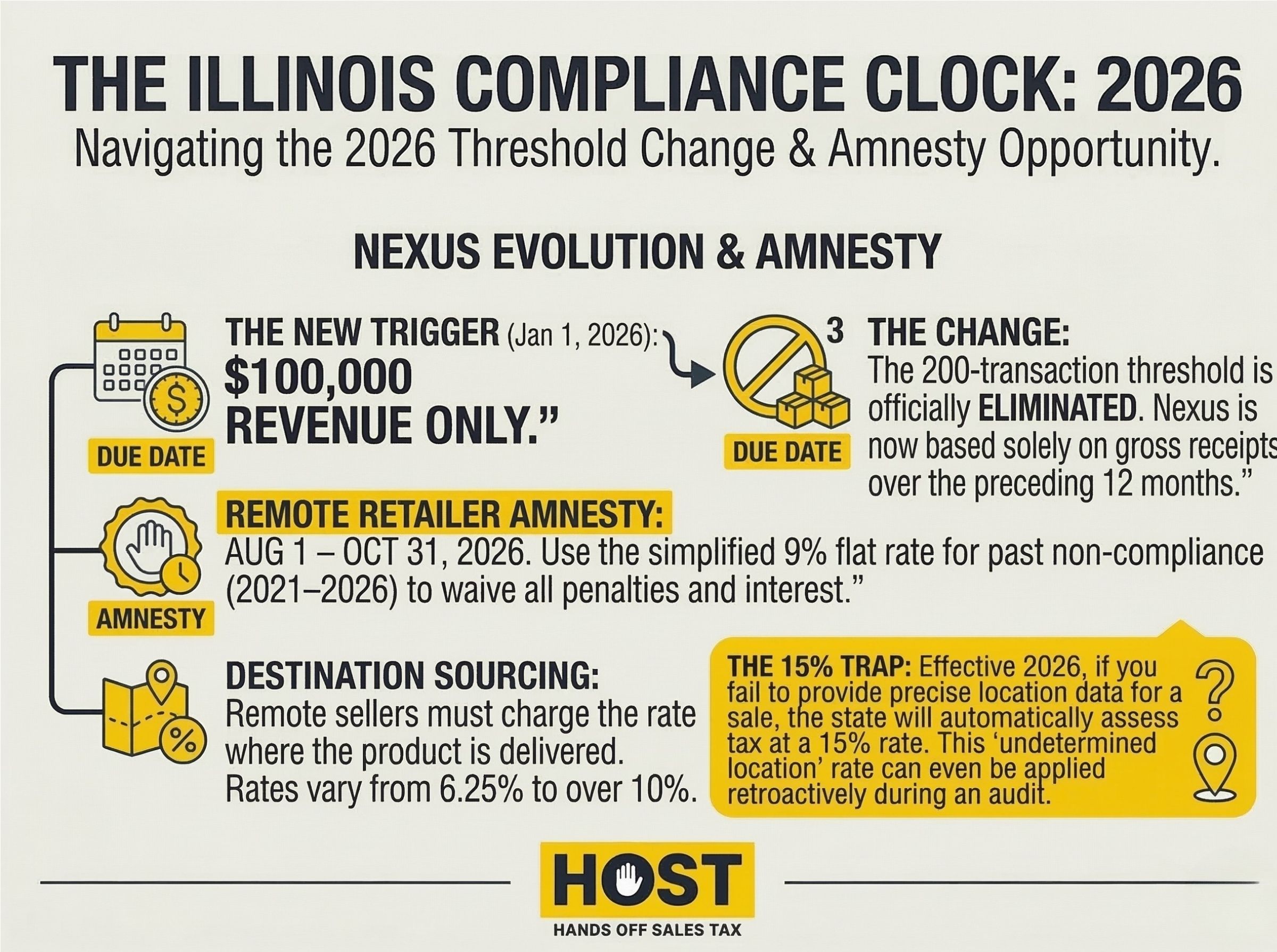
Both thresholds are measured on a rolling 12-month basis, evaluated quarterly at the end of March, June, September, and December. You must continuously monitor your Illinois sales to determine when you’ve triggered nexus.
Through 2025, the transaction threshold creates challenges for businesses selling lower-priced items. A company selling $50 products could cross the 200-transaction threshold at just $10,000 in sales, which is well below the $100,000 revenue threshold. After January 1, 2026, these businesses gain relief unless they exceed $100,000.
Gross receipts include all sales delivered to Illinois addresses, not just taxable sales. Even exempt products count toward determining whether you’ve met the threshold.
However, certain transactions are excluded from the calculation: occasional sales, sales for resale, most services (through 2025), sales through registered marketplace facilitators, and items requiring state registration like vehicles or boats. Understanding what counts ensures accurate threshold monitoring.
What Triggers Illinois Economic Nexus?
Several activities trigger economic nexus beyond simple online sales:
Direct online sales: Selling products through your website directly to Illinois consumers. Once your sales exceed the thresholds, nexus is established.
Marketplace sales: Platforms like Amazon, eBay, or Etsy typically collect and remit sales tax on your behalf. However, you still need to track these sales for other potential nexus triggers.
Drop-shipping arrangements: Sales fulfilled through drop-shippers to Illinois customers count toward your economic nexus calculation.
Digital products and services: Illinois taxes many digital products and electronically delivered services. SaaS, digital downloads, or streaming services to Illinois customers count toward your thresholds and may be taxable.
Service providers (starting 2026): Beginning January 1, 2026, Illinois expands economic nexus to remote service providers. If you provide taxable services to Illinois customers and exceed the $100,000 threshold, you’ll be required to collect both state and local Service Occupation Tax and Service Use Tax. This affects consultants, professional services, and many B2B service businesses.
Affiliate relationships: Illinois has specific click-through nexus rules. If you have contracts with Illinois residents who refer customers (via links, promotional codes, etc.) and cumulative referrals from all Illinois affiliates exceed $10,000 over the preceding four quarters, you may establish nexus even below the $100,000 threshold.
Once you’ve triggered nexus, the obligation doesn’t disappear if your sales drop later. You remain obligated to collect and file until you formally cancel your registration.
Registration Requirements in Illinois
After crossing the economic nexus threshold, you must register with the Illinois Department of Revenue to obtain a Certificate of Registration. This certificate authorizes you to collect sales tax and creates filing obligations.
Registration requires providing your Federal Employer Identification Number (FEIN), business structure, ownership details, and estimated Illinois sales. Illinois assigns filing frequencies based on your expected tax liability. Most remote sellers start quarterly, though high-volume sellers may be assigned monthly.
Registration also requires designating a responsible party who becomes personally liable for ensuring accurate and timely filings. That’s why many business owners partner with specialists who manage these obligations professionally.
HOST handles Illinois registration from start to finish, completing applications, managing follow-up communications, and ensuring you’re properly set up before your first filing deadline.
Illinois Sales Tax Rates and Calculation
Illinois operates one of America’s most complex sales tax systems. The state imposes a 6.25% base rate, but local jurisdictions add their own rates, creating hundreds of different combined rates across the state.
Combined rates range from 6.25% (areas with no local taxes) to over 10% in some Chicago locations. The rate you charge depends on the customer’s specific delivery address, not your business location.
Calculating the correct rate requires address-level precision. Two customers on the same street could owe different rates if they fall into different taxing jurisdictions. Chicago alone has multiple rates depending on whether products qualify for certain local taxes.
Many e-commerce sellers use sales tax automation software to calculate rates, but misconfiguration is common. Software treating exempt items as taxable, applying wrong local rates, or double-taxing due to system overlaps can cost thousands.
HOST offers a Free Sales Tax Software Review to audit your configuration and identify costly errors before they become audit problems.
Filing Requirements and Deadlines
Illinois requires regular sales tax returns based on your assigned filing frequency: monthly, quarterly, or annually. Most remote sellers file quarterly, with returns due by the 20th day of the month following each quarter.
Each return must report gross sales, exempt sales, taxable sales, and tax collected. You’ll remit any tax collected minus eligible deductions or credits. Even with no Illinois sales during a filing period, you may still need to file a zero return.
Late filing triggers penalties starting at the lesser of $250 or 2% of tax due. If you don’t file within 30 days of receiving a non-filing notice, the penalty increases to the greater of $250 or 2% of tax due, up to $5,000. Late payment penalties are progressive: 2% within 30 days, 10% between 30-90 days, 15% between 90-180 days, and 20% after 180 days. The state also charges interest on unpaid balances.
HOST manages Illinois filings across all required frequencies, ensuring accurate reporting, timely submission, and proper documentation. We handle the monthly workload so you focus on running your business instead of tracking deadlines.
Common Illinois Compliance Mistakes
Monitoring only annual thresholds: Illinois measures thresholds on a rolling 12-month basis, evaluated quarterly. Businesses checking only annually may miss when they’ve triggered nexus mid-year, creating months of non-compliance.
Ignoring the transaction threshold (through 2025): Through December 31, 2025, the 200-transaction threshold remains in effect. After January 1, 2026, monitoring becomes simpler with only the revenue threshold to track.
Using incorrect local rates: Applying state rates without local add-ons, or using ZIP code-based tables instead of precise address validation, leads to undercollection and potential audit liability.
Misclassifying exempt sales: Illinois exempts specific products and transactions, but applying exemptions incorrectly triggers audits. Proper documentation is essential for every exempt sale.
Missing filing deadlines: Illinois’s penalty structure makes late filing expensive quickly. Even businesses that eventually file and pay face significant penalties that proper calendar management would have avoided.
How HOST Simplifies Illinois Compliance
Managing Illinois economic nexus and ongoing compliance creates significant operational burden. The average company spends 30+ hours per month on sales tax administration across all states, and that’s time that generates no revenue.
HOST provides comprehensive Illinois sales tax management:
Nexus Analysis: We analyze your sales data to determine exactly when you’ve triggered Illinois economic nexus and identify any historical exposure requiring remediation.
Registration Services: We complete and submit your Illinois registration, handle all state communications, and ensure you’re properly set up before collection obligations begin.
Sales Tax Filing: We prepare and file your Illinois returns on schedule (quarterly, monthly, or annually) ensuring accurate reporting and timely remittance.
Notice Management: We interpret and respond to Illinois Department of Revenue notices, protecting you from penalties while resolving issues efficiently.
Audit Defense: If Illinois audits your business, we serve as your trusted partner, organizing documentation, communicating with auditors, and defending your position to minimize liability.
Voluntary Disclosure Agreements: If you discover past non-compliance, we file VDAs with Illinois to limit lookback periods and abate penalties, resolving historical exposure with minimal financial impact.
Illinois Amnesty Program (2026): Illinois is offering a special Remote Retailer Amnesty Program from August 1 through October 31, 2026. If you had economic nexus between January 1, 2021 and June 30, 2026 but never registered or collected tax, this program lets you come forward voluntarily and pay a simplified 9% flat rate with complete penalty and interest waiver. This limited-time opportunity could save tens of thousands compared to waiting for an audit. HOST can evaluate your eligibility and manage the amnesty filing process.
We’ve been 100% focused on sales tax since 1999. That’s over 25 years helping businesses navigate complex state requirements. Through our parent company TaxMatrix, we’ve served some of North America’s largest companies, and we bring that same expertise to e-commerce sellers of all sizes.
Take Illinois Sales Tax Off Your Plate
Illinois economic nexus rules create ongoing compliance obligations that drain time and create constant audit risk. Whether you’re crossing the threshold for the first time, struggling with existing obligations, or dealing with notice letters from the state, professional management eliminates the burden.
At HOST, we handle every aspect of Illinois sales tax compliance, from initial nexus determination through ongoing filing and audit defense. You focus on growing your business. We ensure you’re collecting correctly, filing on time, and fully protected from costly compliance failures.
Contact HOST today to discuss your Illinois sales tax needs, or schedule a free consultation. Let us handle the tax so you can focus on sales.
Want to learn more? Get our “10 Sales Tax Mistakes E-Commerce Sellers Make” e-book.
Frequently Asked Questions
What is the economic nexus threshold for Illinois?
Through December 31, 2025, Illinois requires remote sellers to collect sales tax once they exceed $100,000 in gross receipts OR 200 separate transactions delivered to Illinois customers in the preceding 12 months. Effective January 1, 2026, the 200-transaction threshold is eliminated, and only the $100,000 gross receipts threshold will apply.
Do marketplace sales count toward Illinois economic nexus?
Yes, all sales delivered to Illinois customers count toward the economic nexus thresholds, including marketplace sales. However, marketplace facilitators like Amazon typically collect and remit the tax on your behalf for those specific transactions.
How quickly must I register after crossing the Illinois nexus threshold?
Illinois expects prompt registration once you’ve exceeded the thresholds. While the state doesn’t specify an exact deadline, waiting months creates retroactive exposure. Most businesses should register within 30 days of crossing the threshold.
What happens if I didn’t know I had Illinois nexus?
Ignorance doesn’t eliminate your obligation. Illinois offers a Voluntary Disclosure Program that can limit lookback periods (typically to 4 years instead of 10+) and abate some penalties if you come forward proactively. Additionally, Illinois is running a special Remote Retailer Amnesty Program from August 1 through October 31, 2026, offering a simplified 9% flat rate with complete penalty and interest waiver for past non-compliance between January 1, 2021 and June 30, 2026. HOST manages VDA filings and can evaluate your eligibility for amnesty to minimize your exposure.
Can I cancel my Illinois registration if my sales drop below the thresholds?
You can request to cancel your registration, but the state may require you to demonstrate sustained absence of nexus-creating activity. You remain obligated to file returns for all periods while registered, even if you had no sales.
What’s the penalty for late filing in Illinois?
Illinois assesses penalties based on when you file and pay. Late filing triggers the lesser of $250 or 2% of tax due immediately. If you don’t file within 30 days of receiving a non-filing notice, the penalty increases to the greater of $250 or 2% (up to $5,000). Late payment penalties are progressive: 2% within 30 days, 10% between 30-90 days, 15% between 90-180 days, and 20% after 180 days, plus interest on all unpaid balances.
