

Florida sales tax nexus for remote sellers operates under clear thresholds that trigger collection obligations, even without physical presence in the state. Understanding when you’ve crossed Florida’s economic nexus line determines whether you’re required to register, collect, and remit sales tax to the Florida Department of Revenue.
For e-commerce businesses expanding across state lines, Florida represents both opportunity and complexity. With over 22 million residents and no state income tax, Florida’s consumer market draws sellers nationwide. But nexus rules, local surtaxes, and product exemptions create scenarios where businesses inadvertently operate non-compliant for months before discovering the obligation.
Hands Off Sales Tax (HOST) specializes in exactly this challenge: determining where your sales footprint has triggered nexus, registering in all required states including Florida, and managing ongoing compliance so you can focus on growth rather than tax codes.
What Is Sales Tax Nexus?
Sales tax nexus is the connection between your business and a state that creates a legal obligation to collect and remit sales tax. Nexus can be established through physical presence (offices, employees, inventory) or economic activity (sales volume).
Before the 2018 South Dakota v. Wayfair Supreme Court decision, only physical presence created nexus. Remote sellers without employees or warehouses in a state weren’t required to collect sales tax there.
Wayfair changed everything. States can now require out-of-state sellers to collect sales tax based solely on economic activity. Florida implemented economic nexus rules effective July 1, 2021.
Florida’s Economic Nexus Threshold
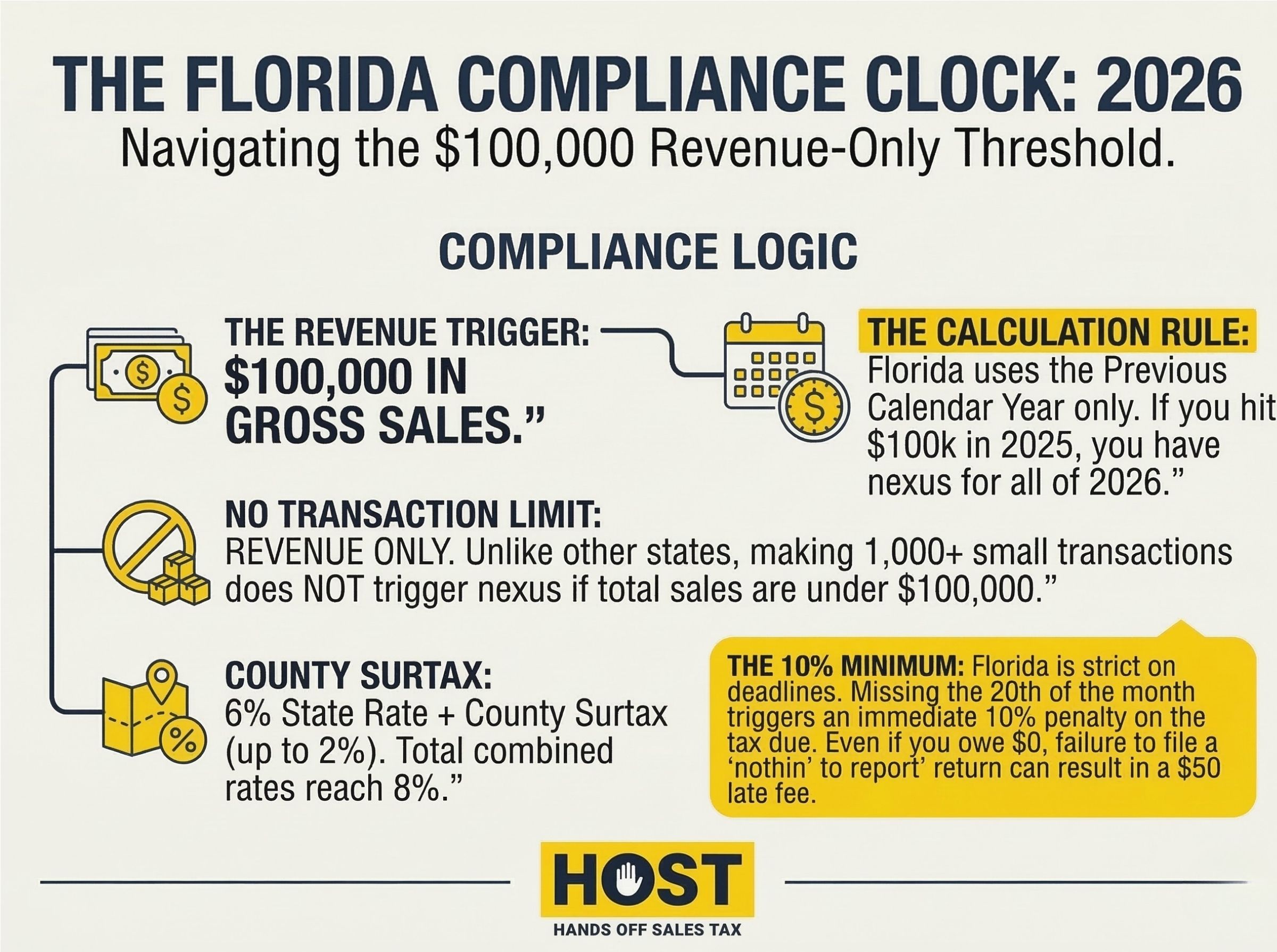
Florida’s economic nexus threshold is straightforward: $100,000 in gross sales delivered to Florida customers in the previous calendar year.
Unlike many states using dual thresholds (revenue OR transaction count), Florida uses only revenue. If you sold $99,999 to Florida customers across 10,000 transactions, you haven’t met the threshold. If you sold $100,001 across just 10 transactions, you have.
Florida defines “remote sales” specifically as retail sales of tangible personal property ordered by mail, telephone, the internet, or other means of communication from a person who receives the order outside Florida and causes the property to be transported into Florida. This means services and non-taxable sales are explicitly excluded from the threshold calculation, which is a detail that differs from some other states.
Key clarification: the $100,000 threshold includes all retail sales delivered into Florida, including exempt sales. Even if you’re selling entirely tax-exempt products, those sales count toward the economic nexus calculation.
When Florida Economic Nexus Takes Effect
Once you exceed Florida’s $100,000 threshold in a calendar year, you have nexus throughout the following year.
Florida uses a previous calendar year measurement period. Exceed $100,000 in Florida sales during 2024? You have collection obligations for all of 2025, regardless of your 2025 sales volume. This creates certainty since you know at the start of each year whether you have nexus.
Register and begin collecting as soon as you know you’ve crossed the threshold. Florida requires registration before collecting sales tax. The registration process takes 2-4 weeks, plus you’ll need time to configure your e-commerce platform or sales tax automation tools.
If you exceeded the threshold in 2024, register immediately in early 2025 to ensure you’re collecting from the start of the year. Collecting without valid registration creates complications. Not collecting when required exposes you to penalties, interest, and audits covering the entire non-compliance period.
HOST’s nexus analysis service tracks your sales across all states, identifies when you’ve crossed thresholds, and ensures you register with correct timing, eliminating guesswork and preventing compliance gaps.
Physical Nexus in Florida Still Applies
Physical nexus hasn’t disappeared. Any physical presence in Florida immediately creates nexus, regardless of sales volume.
Physical nexus triggers include:
- Office or retail location: Even a small office establishes nexus from day one
- Warehouse or fulfillment center: Storing inventory in Florida creates nexus, including inventory in third-party warehouses
- Employees or contractors: Sales representatives, remote employees, or independent contractors working in Florida
- Temporary presence: Attending trade shows or conferences where you make sales
- Affiliate relationships: If your business is part of an affiliated group where another member has Florida nexus, or if you have relationships with Florida-based entities that facilitate sales, you may have nexus under Florida Statute 212.0596 independent of the $100,000 threshold
Amazon FBA sellers should pay attention. If your inventory is stored in a Florida fulfillment center (even temporarily as Amazon redistributes stock) you have physical nexus in Florida. This creates immediate collection obligations, separate from economic nexus thresholds.
The key difference: physical nexus creates immediate obligations. There’s no $100,000 threshold, no lookback period. The day you establish physical presence is the day you’re required to collect.
Florida Sales Tax Rates and Complexity
Florida’s base state sales tax rate is 6%. But every Florida county adds a discretionary sales surtax ranging from 0.5% to 2%, creating combined rates from 6% to 8% depending on the customer’s county.
Unlike states where rates vary by city or zip code within counties, Florida keeps it simpler: one county, one rate. However, with 67 counties, that’s still 67 different rates to track.
For remote sellers, the customer’s location determines the rate. Florida is destination-based for sales tax purposes. You charge based on where the product is shipped, not where your business is located.
Sales tax automation software handles rate calculation, but misconfiguration creates problems. Common errors include using outdated rate tables, applying the wrong jurisdiction due to address validation issues, or double-taxing when multiple systems overlap.
HOST offers a free sales tax software review to identify configuration errors before they become audit liabilities.
Registration Process for Florida Sales Tax
Once you’ve determined you have nexus in Florida, registration is required before you begin collecting:
- Obtain a Federal EIN: Florida requires an Employer Identification Number for most business registrations
- Register online: Use Florida’s Department of Revenue online registration system at floridarevenue.com
- Provide business information: Legal name, trade names, business structure, ownership details, and contact information
- Describe your activities: Florida asks about business activities, products sold, and where you have nexus
- Receive your Certificate of Registration: Florida issues a sales tax registration certificate with your account number
Registration typically processes within 2-4 weeks. Your collection obligation doesn’t pause while registration is pending. If you have nexus, you’re technically required to collect even during the registration process.
HOST handles Florida sales tax registration as part of our comprehensive service. We complete the paperwork, follow up on state questions, and ensure you’re fully registered before your collection deadline.
Filing Frequency and Deadlines
Florida assigns filing frequency based on your expected tax liability:
- Monthly filers: Businesses expecting to collect $1,000+ per month
- Quarterly filers: Businesses expecting to collect $100-$999 per month
- Semiannual filers: Businesses expecting to collect less than $100 per month
Returns are due on the 1st of the month following the reporting period. However, if you file and pay electronically (which Florida strongly encourages), you receive an automatic extension to the 20th of the month. Nearly all businesses take advantage of this extension by filing online.
Missing a Florida filing deadline triggers penalties:
- Late filing: 10% of tax due, with a minimum penalty
- Late payment: 10% of tax due
- Interest: Assessed on unpaid balances from the due date until paid
Most e-commerce businesses spend 30+ hours monthly on sales tax compliance across jurisdictions. That’s time that generates zero revenue and diverts focus from growth activities.
HOST files Florida sales tax returns (and returns in all your nexus states) on your behalf, ensuring every deadline is met and every return is accurate.
Common Florida Nexus Mistakes
Ignoring FBA inventory: Amazon redistributes inventory across fulfillment centers without notifying sellers. Your products could be in Florida today even if you didn’t select it. This creates immediate physical nexus.
Using gross sales incorrectly: The $100,000 threshold includes all retail sales delivered to Florida, not just taxable sales. Businesses selling exempt products still need to track total Florida sales.
Applying wrong rates: Using your own location’s rate instead of the customer’s location, or using outdated county surtax rates, creates collection errors. Florida is destination-based.
Failing to register before collecting: Collecting tax without valid registration is illegal in Florida. The state requires registration first, collection second.
Not monitoring ongoing nexus: Nexus isn’t a one-time evaluation. Sales patterns change, inventory moves, businesses expand. Regular nexus reviews ensure you’re compliant as circumstances evolve.
These mistakes often go unnoticed until Florida issues a notice or initiates an audit. By then, you’re facing back taxes, penalties, interest, and the stress of managing a tax authority investigation.
Discovered You Should Have Been Collecting?
If you’ve been selling to Florida customers since 2021 (or later) and just realized you should have been collecting sales tax, you’re not alone. Many businesses discover nexus obligations after operating for months or years.
Florida’s economic nexus law became effective July 1, 2021. Businesses that registered by October 1, 2021 received amnesty for prior periods, but that window has closed.
If you exceeded Florida’s threshold in 2020 or any subsequent year but didn’t register, you’ve accumulated back tax liability. The longer you wait, the more exposure you build.
Voluntary disclosure agreements (VDAs) offer the best path forward. VDAs limit lookback periods to 3 years (versus 4+ in audits), abate penalties, and allow you to come forward proactively before Florida contacts you.
The key: act immediately. Every month of continued non-collection adds to your liability. Florida’s Department of Revenue actively pursues remote sellers through data matching with payment processors, marketplace platforms, and other states.
HOST files VDAs with Florida to resolve past obligations with minimal financial impact. We’ve helped hundreds of businesses address compliance gaps discovered late, limiting damage and establishing proper collection going forward.
Florida Marketplace Facilitator Law Considerations
Florida’s marketplace facilitator law requires platforms like Amazon, eBay, Etsy, and Walmart Marketplace to collect and remit sales tax on behalf of third-party sellers. This law went into effect July 2021.
For sellers operating through these platforms, the marketplace handles Florida sales tax collection and remittance automatically. You don’t need to register for sales through the platform (as long as all sales go through facilitators collecting on your behalf).
Florida specifically excludes certain businesses from its marketplace facilitator definition:
- Travel agency services
- Delivery network companies
- Payment processors whose sole activity is processing payments
However, if you have any direct sales to Florida customers through your own website, direct phone orders, or non-facilitator platforms, you’re still responsible for collecting tax on those transactions.
This split creates complexity. You need to track which sales channels are covered by marketplace facilitator collection and which require your own collection.
Additionally, if you have physical nexus in Florida (warehouse, office, employees), you’re required to register regardless of whether marketplace facilitators handle your platform sales.
How HOST Simplifies Florida Sales Tax Compliance
Managing Florida sales tax alongside nexus in 44 other states with sales tax creates an administrative burden that grows with your business.
Hands Off Sales Tax exists to eliminate that burden completely.
Nexus Analysis: We analyze your sales data across all states to determine exactly where you’ve triggered nexus obligations. For Florida specifically, we track when you cross the $100,000 threshold and identify when your collection obligation begins.
Florida Sales Tax Registration: We handle the entire Florida registration process: completing applications, providing required documentation, following up with the Department of Revenue, and securing your certificate of registration.
Automated Filing: Whether Florida assigns you monthly, quarterly, or semiannual filing, HOST manages every return. We pull sales data from your systems, calculate tax due, prepare returns, and file by the deadline.
Rate and Taxability Management: We ensure your sales tax software correctly calculates Florida rates based on customer location and applies proper taxability rules to your product catalog. Our free sales tax software review identifies configuration errors that lead to over-collection or under-collection.
Notice Management and Audit Defense: If Florida sends a notice about registration, filing discrepancies, or potential audits, we handle it. We interpret what the notice means, gather required documentation, and respond appropriately. Our audit defense services protect you when state authorities come calling.
Voluntary Disclosure Agreements: Discovered you should have been collecting Florida sales tax? We file voluntary disclosure agreements to limit lookback periods, reduce penalties, and resolve past obligations with minimal financial impact.
We’ve been 100% focused on sales tax since 1999. Over 25 years managing compliance so businesses can focus on growth. Through our parent company TaxMatrix, we’ve helped North America’s largest companies navigate multi-state sales tax. Now we bring that expertise to e-commerce sellers of all sizes.
Ready to Handle Florida Sales Tax the Right Way?
Florida’s nexus rules for remote sellers are clear: $100,000 in sales creates an obligation. But knowing the rule and managing ongoing compliance are entirely different challenges.
The cost of non-compliance (back taxes, penalties, interest, audit stress) far exceeds the investment in proper management. Whether you’re crossing Florida’s threshold for the first time or managing nexus in multiple states simultaneously, professional support eliminates risk and saves time.
At HOST, we’ve built our entire business around one promise: you handle the sales, we handle the tax. Every nexus analysis, registration, filing, and audit response is managed by sales tax specialists who do this every day.
Contact HOST today to discuss your specific situation or schedule a free consultation. Let’s ensure you’re collecting in the right places, filing on time, and staying ahead of state tax authorities.
Want to learn more about common sales tax mistakes? Get our “10 Sales Tax Mistakes E-Commerce Sellers Make” e-book.
Frequently Asked Questions
What is Florida’s economic nexus threshold for remote sellers?
Florida’s economic nexus threshold is $100,000 in gross retail sales delivered to Florida customers in the previous calendar year. There’s no separate transaction count threshold. Once you exceed this amount in a calendar year, you have nexus throughout the following year.
Does physical presence in Florida still create nexus?
Yes. Physical nexus remains separate from economic nexus. Any physical presence in Florida such as your office, warehouse, inventory, employees, or even temporary trade show presence, creates immediate collection obligations regardless of sales volume.
How do I know which Florida sales tax rate to charge?
Florida is destination-based. Charge the rate for the county where the customer receives the product. Florida has 67 counties with combined rates ranging from 6% to 8% (6% state base plus 0.5% to 2% county surtax). Use sales tax software to apply correct rates.
Do marketplace sales count toward Florida’s $100,000 threshold?
Yes. All retail sales delivered to Florida customers count toward the economic nexus threshold, including sales through marketplace facilitators like Amazon. However, once you cross the threshold, marketplace facilitators typically handle collection and remittance for sales through their platforms. You’re only responsible for direct sales.
What happens if I discover I should have been collecting Florida sales tax but wasn’t?
Contact HOST immediately for voluntary disclosure agreement (VDA) support. VDAs limit lookback periods to 3 years, abate penalties, and resolve past obligations. The sooner you address non-compliance voluntarily, the better the outcome.
How often do I need to file Florida sales tax returns?
Florida assigns filing frequency based on expected monthly tax liability: monthly ($1,000+), quarterly ($100-$999), or semiannual (under $100). Most remote sellers file monthly or quarterly. Returns are due the 1st of the month following the period, with automatic extension to the 20th for electronic filing.
