

Arkansas sales tax nexus determines whether your business must collect and remit sales tax in the state. For e-commerce sellers expanding into new markets, understanding nexus rules is the difference between compliance and costly penalties.
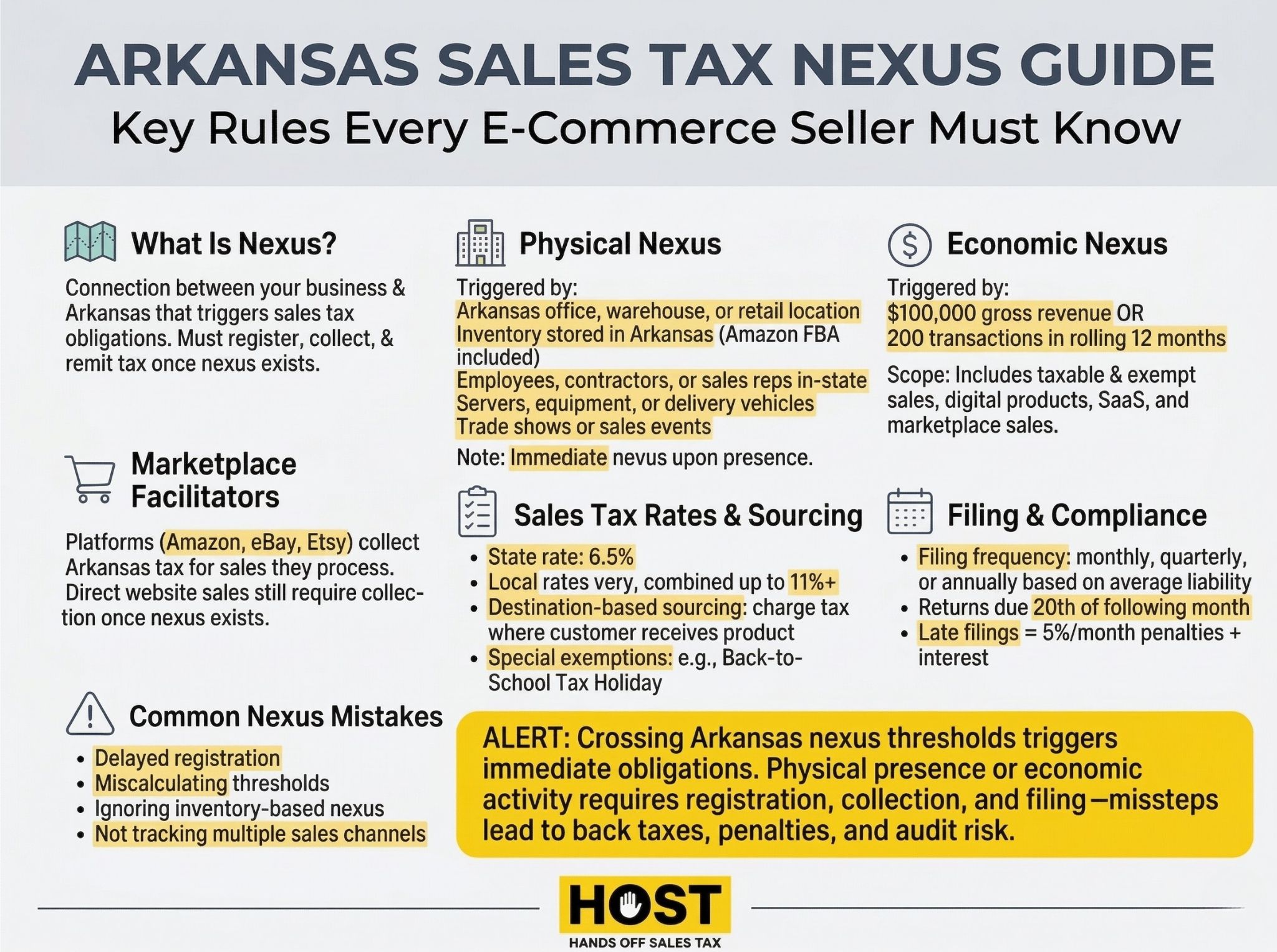
Since the 2018 Wayfair decision, economic nexus has transformed how online retailers approach state tax obligations. Cross Arkansas’s thresholds, and you’re required to register, collect, and file returns regardless of physical presence. Miss those obligations, and you’re looking at back taxes, penalties, and audit exposure.
HOST handles Arkansas nexus analysis, registration, and ongoing compliance so you can expand confidently. From determining when you’ve triggered nexus to managing filings across all your obligation states, we keep compliance seamless.
What Is Sales Tax Nexus in Arkansas?
Sales tax nexus is the connection between your business and Arkansas that creates a tax collection obligation. Once established, Arkansas law requires you to register for a permit, collect tax from customers, and remit it to the state.
Arkansas recognizes two types: physical presence and economic activity. Either one triggers collection obligations.
Physical Nexus in Arkansas
Physical nexus exists when your business maintains a tangible presence in Arkansas:
- Office, warehouse, or retail location in the state
- Inventory stored in Arkansas fulfillment centers (including third-party facilities like Amazon FBA)
- Employees, contractors, or sales representatives working in Arkansas
- Property or equipment located in the state (including servers)
- Using company-owned or leased trucks to deliver goods to Arkansas customers
- Attending trade shows or sales events in Arkansas
Even minimal physical presence establishes nexus. Storing inventory in a Little Rock warehouse for FBA creates nexus immediately, regardless of whether you’ve made a single sale to an Arkansas customer. Note that Arkansas does not have trailing nexus. Once you cease activities that created physical presence, your obligations end.
Economic Nexus in Arkansas
Economic nexus triggers based on sales volume alone, no physical presence required. Arkansas’s economic nexus threshold is $100,000 in gross revenue OR 200 transactions from sales into the state during the current or previous calendar year.
Once you exceed either benchmark in any rolling 12-month period, you’ve established economic nexus and must register within a reasonable timeframe. Arkansas doesn’t use just the $100,000 threshold—the 200-transaction count matters independently.
The threshold includes sales of tangible personal property, taxable services, digital codes, and specified digital products delivered into Arkansas. This means SaaS providers, digital product sellers, and traditional retailers all need to monitor their Arkansas sales. Even exempt transactions count. If you sold $120,000 of products to Arkansas customers but $30,000 were exempt items, you still crossed the threshold because total sales exceeded $100,000.
How the $100,000 Threshold Works
Arkansas adopted economic nexus legislation effective July 1, 2019, following the Wayfair precedent. The law applies to remote sellers and marketplace facilitators.
The $100,000 threshold calculates based on gross revenue from sales delivered into Arkansas:
- Sales are sourced to the customer’s location (destination-based)
- Both taxable and exempt sales count toward the threshold
- The measurement period is the current or previous calendar year
- Once you exceed $100,000 OR 200 transactions, nexus exists immediately
Arkansas measures the threshold on a calendar year basis, but businesses should track it monthly to identify the exact trigger date. Hit $100,000 in October, and you’ve established nexus in October, not at year-end.
Registration After Crossing the Threshold
Once you establish economic nexus, Arkansas expects registration “within a reasonable time.” While the statute doesn’t specify an exact deadline, tax professionals recommend registering within 30 days of crossing the threshold to demonstrate good-faith compliance.
Arkansas is a full member of the Streamlined Sales Tax Governing Board, which means you can register through the SST system if you need permits in multiple member states. This central registration system simplifies multi-state compliance for businesses expanding beyond Arkansas.
HOST handles Arkansas registration for clients, managing the paperwork, follow-up, and ensuring you’re properly licensed before collection obligations begin.
Marketplace Facilitator Laws in Arkansas
Arkansas enacted marketplace facilitator legislation effective July 1, 2019. This requires platforms like Amazon, eBay, Etsy, and Walmart Marketplace to collect and remit sales tax on behalf of third-party sellers.
If you sell through a marketplace facilitator that handles payment processing, the platform collects Arkansas sales tax and remits it to the state. You’re relieved of collection obligations for those facilitated sales.
However, you still need to understand your nexus status because:
- Sales through facilitators count toward your economic nexus threshold for direct sales channels
- If you also sell through your own website, you must collect tax on those direct sales once you have nexus
- You may need to register separately for direct sales even if a facilitator handles marketplace transactions
For businesses selling both through Amazon and their own Shopify store, this creates a split obligation: Amazon collects on marketplace sales, but you collect on direct website sales.
Arkansas Sales Tax Rates and Sourcing Rules
Arkansas imposes a 6.5% state sales tax rate. Local jurisdictions add additional percentages, with combined rates ranging from 6.5% to over 11% depending on location. (Note: Arkansas applies a reduced rate of 1.5% on groceries, excluding candy and soft drinks.)
Arkansas uses destination-based sourcing for remote sellers. You collect tax based on where the customer receives the product, not where your business is located.
For an online retailer shipping to a customer in Fayetteville, you’d charge the Fayetteville rate (state tax plus Washington County and Fayetteville city taxes). A shipment to Pine Bluff requires the Jefferson County and Pine Bluff rate.
With over 300 local jurisdictions in Arkansas, manual calculation is impractical. Sales tax automation software handles this through address-level validation. However, software must be properly configured, and a common mistake is applying wrong sourcing rules or failing to update rate changes.
Arkansas also has an annual back-to-school sales tax holiday during the first full weekend of August, when certain electronics, school supplies, and clothing are exempt from state and local sales tax. Businesses need to configure systems to handle this temporary exemption correctly.
HOST’s free sales tax software review identifies configuration errors before they become audit problems.
Filing Frequencies and Deadlines
Arkansas assigns filing frequencies based on your average monthly tax liability:
- Monthly filers: Average monthly liability exceeds $100
- Quarterly filers: Average monthly liability is $25-$100
- Annual filers: Average monthly liability is under $25
Most e-commerce businesses meeting the $100,000 economic nexus threshold will initially file quarterly, then potentially move to monthly as sales volume increases.
Returns and payments are due on the 20th of the month following the reporting period. Arkansas does not grant automatic extensions. Late returns incur penalties of 5% of the tax due per month or partial month (up to 35%) plus interest at 10% annually. Returns filed more than 30 days late face a minimum $50 penalty.
Missing even one filing deadline triggers penalty assessments that compound quickly. HOST manages filing deadlines across all your obligation states, ensuring Arkansas returns are submitted on time every period.
Common Arkansas Nexus Mistakes
Waiting Too Long to Register
Many businesses delay registration after crossing the threshold, hoping to avoid administrative burden. This creates exposure. Arkansas can assess back taxes from the date nexus was established, plus penalties and interest.
Voluntary Disclosure Agreements (VDAs) can limit lookback periods if you come forward before the state contacts you. Arkansas VDAs typically limit lookback to 3 years and may waive penalties, compared to the full exposure period if the state discovers non-compliance through audit.
Miscalculating the Threshold
Some businesses only count taxable sales toward the $100,000 threshold, excluding exempt transactions. Arkansas law clearly includes all gross receipts. Others forget to include prior year sales when measuring the threshold.
Ignoring Inventory-Based Nexus
Storing inventory in Arkansas creates immediate physical nexus regardless of sales volume. FBA sellers using Arkansas fulfillment centers often miss this, assuming only economic nexus matters.
Failing to Track Multiple Sales Channels
Economic nexus calculations must include sales across all channels: your website, Amazon, eBay, Etsy, wholesale transactions to Arkansas businesses, and any other revenue from Arkansas customers.
What to Do When You Establish Arkansas Nexus
Once you determine you’ve established Arkansas sales tax nexus:
Register for an Arkansas Sales and Use Tax Permit through the ATAP system or work with a service provider. Registration typically processes within 7-10 business days.
Configure your sales tax software to collect Arkansas sales tax at correct destination-based rates. Test your configuration with several Arkansas addresses to verify accuracy.
Set up a compliance calendar marking Arkansas filing deadlines and reminders to file several days early.
Maintain detailed records. Arkansas requires documentation of all sales, exemptions, and tax collected. Retain records for at least three years.
HOST handles all these steps through our comprehensive nexus analysis and registration services, plus ongoing filing management so nothing falls through the cracks.
Why Arkansas Nexus Analysis Matters for Growth
Understanding your Arkansas sales tax nexus status before expanding prevents compliance surprises that derail growth plans.
Entering Arkansas with solid compliance foundation means:
- No surprise tax bills from undiscovered nexus
- Competitive pricing that accounts for sales tax collection
- Clear understanding of your filing obligations
- Confidence you’re protected from audit exposure
Many businesses only discover nexus issues when they receive a notice from Arkansas DFA or during due diligence for funding or acquisition. At that point, resolving back taxes and penalties becomes expensive and time-consuming.
Proactive nexus analysis identifies obligations before they become problems. HOST’s nexus analysis service examines your sales footprint across all states, including Arkansas, to determine exactly where you have obligations and when they began.
HOST: Your Partner for Arkansas Sales Tax Compliance
Managing Arkansas sales tax nexus is complex, but it doesn’t have to drain your time or create constant stress.
What HOST Delivers:
- Nexus Analysis: We examine your sales data and physical footprint to determine if you’ve established Arkansas nexus and identify the exact trigger date
- Arkansas Registration: We handle the application process, paperwork, and state communications to get you properly licensed
- Ongoing Filings: We prepare and file your Arkansas returns monthly, quarterly, or annually based on your assigned frequency
- Software Review: We audit your sales tax automation setup to ensure Arkansas rates calculate correctly
- Notice Management: We interpret and respond to Arkansas DFA notices, protecting you from penalties
- VDA Facilitation: If you discover past Arkansas obligations, we file voluntary disclosures to limit lookback periods and reduce penalties
We’ve focused exclusively on sales tax for over 25 years. Founded by Mike Espenshade, with parent company TaxMatrix serving North America’s largest companies, we bring enterprise expertise to e-commerce sellers of all sizes.
You handle the sales, we handle the tax.
Ready to Expand Into Arkansas With Confidence?
Arkansas sales tax nexus doesn’t have to be a barrier to growth. Understanding when you’ve triggered obligations and having the right compliance partner ensures you can serve Arkansas customers without diverting focus from your core business.
Contact HOST today to discuss your Arkansas sales tax needs or schedule a free consultation. We’ll help you determine your nexus status, handle registration if needed, and manage ongoing compliance so you can concentrate on scaling revenue.
Want to learn more? Get our “10 Sales Tax Mistakes E-Commerce Sellers Make” e-book.
Frequently Asked Questions
What is the economic nexus threshold for Arkansas sales tax?
Arkansas’s economic nexus threshold is $100,000 in gross revenue OR 200 transactions from sales into the state during the current or previous calendar year. Once you exceed either benchmark, you must register and begin collecting sales tax.
Do I need to collect Arkansas sales tax if I only sell through Amazon?
If you sell exclusively through Amazon FBA or other marketplace facilitators, the platform collects and remits Arkansas sales tax on your behalf. However, if you also sell through your own website or non-facilitated channels and have nexus, you must collect tax on those direct sales.
How soon must I register after establishing Arkansas nexus?
Arkansas law requires registration “within a reasonable time” after establishing nexus. Tax professionals recommend registering within 30 days of crossing the economic nexus threshold or establishing physical presence to demonstrate good-faith compliance and avoid penalties.
Does storing inventory in Arkansas create nexus even if I have low sales?
Yes. Physical nexus through inventory storage creates immediate sales tax obligations regardless of sales volume. If you use FBA or third-party warehouses in Arkansas, you have nexus the moment your inventory arrives, even before making any Arkansas sales.
What happens if I discover I should have been collecting Arkansas sales tax but wasn’t?
If you discover past nexus, consider filing a Voluntary Disclosure Agreement (VDA) with Arkansas before the state contacts you. VDAs limit the lookback period and can reduce or eliminate penalties. HOST facilitates VDAs to resolve past obligations efficiently while minimizing liability.
How do I calculate the correct sales tax rate for Arkansas customers?
Arkansas uses destination-based sourcing, meaning you charge tax based on the customer’s delivery address. With over 300 local jurisdictions and combined rates exceeding 11% in some areas, manual calculation is impractical. Sales tax automation software calculates correct rates, but proper configuration is essential to avoid errors.
