

Arizona’s economic nexus threshold determines when out-of-state sellers must collect and remit sales tax, even without a physical presence in the state. Cross it, and you’re legally required to register, collect, and file. Miss it, and you’re facing audits, back taxes, and penalties that can stretch years into the past.
That’s where Hands Off Sales Tax (HOST) comes in. We analyze your sales footprint across all states, pinpoint exactly where you’ve triggered nexus, handle the registration paperwork, and manage ongoing compliance so you can focus on what matters: growing your business.
What Is Economic Nexus?
Economic nexus is the legal connection between your business and a state based purely on sales volume. No warehouse, no employees, no physical presence required. Once you exceed a state’s threshold through customer sales, you’re obligated to register and collect sales tax there.
The concept emerged from the 2018 South Dakota v. Wayfair Supreme Court decision, which eliminated the old physical presence rule. Before Wayfair, only businesses with inventory or staff in a state had to collect sales tax. Now, your revenue alone creates the obligation.
Arizona adopted economic nexus on October 1, 2019, joining 45+ states with similar requirements. For online sellers, this multiplied compliance obligations across jurisdictions with different thresholds, rates, and filing schedules.
Arizona’s Threshold: The Numbers That Matter
Arizona’s economic nexus threshold is refreshingly straightforward: $100,000 in gross retail sales to Arizona customers in the current or preceding calendar year.
Arizona was the first state to use a graduated approach when implementing economic nexus. The threshold started at $200,000 in 2019, dropped to $150,000 in 2020, and settled at $100,000 in 2021 where it remains today. If you registered under an earlier threshold, you’re still obligated to collect under current rules.
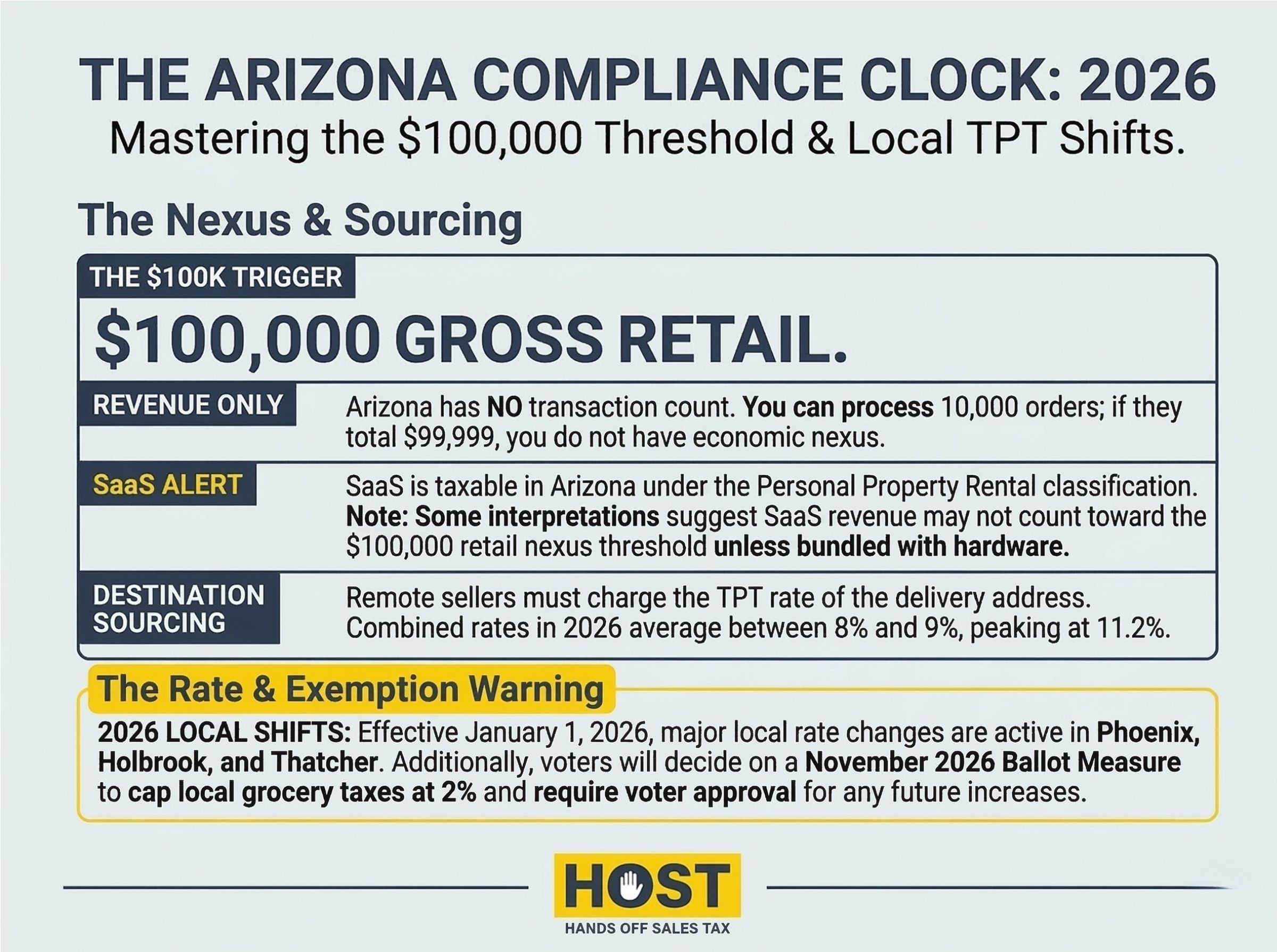
Key details worth knowing:
Transaction count doesn’t matter. Unlike states that combine revenue and transaction thresholds, Arizona only looks at dollar volume. One $100,000 sale or 10,000 $10 sales, same result.
Lookback period flexibility. Arizona evaluates both the current calendar year and prior calendar year. Exceed $100,000 in either period, and you’ve triggered nexus. Hit the threshold in December 2024? You’re obligated throughout 2025 even if current-year sales drop. This is called “trailing nexus.” Once triggered, you must collect for the remainder of the current year and the entire following calendar year.
Gross retail sales count. The calculation includes total sales price before tax. Returns and refunds reduce your total, but exempt sales like wholesale transactions typically don’t count toward the threshold since they’re not retail.
Once you cross $100,000, you must register with the Arizona Department of Revenue and begin collecting Transaction Privilege Tax (TPT), which is Arizona’s version of sales tax, on all subsequent Arizona sales.
How Arizona Calculates the Threshold
Arizona measures economic nexus using gross retail sales delivered to Arizona customers.
Included in calculations:
- Tangible personal property shipped to Arizona addresses
- Digital products and downloads delivered to Arizona customers
- Taxable services provided to Arizona residents
- Sales through online marketplaces (if you’re the seller of record)
Excluded from calculations:
- Wholesale transactions with valid resale certificates
- Sales of exempt items (certain groceries, prescription drugs)
- Sales where a marketplace facilitator collected tax on your behalf
The calendar year lookback creates timing considerations. Hit $100,000 in November 2024, and you’ve triggered nexus for the remainder of 2024 and all of 2025, even if 2025 sales plummet.
Physical nexus operates separately. While economic nexus focuses on sales volume, physical nexus triggers through presence in Arizona. Employees or contractors in the state for more than two days per year, inventory stored in warehouses, or offices and equipment. Physical nexus creates obligations regardless of sales volume and follows different rules than economic nexus.
Marketplace Facilitator Rules
Arizona’s marketplace facilitator law shifts collection responsibility to platforms like Amazon, eBay, Etsy, and Walmart Marketplace. If you sell through these platforms, the marketplace collects and remits TPT on your behalf.
Here’s what matters:
Your marketplace sales don’t create direct collection obligations. Amazon handles TPT on items you sell through their platform.
Marketplace sales still count toward your threshold. Even though Amazon collects the tax, those sales contribute to your $100,000 calculation for determining if you need to collect on non-marketplace sales.
You still register if you have direct sales. Sell through your own Shopify store totaling $100,000+ to Arizona? You must register and collect TPT on those direct sales, regardless of marketplace revenue.
Many e-commerce businesses operate hybrid models. You must track both channels separately for compliance.
Arizona’s Transaction Privilege Tax: Not Quite Sales Tax
Arizona technically doesn’t have “sales tax,” it has Transaction Privilege Tax (TPT), a tax on the privilege of doing business in Arizona. While consumers ultimately pay it, the legal obligation falls on the seller.
State base rate: 5.6% for retail sales.
Local jurisdictions add their own rates. Arizona has over 90 local taxing jurisdictions. Combined state and local TPT rates range from 5.6% to 11.2% depending on customer location. Phoenix sits around 8.6%, while some rural areas remain closer to base rate.
Destination-based sourcing: You collect TPT based on where the customer receives the product, not where you’re located. This means calculating the correct rate for each Arizona address, which is a complexity sales tax software handles automatically.
Monthly, quarterly, or annual filing: Filing frequency depends on your Arizona TPT liability. High-volume sellers file monthly, smaller operations may qualify for quarterly or annual filing.
HOST manages TPT filings across all Arizona jurisdictions, ensuring you file on time with correct calculations for every local rate. No spreadsheet tracking required.
When You Must Register
Once you exceed Arizona’s $100,000 threshold, register promptly. Arizona requires registration and collection beginning on the first day of the first month that starts at least 30 days after you exceed the threshold.
Here’s a concrete example: If you cross the $100,000 threshold on February 15, you must begin collecting TPT on April 1. If you exceed the threshold on March 1, collection starts May 1.
Registration process:
- Create an AZTaxes.gov account with Arizona Department of Revenue
- Apply for a TPT license using the online application ($12 fee)
- Receive your license number (typically 2-3 weeks)
- Begin collecting TPT on all Arizona sales
- File your first return according to assigned frequency
Remote sellers benefit from a municipal license fee waiver. You don’t need separate city business licenses solely due to economic nexus. Registration is straightforward, but navigating Arizona’s multi-jurisdictional system creates complexity, particularly determining which local jurisdictions apply.
HOST handles Arizona registrations as part of our comprehensive nexus analysis and registration service, managing paperwork, follow-up, and ensuring you’re properly licensed across all required jurisdictions.
Consequences of Ignoring Arizona’s Requirements
Failing to register and collect Arizona TPT after triggering economic nexus exposes your business to significant liability:
Back taxes: Arizona can assess uncollected taxes retroactively. Even though you didn’t collect from customers, you’re liable for the tax that should have been collected, and that’s potentially years of sales.
Interest and penalties: Arizona charges interest on unpaid tax from the original due date plus penalties up to 25% of tax due for failure to file returns.
Audits: The Arizona Department of Revenue increasingly targets online sellers who’ve exceeded thresholds but haven’t registered. Audits are time-consuming and expensive even when you eventually prove compliance.
The financial exposure grows quickly. Wait two years to register after crossing the threshold, and you could face six-figure liabilities when Arizona eventually discovers the non-compliance.
Voluntary Disclosure Agreements: Fixing Past Non-Compliance
Discovered you crossed Arizona’s threshold months or years ago without registering? A Voluntary Disclosure Agreement (VDA) can limit your exposure.
Arizona’s VDA program allows businesses to come forward voluntarily, register, and resolve past non-compliance with reduced penalties and a limited lookback period (typically 3-4 years instead of unlimited liability).
VDA benefits:
- Penalty abatement: Arizona typically waives penalties for voluntary disclosure
- Limited lookback: Cap exposure at 3-4 years instead of unlimited retroactive liability
- Anonymity during negotiations: Your identity remains confidential until terms are finalized
- Certainty: Once completed, the VDA resolves your Arizona liability completely
VDAs require careful navigation, and filing incorrectly can void the benefits. HOST manages the entire VDA process, working with Arizona authorities to minimize your liability while bringing you into compliance.
Why Multi-State Compliance Requires Professional Help
Arizona represents just one of 45+ states with economic nexus requirements. Managing multi-state sales tax compliance creates exponential complexity:
Threshold variations: While many states use $100,000, some differ. Alabama requires $250,000. California requires $500,000. Texas uses $500,000.
Different lookback periods: States measure thresholds over current/prior year, trailing 12 months, or other periods.
Product taxability differences: An item taxable in Arizona might be exempt in Massachusetts, requiring product-level tax configuration.
Filing frequency variations: You might file monthly in California, quarterly in Arizona, and annually in Wyoming, each with different deadlines.
Managing this manually is nearly impossible for growing businesses. Sales tax software helps with calculations, but proper configuration requires expertise. Misconfigured software can overtax customers, apply wrong jurisdictions, or miss exemptions. HOST’s free sales tax software review identifies these issues before they cost you.
HOST: Your Partner for Arizona and Multi-State Compliance
At Hands Off Sales Tax, we’ve focused exclusively on sales tax for over 25 years. We help e-commerce businesses manage economic nexus obligations across all states, including Arizona’s specific requirements, so you can focus on growth instead of compliance.
What HOST delivers:
Nexus Analysis: We analyze your sales data across all states to determine precisely where you’ve exceeded thresholds, including Arizona’s $100,000 requirement.
Sales Tax Registration: We handle Arizona TPT license applications and registrations in all required states, managing paperwork and state communications.
Ongoing TPT Filing: We prepare and file your Arizona returns (and all other states) at the correct frequency, calculating rates for every local jurisdiction.
Software Optimization: We review and optimize your TaxJar, Avalara, or other automation tools to ensure accurate Arizona calculations. Get a free review to identify costly errors.
Audit Defense: We handle communications with Arizona tax authorities during audits, organize documentation, and work to minimize liability.
VDA Support: If you’ve crossed Arizona’s threshold without registering, we file Voluntary Disclosure Agreements to limit lookback periods and abate penalties.
We’ve been 100% focused on sales tax since 1999. That’s over 25 years helping businesses navigate compliance. Founded by Mike Espenshade, with parent company TaxMatrix serving North America’s largest companies, we bring enterprise expertise to e-commerce sellers of all sizes.
Ready to Get Arizona Compliant?
If you’re approaching or have exceeded Arizona’s $100,000 threshold, taking action now prevents expensive problems later. Every day of non-compliance after crossing the threshold increases your potential liability.
At HOST, we combine deep technical expertise with 25+ years of specialized experience, transparent communication, and personalized support. When you’re ready to ensure Arizona compliance while staying on top of every other state’s requirements, we’re ready to help.
Contact HOST today to discuss your Arizona sales tax needs or schedule a free consultation. Let us handle the tax so you can focus on sales.
Frequently Asked Questions
What is Arizona’s economic nexus threshold?
Arizona’s economic nexus threshold is $100,000 in gross retail sales to Arizona customers in the current or preceding calendar year. Transaction count doesn’t factor into Arizona’s threshold. Only total dollar volume matters.
Do my Amazon sales count toward Arizona’s threshold?
Yes. Marketplace sales through Amazon, eBay, Etsy, and similar platforms count toward your $100,000 threshold calculation. However, the marketplace collects and remits Arizona TPT on those sales, so you don’t have direct collection obligations for marketplace transactions. Only for direct sales through your own channels.
When must I register after crossing the threshold?
Arizona doesn’t specify an exact registration deadline, but best practice is registering within 30 days of exceeding $100,000 or before making your next Arizona sale. Delayed registration increases your exposure to back taxes and penalties.
What happens if I crossed Arizona’s threshold years ago without registering?
You face potential liability for back taxes, interest, and penalties covering multiple years. A Voluntary Disclosure Agreement can limit your lookback period (typically 3-4 years), abate penalties, and resolve the situation with reduced exposure compared to waiting for Arizona to discover the non-compliance through an audit.
How is Arizona’s Transaction Privilege Tax different from sales tax?
Arizona’s TPT is technically a tax on the seller’s privilege of doing business rather than a traditional sales tax on consumers. While functionally similar (consumers pay it at checkout), the legal distinction means sellers bear the tax liability rather than merely collecting it on behalf of customers.
What Arizona TPT rate should I charge customers?
Arizona’s base state rate is 5.6%, but local jurisdictions add additional amounts ranging from 0% to over 5%, creating combined rates between 5.6% and 11.2% depending on customer location. You must calculate destination-based rates for each customer’s specific address, which sales tax automation software typically handles.
