

Alaska doesn’t play by the usual sales tax rules. No statewide tax. Over 100 independent municipalities making their own decisions, and yet economic nexus absolutely exists here, catching remote sellers off guard.
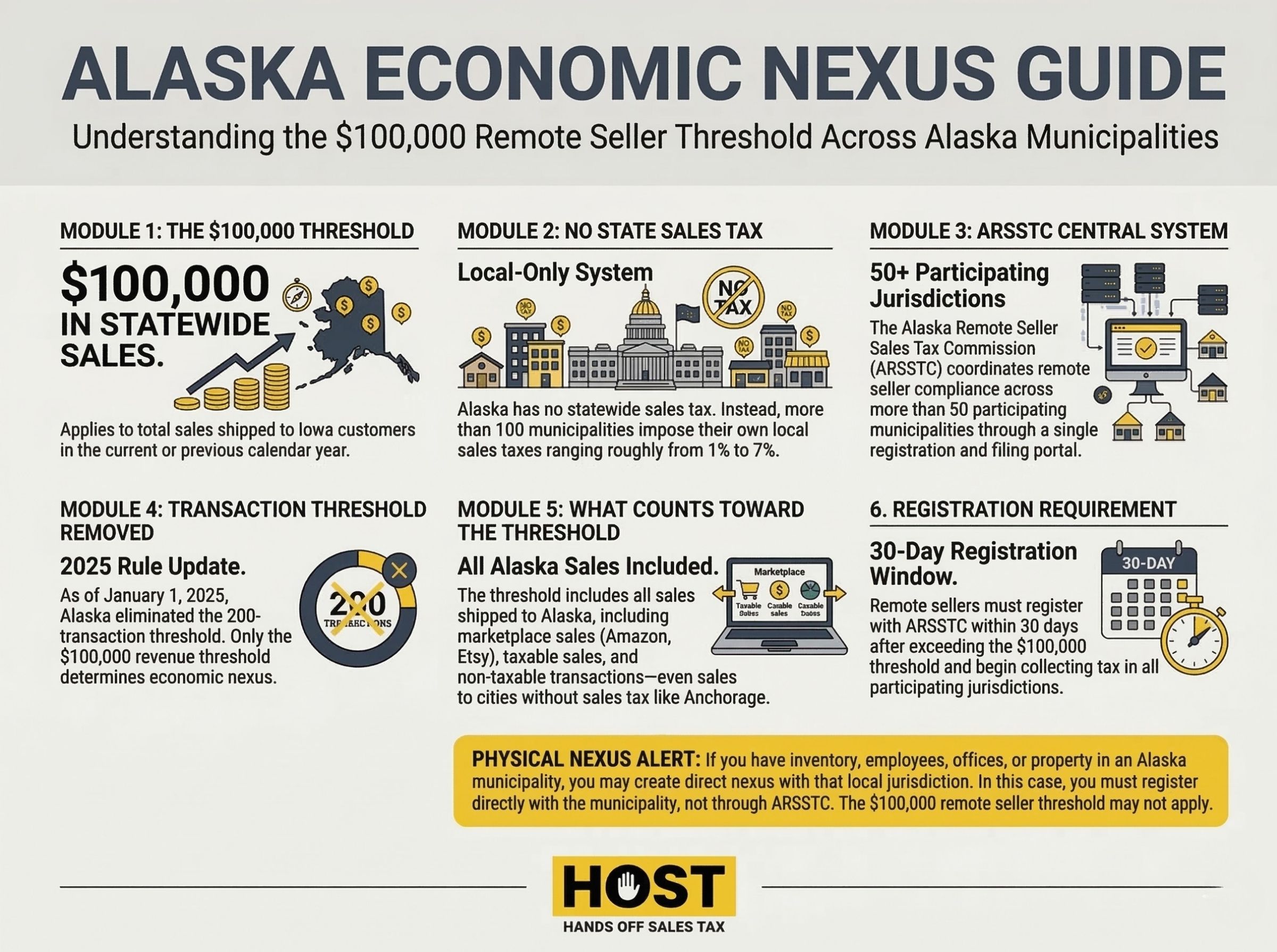
The Alaska Remote Seller Sales Tax Commission (ARSSTC) coordinates economic nexus enforcement across 50+ participating jurisdictions. Cross $100,000 in Alaska sales, and you’re suddenly collecting tax in dozens of municipalities simultaneously.
Hands Off Sales Tax (HOST) has spent 25+ years untangling exactly these scenarios. Alaska’s fragmented system isn’t intuitive, but it’s manageable when you know what triggers obligations and how the pieces fit together.
Why Alaska’s Economic Nexus Feels Different
Most states keep it simple: one threshold, one registration, one tax authority. Alaska fragments everything.
Over 100 municipalities impose local sales taxes ranging from 1% to 7%. Each operates independently. Anchorage charges nothing. Juneau hits 5%. Drive 50 miles and the rules change completely.
After Wayfair, local governments formed the ARSSTC to coordinate remote seller compliance. They established a unified threshold ($100,000 in statewide gross sales) but enforcement happens across 50+ separate jurisdictions.
As of January 1, 2025, Alaska eliminated the old 200-transaction requirement. Now it’s purely revenue-based: exceed $100,000 in Alaska sales (current or previous year), and you’re in.
How the Threshold Actually Works
Alaska calculates the threshold on total statewide sales but triggers obligations in multiple independent jurisdictions at once.
What counts toward $100,000:
- Every sale shipped to Alaska customers, regardless of location
- Sales to Anchorage count toward your threshold even though Anchorage has no sales tax
- Marketplace sales through Amazon, Etsy, and similar platforms
- Both taxable and non-taxable transactions
What happens when you cross it: Register with the ARSSTC within 30 days and start collecting tax in all participating member jurisdictions, currently over 50 municipalities.
The ARSSTC provides one registration portal and filing system for all members. It’s still dozens of jurisdictions with different rates, but at least you’re not registering separately with each one.
Here’s the tricky part: you include all Alaska sales when calculating the threshold, even sales to non-taxing areas like Anchorage. But you only collect tax in ARSSTC member jurisdictions.
Which Jurisdictions Enforce This
Not every Alaska municipality participates. Over 50 have adopted the ARSSTC’s Remote Seller Uniform Code as of 2025.
Key participants include:
- Juneau (5% sales tax)
- Kenai Peninsula Borough (3%)
- Nome, Sitka, Petersburg, Kodiak Island Borough
Notable exception: Anchorage has no sales tax and doesn’t participate.
The complete list lives on the ARSSTC website, and it changes as new jurisdictions join. That’s another wrinkle: municipalities continue adopting the code, expanding your collection obligations without warning.
What Remote Sellers Need to Know
If you’re selling into Alaska remotely, your obligations hinge on sales volume.
You must register and collect when:
- Alaska sales exceed $100,000 (current or previous year), AND
- You make sales into ARSSTC member jurisdictions
You’re off the hook when:
- Alaska sales stay under $100,000 annually, AND
- You have no physical presence in taxing jurisdictions
Physical presence changes everything: Inventory, employees, or offices in Alaska municipalities create separate nexus in those specific locations. You’d register directly with each municipality (not through ARSSTC) and file accordingly.
If you have both physical presence and remote sales, you must separate these revenue streams completely. Physical presence sales go to individual municipalities. Remote sales go through the ARSSTC portal.
Sellers who exclusively use marketplace facilitators (Amazon, Etsy) don’t need to register with ARSSTC but must complete a Marketplace Seller Affidavit with the commission.
HOST’s nexus analysis service examines your complete Alaska footprint: sales volume, inventory locations, employee addresses, to pinpoint exactly where obligations exist.
Alaska’s Other Business Taxes
Alaska charges corporate income tax on C-corporations earning income in-state. It requires more substantial presence than occasional remote sales, so most e-commerce sellers under $100,000 won’t trigger it.
Municipalities may also require business licenses for companies operating within their boundaries, even without sales tax obligations.
HOST focuses on sales tax, but we flag when your Alaska activity might create obligations requiring other specialists.
Registration Through ARSSTC
Once you’ve crossed $100,000, registration is straightforward.
You’ll need:
- Business legal name and structure
- EIN or SSN
- Physical and mailing addresses
- Bank account for tax remittance
- Alaska sales estimates
The process:
- Visit the ARSSTC registration portal
- Complete the online form
- Receive credentials
- Start collecting in all member jurisdictions
No registration fees. No separate applications for each municipality.
Once registered, you collect the applicable local rate for each jurisdiction where customers are located. The ARSSTC portal provides rate tables and filing instructions.
HOST’s registration service handles Alaska’s system end-to-end, ensuring proper setup so you collect correctly from day one.
Filing Requirements and Deadlines
Filing frequency depends on your Alaska tax liability. Monthly, quarterly, or annually. The ARSSTC assigns your schedule upon registration.
Returns typically come due on the last day of the month following the reporting period. Miss that deadline (even with zero tax collected), and penalties start accumulating.
The centralized ARSSTC filing portal distributes collected taxes to member jurisdictions automatically. You file once; the system handles distribution. It beats managing 50+ separate returns, but you still must track sales by jurisdiction to report accurately.
HOST handles filing across all ARSSTC members, ensuring accurate reporting and timely remittance so deadlines never slip.
Best Practices for Alaska Sales
Even under the threshold currently, smart practices prepare you for eventual obligations.
Track Alaska sales separately: Record total Alaska sales and municipality breakdowns quarterly. When you approach $100,000, you’ll have data ready for registration.
Configure software carefully: Tax automation tools must calculate Alaska rates based on customer location within ARSSTC jurisdictions. Misconfiguration either over-collects (annoying customers) or under-collects (creating compliance gaps).
Monitor jurisdiction changes: New municipalities join the ARSSTC regularly. Annual reviews keep you current.
Separate physical and remote sales: Different sales types require different filing processes. Keep them distinct from the start.
HOST’s software review service ensures your configuration handles Alaska correctly. No over-collecting, no missed obligations.
When You Exceed the Threshold
Discovered you’ve crossed $100,000? Immediate action prevents penalties.
Immediate steps:
- Calculate total Alaska sales (current + previous year, including marketplace sales)
- Register with ARSSTC within 30 days
- Configure systems to collect correct local rates
- Address historical liability if you exceeded the threshold previously
- Establish filing procedures for your assigned frequency
If you exceeded the threshold months ago without collecting, you likely owe back taxes. A Voluntary Disclosure Agreement can limit lookback periods and abate penalties, but only if you come forward before they find you.
HOST manages this entire process, from nexus analysis to registration to ongoing compliance, ensuring you handle obligations correctly without pulling resources from your business.
HOST: Your Alaska Sales Tax Partner
Alaska’s system confuses even experienced sellers. The ARSSTC simplifies administration compared to 50+ separate registrations, but knowing when you’ve triggered obligations requires constant monitoring.
What HOST delivers:
- Threshold monitoring: Track Alaska sales to identify when you approach $100,000
- Nexus analysis: Examine sales volume, inventory, employees, and determine exactly where obligations exist
- ARSSTC registration: Handle paperwork and setup
- Multi-jurisdiction filing: File returns through ARSSTC for all members on required schedules
- Policy monitoring: Track new municipalities joining ARSSTC
- Software review: Ensure correct rate calculation for each jurisdiction
We’ve focused exclusively on sales tax since 1999. 25+ years managing fragmented compliance systems so you can focus on growth.
Ready to Confirm Your Alaska Status?
Alaska’s $100,000 threshold creates obligations many remote sellers miss entirely. Understanding where you stand prevents compliance gaps and unexpected ARSSTC assessments.
Whether you’re approaching the threshold, already past it, or managing physical presence, clarity matters.
At HOST, we combine specialized expertise with transparent communication. When you’re ready to confirm your Alaska status and ensure proper compliance across ARSSTC jurisdictions, we’re ready to help.
Contact HOST today or schedule a free consultation. We’ll handle the complexity while you focus on growth.
Get our “10 Sales Tax Mistakes E-Commerce Sellers Make” e-book.
Frequently Asked Questions
What is Alaska’s economic nexus threshold?
Alaska’s threshold is $100,000 in statewide gross sales (current or previous year). The 200-transaction requirement was eliminated January 1, 2025. Exceed this threshold, and you must collect sales tax in 50+ ARSSTC member jurisdictions.
Do I collect Alaska sales tax without physical presence?
Yes, if you exceed $100,000 in total Alaska sales. Register with the ARSSTC and collect tax in all participating municipalities. Each with independent rates and rules.
How is Alaska different from other states?
Alaska has no state sales tax. Local jurisdictions enforce economic nexus through the ARSSTC. You calculate the threshold on total Alaska sales but collect in 50+ independent municipalities simultaneously through one portal.
Which cities require remote sellers to collect?
Over 50 municipalities participate, including Juneau (5%), Kenai Peninsula Borough (3%), Nome, Sitka, and Kodiak Island Borough. Anchorage has no sales tax. See the complete list at arsstc.org.
What if I exceeded the threshold but didn’t collect?
You likely owe back taxes to ARSSTC jurisdictions. HOST can file a Voluntary Disclosure Agreement to limit lookback and potentially abate penalties. Earlier action produces better outcomes.
How do remote sellers register in Alaska?
Register through the ARSSTC portal at arsstc.org! Free, with access to all participating jurisdictions through one system. HOST’s registration service handles the entire process.
