
Iowa economic nexus determines when out-of-state sellers must collect sales tax from Iowa customers. Since the 2018 Wayfair decision, physical presence no longer dictates obligations, your sales volume does.
For e-commerce businesses crossing state lines, understanding Iowa’s threshold, registration requirements, and filing deadlines prevents penalties while keeping operations running smoothly. Whether you hit Iowa’s nexus mark last quarter or you’re planning Midwest expansion, clarity here matters.
That’s where Hands Off Sales Tax (HOST) steps in. We analyze your footprint across all 50 states, handle Iowa paperwork, file returns on schedule, and manage state notices so you stay compliant without losing focus.
What Is Economic Nexus?
Economic nexus means Iowa can require sales tax collection based solely on your economic activity. No physical presence needed. Iowa adopted economic nexus on January 1, 2019, following South Dakota v. Wayfair, the 2018 Supreme Court ruling that transformed online sales tax.
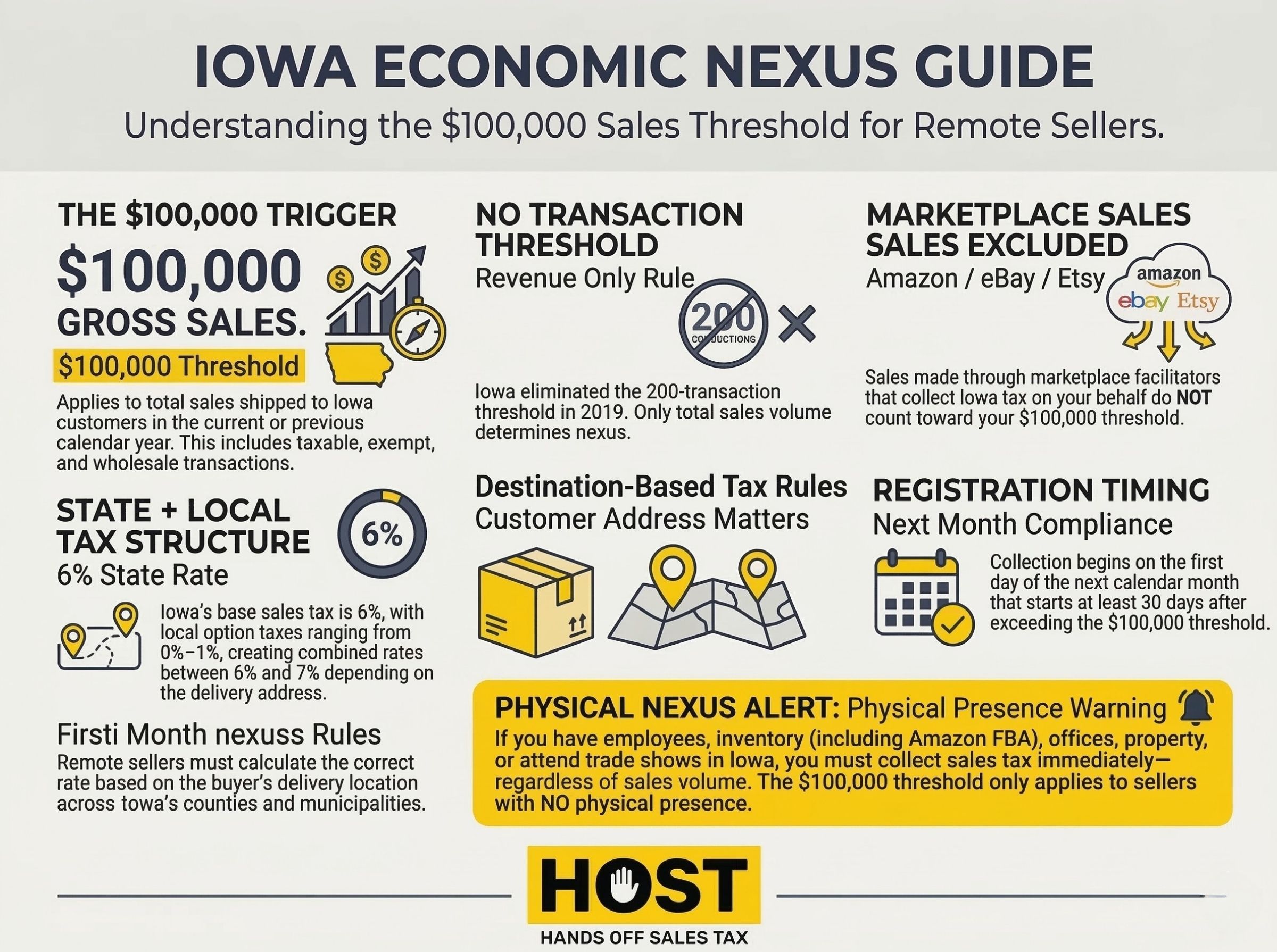
Physical vs. Economic Nexus: Physical nexus still applies if you have Iowa offices, warehouses, inventory (including FBA), employees, or attend trade shows in Iowa. Physical presence triggers collection obligations regardless of sales volume. Economic nexus applies only to remote sellers without physical presence.
An Oregon seller shipping to Iowa customers now faces the same requirements as a Des Moines storefront once thresholds are exceeded.
Iowa Economic Nexus Thresholds
Iowa’s threshold is simple: $100,000 in gross sales during the current or previous calendar year.
Sales Volume Only: Iowa eliminated its 200-transaction threshold on July 1, 2019. Whether you make 50 sales totaling $100,001 or 5,000 sales, you’ve triggered nexus.
Gross Revenue Calculation: The $100,000 includes everything shipped to Iowa, like taxable sales, exempt transactions, wholesale orders, and even sales for resale. Iowa counts total economic activity, not just retail transactions that collect tax.
Rolling Calendar Year: Iowa measures the current or previous calendar year. If you exceeded $100,000 in 2024, you have nexus throughout 2025 even if current sales drop.
Registration Timing: Once you cross the threshold, Iowa expects registration and collection. No grace period exists.
Marketplace Sales Excluded: Sales through Amazon, eBay, or Etsy don’t count toward your threshold. Platforms collect Iowa tax on your behalf, excluding those transactions from your calculation.
Hybrid Seller Scenario: If you sell both through marketplaces and your own website, only direct sales count toward the threshold. However, you must report total Iowa sales on returns and deduct marketplace sales where tax was already collected. Example: $60,000 in marketplace sales + $50,000 direct sales = $110,000 total, but only $50,000 counts for nexus (no registration required).
Example: A California furniture retailer ships $80,000 through their website in 2024, plus $50,000 via Amazon FBA. Only the $80,000 counts. The retailer hasn’t triggered Iowa nexus.
When Does Iowa Economic Nexus Begin?
Nexus begins the moment you exceed $100,000 during any calendar year. Unlike states offering prospective enforcement, Iowa expects immediate compliance.
Collection obligations start “on the first day of the next calendar month that starts at least 30 days from the day the remote seller first exceeded the threshold.” Translation: If you crossed $100,000 on September 15th, you must register and begin collecting by November 1st (first day of the next month starting at least 30 days after Sept 15).
Retroactive Concerns: Iowa generally doesn’t pursue aggressive enforcement for sellers who register shortly after crossing thresholds. The state prioritizes bringing sellers into compliance going forward rather than penalizing brief gaps.
Significant delays create risk. If you exceeded Iowa’s threshold 18 months ago without registering, you face potential back taxes, penalties, and interest. The longer the gap, the greater the exposure.
Monitoring Multiple States: Most e-commerce businesses don’t just watch Iowa. With 45+ states imposing economic nexus, tracking when you’ve crossed each state’s unique thresholds demands ongoing vigilance.
HOST’s nexus analysis service examines your sales data across all states, identifies triggered obligations, and prioritizes registration based on exposure.
How to Register for Iowa Sales Tax
Once you’ve established nexus, registration with the Iowa Department of Revenue becomes mandatory.
Visit the Iowa Department of Revenue’s online system (GovConnectIowa). Create an account and select “Sales/Use Tax Permit.” Provide business details: legal name, EIN or SSN, structure, physical address, and anticipated sales volume.
Iowa assigns your permit immediately upon approval, typically within 1-2 business days.
Information Required:
- Federal EIN or Social Security Number
- Legal business name and DBA if applicable
- Business and mailing addresses
- Ownership structure (LLC, Corporation, Sole Proprietor)
- Start date for Iowa collection
- Estimated monthly Iowa sales volume
- NAICS code
Common Mistake: Remote sellers often list their home state address without clarifying they’re out-of-state. Be clear during registration that you’re registering due to economic nexus, not physical presence.
HOST handles Iowa registration as part of our services. We complete paperwork, follow up with the state, and ensure your permit activates before collection begins.
Iowa Sales Tax Collection Requirements
After registration, collect Iowa sales tax from all Iowa customers on taxable sales. Iowa’s state rate is 6%, but local taxes add complexity.
State and Local Rates: Iowa imposes 6% state tax. Most jurisdictions levy local option taxes from 0% to 1%, creating combined rates between 6% and 7%.
Calculating correct rates requires destination-based sourcing. You must charge the rate at the customer’s delivery address, not your business location. With 99 Iowa counties and hundreds of municipalities imposing local taxes, address-level accuracy matters.
Exempt Sales: Not every transaction is taxable. Iowa exempts prescription drugs, most groceries, manufacturing machinery, and sales to tax-exempt organizations holding valid certificates.
For exempt sales, maintain documentation. Collect a completed Iowa Sales Tax Exemption Certificate before the transaction. Without proper documentation, you’re liable for uncollected tax during audits.
HOST offers a Free Sales Tax Software Review to audit your automation setup. We identify configuration errors causing incorrect Iowa calculations, exempt item mishandling, or wholesale transaction taxation.
Iowa Sales Tax Filing and Remittance
Iowa assigns filing frequencies based on expected monthly tax liability: monthly, quarterly, or annually.
Filing Frequencies:
- Monthly: Businesses collecting over $200 monthly
- Quarterly: Businesses collecting $50-$200 monthly
- Annually: Businesses collecting under $50 monthly
Iowa communicates your frequency during registration. File returns even during zero-sales periods. Failure to file causes penalties regardless of tax owed.
Filing Deadlines: Returns are due the last day of the month following the reporting period. January 2025 sales are due February 28, 2025.
Penalties for Non-Compliance: Late filing incurs 10% penalty on tax due (minimum $5). Late payment adds 5%. Interest accrues on all unpaid balances.
Repeated late filings can result in permit revocation or referral to collections. Iowa actively pursues non-compliant remote sellers.
HOST manages Iowa filing completely. We prepare returns using your sales data, file on deadline, remit payment, and handle state communications.
Managing Iowa Sales Tax Compliance
Staying compliant in Iowa while managing 44 other states creates operational burden. Between monitoring thresholds, calculating rates, filing returns, and responding to notices, sales tax consumes time that generates zero revenue.
Notice Management: Iowa occasionally sends notices requesting information, questioning discrepancies, or proposing assessments. These require prompt, accurate responses to avoid escalating penalties.
HOST’s notice management service interprets Iowa notices, determines appropriate responses, and handles communications on your behalf.
Audit Defense: Iowa conducts sales tax audits on remote sellers, particularly those with substantial state volume. Audits examine whether you’ve collected correct amounts, properly documented exempt sales, and filed complete returns.
HOST provides audit defense services. We organize documentation, communicate with Iowa auditors, and advocate for minimal liability.
Voluntary Disclosure Agreements: If you discover past Iowa nexus you never addressed, Voluntary Disclosure Agreements (VDAs) can limit lookback periods and abate penalties. Iowa typically offers 3-year lookback through VDA versus 4+ years in standard audits, with penalty waivers for voluntary compliance.
HOST facilitates VDAs when appropriate, minimizing back tax exposure and bringing you into compliance without catastrophic assessments.
Why Choose HOST for Iowa Sales Tax?
Managing Iowa nexus represents one piece of a complex multi-state puzzle. E-commerce businesses selling nationwide face obligations in dozens of jurisdictions simultaneously, each with unique thresholds, processes, rates, and filing requirements.
DIY compliance or relying solely on software creates gaps. Software calculates rates but doesn’t register you, file returns, or handle audits. Misconfigured software treats non-taxable items as taxable or double-taxes due to setup errors. Software doesn’t respond to Iowa notices or represent you during examinations.
What HOST Delivers:
- Nexus Analysis: We examine your complete sales footprint, identifying exactly where you’ve triggered obligations including Iowa
- Sales Tax Registration: We handle Iowa paperwork, follow up with the state, and ensure your permit activates before collection begins
- Rate Calculation & Filing: We prepare and file Iowa returns on schedule (monthly, quarterly, or annually) ensuring accuracy and on-time remittance
- Notice Management: We interpret Iowa communications, determine responses, and handle correspondence so you avoid penalties
- Audit Defense: We organize documentation, communicate with auditors, and work to minimize liability during examinations
- Software Optimization: We review and configure your automation tools to calculate Iowa rates correctly and avoid costly errors
We’ve focused exclusively on sales tax since 1999. Over 25 years helping businesses navigate compliance. Founded by Mike Espenshade, with parent company TaxMatrix serving North America’s largest enterprises, we bring institutional expertise to e-commerce sellers of all sizes.
Get Iowa Sales Tax Off Your Plate
Iowa economic nexus creates real obligations the moment you exceed $100,000. Registration, rate calculation, filing, and notices all demand attention, and that’s time that could be spent growing your business.
Whether you just crossed Iowa’s threshold, you’re expanding into Midwestern markets, or you’re overwhelmed managing compliance across multiple states, professional help eliminates guesswork and prevents expensive mistakes.
At HOST, we combine deep technical knowledge with transparent communication and personalized support. When you’re ready to ensure Iowa compliance without operational burden, we’re ready to help.
Contact HOST today to discuss your Iowa sales tax needs or schedule a free consultation. Let us handle the tax so you can focus on sales.
Want to learn more? Get our “10 Sales Tax Mistakes E-Commerce Sellers Make” e-book to identify common pitfalls before they become audit problems.
Frequently Asked Questions
What is Iowa’s economic nexus threshold?
Iowa’s threshold is $100,000 in gross sales during the current or previous calendar year. No transaction count exists. Only revenue matters. Once you exceed this, register and collect Iowa sales tax.
Do marketplace sales count toward Iowa economic nexus?
No. Sales through Amazon, eBay, Walmart, or Etsy don’t count toward your threshold. These platforms collect and remit Iowa tax on your behalf, excluding those transactions from your $100,000 calculation.
When do I need to register after crossing Iowa’s threshold?
Iowa expects registration promptly after crossing $100,000. Unlike states offering prospective enforcement, Iowa requires immediate compliance once you’ve established nexus. Register as soon as possible to minimize exposure.
What happens if I exceeded Iowa’s threshold months ago but never registered?
You face potential back taxes, penalties, and interest for the period between crossing the threshold and registration. The longer the gap, the greater the exposure. A Voluntary Disclosure Agreement can limit lookback periods and abate penalties if you self-report.
How often do I need to file Iowa sales tax returns?
Iowa assigns filing frequencies based on expected monthly tax liability: monthly (over $200/month), quarterly ($50-$200/month), or annually (under $50/month). Most remote sellers receive monthly or quarterly assignments initially.
Can sales tax software handle Iowa compliance completely?
No. Software calculates rates at checkout but doesn’t register you, file returns, respond to notices, or provide audit defense. Misconfigured software also causes errors—overtaxing exempt items, applying incorrect rates, or double-taxing. Professional review ensures accuracy and complete compliance.
