
Understanding North Carolina sales tax nexus determines whether your business must collect and remit sales tax in the state. For e-commerce sellers shipping to North Carolina customers, nexus rules create specific obligations that trigger the moment you cross certain thresholds.
Missing nexus obligations leads to back taxes, penalties, and audit exposure. Hands Off Sales Tax (HOST) specializes in nexus analysis across all states, including North Carolina. We determine exactly where you have obligations, handle registrations, and manage ongoing filings so you can focus on growth.
What Is Sales Tax Nexus?
Sales tax nexus is the connection between your business and a state that creates a legal obligation to collect and remit sales tax. Without it, a state cannot require you to collect its sales tax.
Two primary types exist: physical nexus and economic nexus.
Physical nexus occurs when your business maintains a tangible presence in a state: offices, warehouses, employees, inventory, or even temporary presence like attending trade shows.
Economic nexus, established by the 2018 South Dakota v. Wayfair Supreme Court decision, allows states to require collection based solely on sales volume. No physical presence needed.
For remote sellers, economic nexus represents the most common trigger. Once your North Carolina sales exceed the state’s threshold, you must register, collect, and remit sales tax regardless of whether you’ve ever set foot in the state.
North Carolina Economic Nexus Thresholds
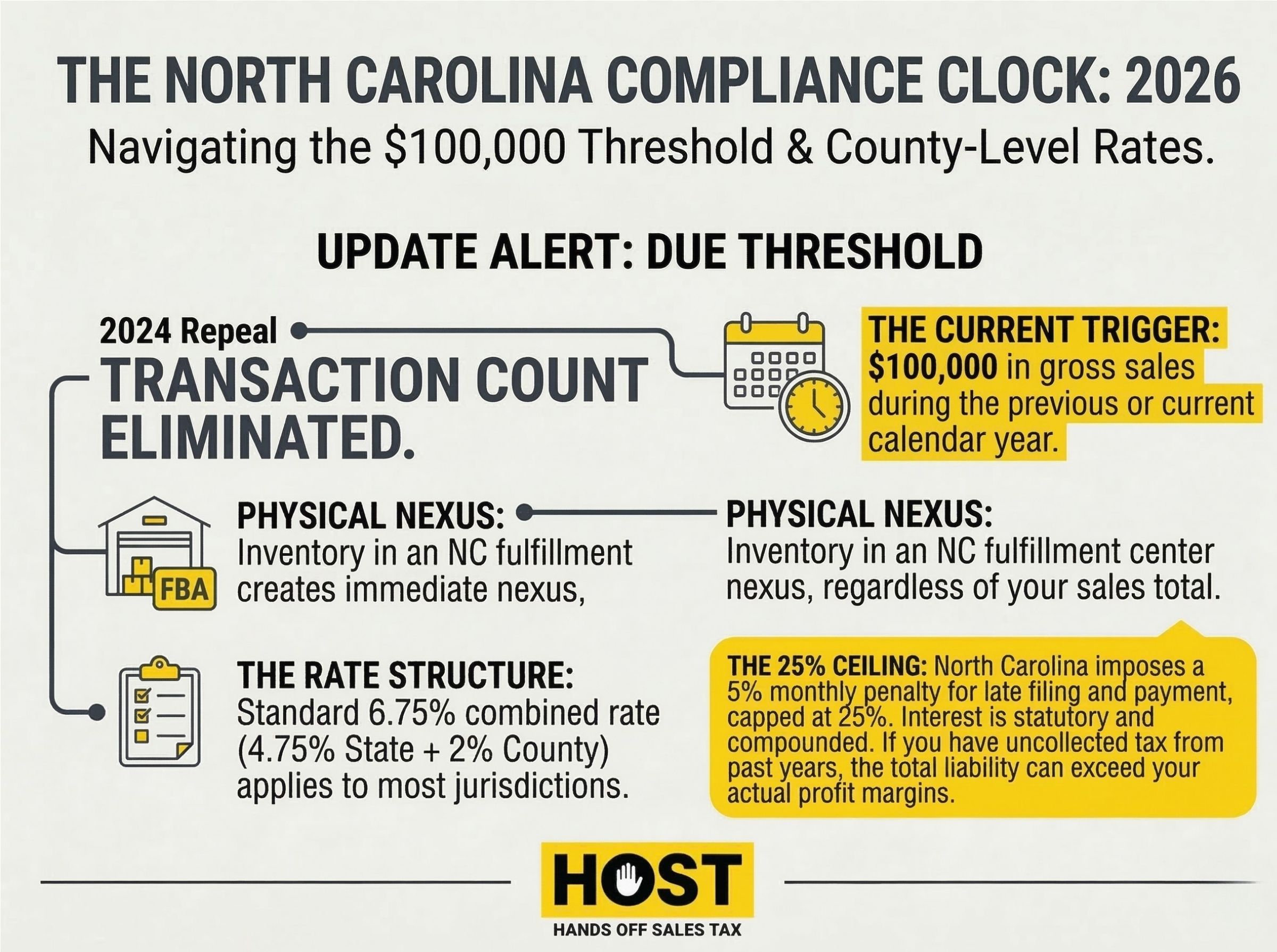
North Carolina sales tax nexus for remote sellers triggers at $100,000 in gross sales during the previous or current calendar year.
The threshold operates on an annual basis, evaluated both for the current calendar year and the immediately preceding year. If you exceeded $100,000 in North Carolina sales during 2024, you have nexus in 2025 even if your current year sales haven’t yet reached that level.
North Carolina uses gross sales to calculate the threshold. Total revenue from sales shipped to North Carolina customers. This includes taxable sales, exempt sales, resale transactions, and wholesale sales. Even if you sell exclusively B2B with resale certificates, those transactions count toward the $100,000 threshold.
Important: North Carolina eliminated its 200-transaction threshold effective July 1, 2024. Nexus determination is now based solely on the $100,000 gross sales threshold.
Once you meet the threshold, you have nexus immediately. North Carolina expects registration and collection to begin promptly.
Could You Cancel Your Registration?
If you were registered solely because you exceeded 200 transactions (but not $100,000 in sales), you may now be eligible to cancel your North Carolina registration. To qualify, you must not have exceeded $100,000 in gross sales during 2023 or 2024 through your cancellation date, and you cannot have any other legal requirement (like physical presence) to collect North Carolina sales tax.
However, consider carefully before canceling. You must continue collecting and filing until you officially cancel through Form NC-BN. And if your sales grow beyond $100,000 later, you’ll need to re-register and resume collection.
Physical Nexus in North Carolina
Physical presence in North Carolina creates nexus regardless of sales volume. Even minimal physical connection triggers collection obligations.
Common physical nexus triggers:
- Maintaining an office, warehouse, or distribution center
- Storing inventory in North Carolina (including third-party fulfillment centers)
- Employing sales representatives, contractors, or remote workers residing in the state
- Using independent contractors or sales agents who solicit sales
- Owning or leasing property
- Attending trade shows or promotional events
Amazon FBA sellers face particular exposure. If Amazon stores your inventory in a North Carolina fulfillment center, you have physical nexus. Amazon determines where inventory is stored, not you. Your inventory can create nexus without your knowledge.
Third-party logistics providers create the same issue. Inventory stored in North Carolina warehouses triggers physical nexus, requiring registration and collection regardless of sales volume.
Temporary physical presence matters too. Attending a three-day trade show in Charlotte creates nexus for that period and potentially beyond, depending on frequency and duration.
Marketplace Facilitator Laws and North Carolina Nexus
North Carolina’s marketplace facilitator law, effective February 1, 2020, requires platforms like Amazon, eBay, Etsy, and Walmart Marketplace to collect and remit sales tax on behalf of third-party sellers.
This shifts the collection burden from individual sellers to the platform. If you sell exclusively through marketplace facilitators, the platform handles North Carolina sales tax collection, and you typically don’t need to register separately.
However, this protection only applies to sales made through the marketplace. If you also sell through your own website or other channels, you must evaluate nexus independently for those sales.
Many sellers operate hybrid models: Amazon FBA for some products, Shopify for others. The Amazon sales are covered by Amazon’s marketplace facilitator collection. The Shopify sales require your own nexus analysis and potentially separate registration.
HOST’s nexus analysis service evaluates your complete sales footprint across all channels, identifying where you have independent collection obligations versus marketplace facilitator coverage.
How to Register for North Carolina Sales Tax
Once you determine you have North Carolina sales tax nexus, registration must occur before you begin collecting.
Step 1: Gather Required Information
- Federal Employer Identification Number (FEIN) or Social Security Number
- Business legal name and trade names
- Business structure (LLC, corporation, sole proprietorship)
- Physical and mailing addresses
- North Carolina business start date
- NAICS code describing your business activity
- Estimated monthly sales in North Carolina
Step 2: Complete Online Registration Visit the NC Department of Revenue website and create an account. Complete Form NC-BR (Business Registration Application). The application asks about various tax types, like select sales and use tax.
Step 3: Receive Your Certificate Once approved, North Carolina issues a Certificate of Registration with your sales tax account number. This typically takes 7-10 business days.
Step 4: Configure Collection Systems Update your e-commerce platform with your North Carolina registration details and begin collecting at the state rate of 4.75% plus applicable local rates.
North Carolina has no registration fee. Missing registration deadlines after establishing nexus creates exposure, so the state can assess back taxes from the date nexus was established, plus penalties and interest.
HOST handles North Carolina sales tax registration as part of our comprehensive services, managing the paperwork and ensuring you’re set up correctly from day one.
North Carolina Sales Tax Rates and Calculations
North Carolina imposes a state sales tax rate of 4.75% on most retail sales. Counties levy local sales taxes ranging from 2% to 2.75%, creating combined rates between 6.75% and 7.5% depending on the buyer’s location.
The most common combined rate is 6.75% (state 4.75% + local 2%). Higher rates exist in specific counties:
- Mecklenburg County (Charlotte): 7.25%
- Durham County: 7.5%
- Orange County (Chapel Hill): 7.5%
North Carolina uses destination-based sourcing for remote sales. You must charge the rate applicable at the customer’s location, not your business location. This means calculating the correct combined rate for every North Carolina ZIP code you ship to.
With 100 counties each potentially having different local rates, manual calculation becomes impractical. Sales tax automation software like TaxJar or Avalara calculates rates automatically based on customer address.
However, software must be configured correctly. Common configuration errors include taxing exempt items like groceries, applying incorrect local rates, double-taxing when multiple systems overlap, or treating wholesale transactions as retail.
HOST offers a Free Sales Tax Software Review to audit your configuration and identify costly mistakes before they impact compliance or customer relationships.
What Products Are Taxable in North Carolina?
North Carolina taxes most tangible personal property and certain digital products.
Taxable items include:
- Clothing and electronics
- Furniture and home goods
- Digital products (software, music, e-books)
- Prepared food and restaurant meals
Exempt items include:
- Unprepared food (groceries)
- Prescription medications
- Prosthetic devices and durable medical equipment
- Certain agricultural and manufacturing equipment
Service taxability varies significantly. Most professional services (legal, accounting, consulting) remain exempt. Services involving tangible personal property, like installation or repair, are often taxable.
Product taxability questions arise constantly. HOST’s consultation services provide clarity on specific scenarios, ensuring you collect correctly without overcharging customers on exempt items.
Filing Frequencies and Deadlines
North Carolina assigns filing frequencies based on your average monthly tax liability:
Monthly filers: Businesses remitting more than $100 in average monthly sales tax file monthly by the 20th of the following month.
Quarterly filers: Businesses remitting $20 to $100 in average monthly tax file quarterly.
Semi-annual filers: Businesses remitting less than $20 in average monthly tax file every six months.
Most e-commerce sellers exceeding the $100,000 nexus threshold will file monthly. North Carolina does not offer extensions, the deadline is firm.
Late filing triggers penalties of 5% of tax due for the first month, plus an additional 5% for each additional month, up to 25% maximum. Interest accrues at the statutory rate.
Missing deadlines, incorrect calculations, or failing to remit collected tax creates audit risk. North Carolina’s Department of Revenue has become increasingly aggressive pursuing remote sellers post-Wayfair.
HOST manages filing across all required frequencies and jurisdictions, including North Carolina’s local and special district returns, ensuring deadlines are met and calculations are correct.
How HOST Simplifies North Carolina Sales Tax Compliance
North Carolina sales tax nexus creates multiple compliance touchpoints: threshold monitoring, registration, rate calculation, filing, and notice management.
What HOST Delivers:
Nexus Analysis: We analyze your complete sales footprint to determine exactly when you established North Carolina nexus.
Sales Tax Registration: We handle the North Carolina registration process, completing Form NC-BR and managing communications with the Department of Revenue.
Automated Filing: We prepare and file your North Carolina returns on schedule: monthly, quarterly, or semi-annually, including all required local returns.
Software Review and Optimization: We audit your TaxJar, Avalara, or other automation tools to ensure correct rate calculation for all 100 North Carolina counties.
Notice Management: We interpret and respond to North Carolina Department of Revenue notices, protecting you from penalties.
Audit Defense: If North Carolina audits your business, we organize documentation, communicate with auditors, and defend your position.
Voluntary Disclosure Agreements: If you discover past nexus obligations, we file VDAs with North Carolina to limit lookback periods and abate penalties.
We’ve been 100% focused on sales tax since 1999. That’s over 25 years helping businesses navigate compliance across all states, including North Carolina’s unique requirements. Co-founded by Mike Espenshade, with parent company TaxMatrix serving North America’s largest companies, we bring enterprise expertise to e-commerce sellers of all sizes.
Ready to Get North Carolina Sales Tax Under Control?
North Carolina sales tax nexus doesn’t have to be complicated. Whether you’re crossing economic nexus thresholds for the first time, managing FBA inventory in the state, or dealing with registration backlogs, the right partner eliminates guesswork and prevents costly mistakes.
Every hour spent researching North Carolina regulations is an hour not spent growing your business. At HOST, we handle the complexity so you can focus on sales.
When you’re ready to ensure compliant collection and take sales tax off your plate entirely, we’re ready to help. Contact HOST today to discuss your North Carolina nexus situation or schedule a free consultation.
You handle the sales, we handle the tax.
Want to learn more? Get our “10 Sales Tax Mistakes E-Commerce Sellers Make” e-book.
Frequently Asked Questions
What is the North Carolina sales tax nexus threshold for remote sellers?
North Carolina sales tax nexus triggers at $100,000 in gross sales during the previous or current calendar year. North Carolina eliminated its 200-transaction threshold on July 1, 2024, so nexus is now based solely on the sales amount.
Do I need to register in North Carolina if I only sell through Amazon FBA?
If Amazon stores your inventory in North Carolina fulfillment centers, you have physical nexus and must register regardless of sales volume. However, Amazon collects sales tax as a marketplace facilitator, potentially eliminating your separate collection obligation for FBA sales. Independent website sales require separate nexus evaluation.
How long does North Carolina sales tax registration take?
North Carolina typically processes sales tax registrations within 7-10 business days after submitting the online NC-BR form.
What happens if I discover I should have been collecting North Carolina sales tax for the past two years?
North Carolina can assess back taxes from the date nexus was established, plus penalties and interest. Filing a Voluntary Disclosure Agreement (VDA) can limit the lookback period and abate penalties. HOST specializes in VDAs to minimize liability for past obligations.
Does North Carolina charge sales tax on shipping fees?
North Carolina generally does not tax separately stated shipping charges if the sale itself is taxable and the shipping charge is reasonable. If shipping is included in the product price, the entire amount is taxable.
How do I determine the correct local tax rate for each North Carolina customer?
North Carolina has 100 counties with varying local rates. Sales tax automation software calculates the correct combined rate based on the customer’s address. Manual rate calculation is impractical for businesses with significant North Carolina sales volume.
