
Alabama sales tax nexus determines whether your business must collect and remit sales tax to the state. Cross Alabama’s $250,000 economic nexus threshold, and you’re facing registration deadlines, filing obligations, and potential audits that can devastate cash flow if handled incorrectly.
Since the 2018 Wayfair decision, states gained authority to require out-of-state sellers to collect sales tax based purely on economic activity. Alabama implemented its economic nexus rule effective October 1, 2018, joining 45+ states with similar requirements.
Understanding nexus isn’t optional anymore. Hands Off Sales Tax (HOST) analyzes your sales footprint, determines exactly where you’ve triggered nexus, handles Alabama registrations, and manages ongoing compliance so you can focus on growth instead of tracking thresholds.
What Is Sales Tax Nexus in Alabama?
Nexus is the connection between your business and Alabama that creates a sales tax obligation. Think of it as the trigger point. Once you cross it, Alabama can legally require you to collect sales tax from customers and remit it to the state.
Alabama recognizes two types: physical and economic. Both create the same obligation, but they’re triggered differently.
Physical Nexus in Alabama
Physical nexus exists when your business maintains a tangible presence in Alabama:
- Office, warehouse, or retail location: Any owned or leased space where business operations occur
- Employees working in Alabama: Remote employees, sales reps, or contractors performing services in-state
- Inventory stored in Alabama: Including inventory in third-party fulfillment centers like Amazon FBA
- Temporary presence: Attending trade shows, pop-up shops, or conducting business activities exceeding two days annually
Alabama’s physical nexus rules are broad. A single employee working remotely from Birmingham or inventory sitting in a Mobile warehouse creates nexus. Many e-commerce sellers discover physical nexus exists through FBA without realizing it. Amazon stores inventory across multiple states, and Alabama is a common distribution hub.
Economic Nexus in Alabama
Economic nexus triggers when your sales volume into Alabama exceeds $250,000 in retail sales during the current or previous calendar year. Alabama uses a single metric (gross revenue) with no transaction count requirement.
When calculating your threshold, include all retail sales (taxable and non-taxable) made directly by your business. Exclude wholesale sales with valid resale certificates and sales made through marketplace facilitators that collect tax on your behalf. These exclusions prevent double-counting sales where tax obligation already exists elsewhere.
Once you exceed the threshold, your collection obligation begins January 1 following the year you crossed it. If you hit $250,000 in August 2024, you start collecting January 1, 2025. This delayed start gives you time to register and configure systems, but don’t wait. Register well before January to avoid last-minute complications.
Economic nexus revolutionized sales tax compliance for remote sellers. Before Wayfair, only physical presence mattered. Now, strong sales volume alone creates obligation. For growing e-commerce businesses, crossing thresholds in multiple states simultaneously is common, making nexus analysis essential.
HOST’s nexus analysis service examines your complete sales data across all states, identifying exactly where you’ve triggered economic or physical nexus and prioritizing which registrations need immediate attention.
Alabama’s Simplified Sellers Use Tax (SSUT) Program
For remote sellers without physical presence in Alabama, the state offers a compliance shortcut: the Simplified Sellers Use Tax program. Instead of tracking hundreds of local rates across Alabama’s complex jurisdictional landscape, SSUT participants collect a flat 8% rate on all Alabama sales.
This eliminates destination-based complexity. No address-level validation. No county-versus-city rate debates. Just 8% on everything shipped to Alabama, plus a 2% vendor discount if you file and pay timely.
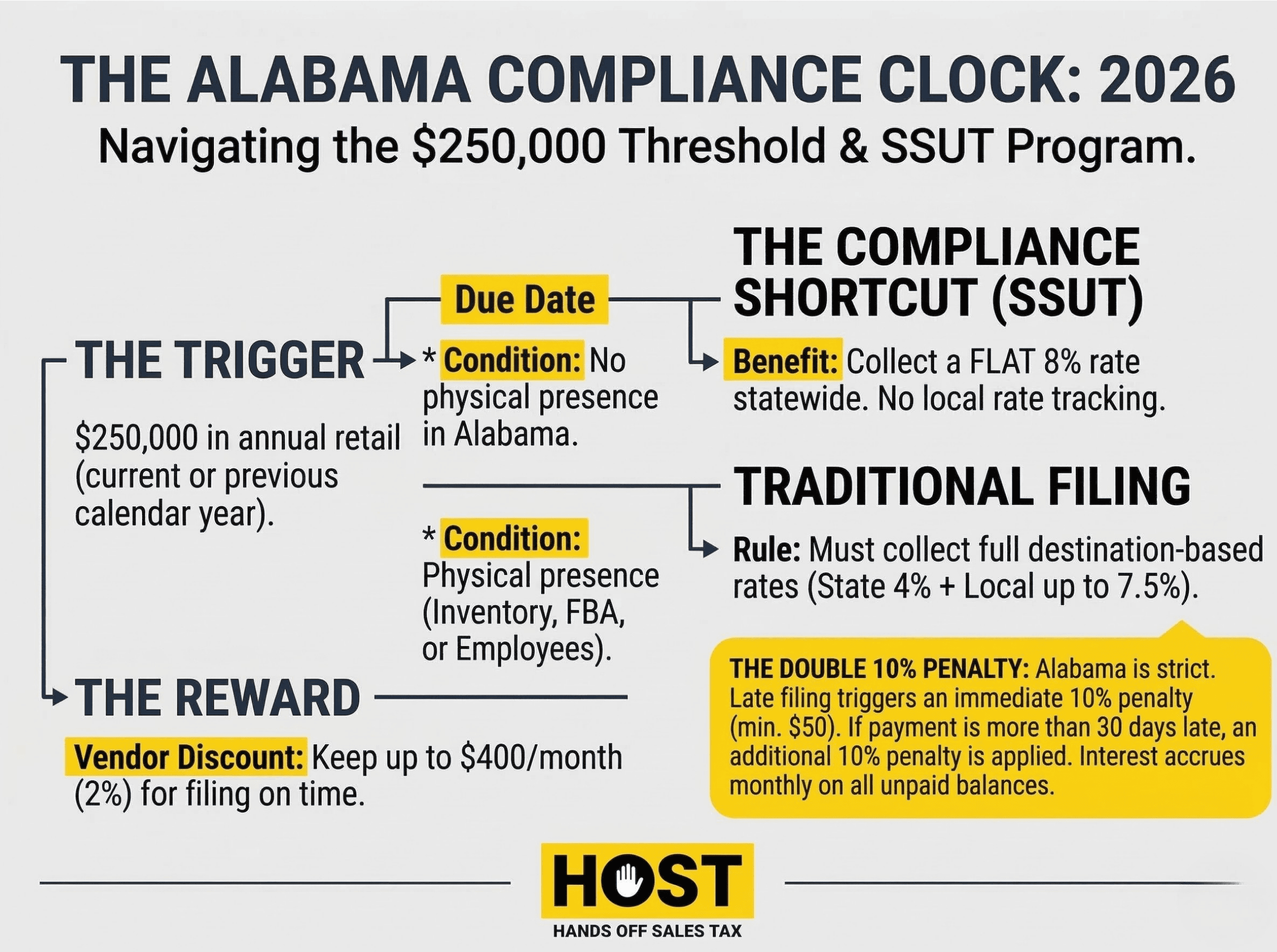
Who qualifies: Remote sellers meeting the $250,000 threshold with no physical presence in Alabama. If you have offices, employees, or inventory in-state, you don’t qualify for SSUT. You must collect actual destination-based rates.
Alabama Sales Tax Rates and Structure
Alabama’s sales tax structure combines state, county, and municipal rates. The state base rate is 4%. Counties add between 1% and 5%, and municipalities can add up to 5.5%. Combined rates range from 5% to over 11% depending on customer location.
Alabama is destination-based. You charge tax based on where the customer receives the product, not where your business is located. For businesses with physical presence, every sale requires determining the customer’s location and applying that jurisdiction’s combined rate, often requiring rate lookup for every transaction since ZIP codes span multiple jurisdictions.
HOST offers a free sales tax software review to audit your TaxJar, Avalara, or other automation tool configuration, ensuring you’re calculating rates correctly and avoiding costly errors.
How to Register for Alabama Sales Tax
Once you’ve determined nexus exists, registration is mandatory before collecting sales tax. Alabama’s registration process is straightforward but requires attention to detail.
Registration Steps
- Obtain a Federal EIN: Alabama requires a Federal Employer Identification Number. Apply through the IRS website, it’s free and typically issued immediately.
- Choose your registration type: Remote sellers without physical presence should register for the Simplified Sellers Use Tax (SSUT) program. Businesses with physical presence register for traditional sales tax permits.
- Register via My Alabama Taxes (MAT): Alabama’s online portal handles both registration types. Create an account, then complete the appropriate application.
- Complete the form: Provide business information including legal name, trade names, business structure, contact information, NAICS code, and estimated monthly sales volume.
- Specify nexus type: Indicate whether you have physical presence, economic nexus, or both.
- Receive your license: Alabama issues a Certificate of Compliance electronically. You’ll also receive your sales tax account number for use on returns.
Registration is free, with no application fees. Processing typically takes 2-4 weeks, though delays can occur during peak periods.
HOST handles Alabama registrations completely, managing the paperwork, following up on delays, and ensuring your account is established correctly the first time.
Alabama Sales Tax Filing Requirements
After registration, ongoing filing obligations begin. Alabama assigns filing frequency based on your tax liability: monthly, quarterly, semi-annual, or annual.
Filing Frequencies
- Monthly filers: Default filing frequency for most businesses, due by the 20th of the following month
- Quarterly filers: Available when total state sales tax liability is less than $2,400 for the preceding calendar year, due by the 20th of the month following quarter end
- Semi-annual filers: Available when liability is less than $1,200 for the preceding calendar year, due July 20 and January 20
- Annual filers: Available when liability is less than $600 for the preceding calendar year, due January 20
To change filing frequency, you must submit a written request to Alabama Department of Revenue by February 20 of each year. Alabama may also adjust your frequency based on actual collections.
What to Report
Alabama sales tax returns require reporting gross sales to Alabama customers, exempt sales with justification, taxable sales by location, tax collected by jurisdiction, and any deductions or credits. Alabama uses separate line items for state and local taxes, requiring allocation of collections between state, county, and municipal portions.
Timely filing discount: Alabama rewards compliance with a vendor discount: 5% on the first $100 of tax collected, then 2% on amounts over $100, capped at $400 monthly. File and pay on time to keep this discount. For a business remitting $5,000 monthly, that’s a $99 discount each month, or nearly $1,200 annually. It adds up.
Penalties for Late Filing
Alabama imposes penalties for late filing and payment:
- Late filing penalty: 10% of tax due, minimum $50
- Late payment penalty: Additional 10% if payment is late beyond 30 days
- Interest: Accrues monthly on unpaid balances
These penalties accumulate quickly. A $1,000 tax liability filed 45 days late incurs $200 in penalties plus interest, which is a 20%+ cost for missing deadlines.
HOST manages Alabama sales tax filings completely, ensuring returns are filed on time, every time, across all assigned frequencies. We handle the calculations, jurisdictional allocations, and remittances so you never face late penalties.
Special Considerations for Alabama Remote Sellers
Marketplace Facilitator Law
Alabama’s marketplace facilitator law, effective January 1, 2019, requires platforms like Amazon, eBay, and Etsy to collect and remit sales tax on behalf of third-party sellers. If you sell exclusively through facilitator marketplaces, those platforms handle Alabama collection and remittance for you.
However, if you also sell through your own website, you’re responsible for those direct sales separately. Many sellers mistakenly believe marketplace facilitator coverage extends to all sales. It doesn’t.
Exemption Certificates
Alabama allows sales tax exemptions for specific transactions: wholesale purchases, manufacturing equipment, agricultural products, and sales to nonprofits or government entities. Accepting exemption certificates requires verification and record retention for at least three years.
What Happens If You Don’t Comply?
Ignoring Alabama nexus creates significant risk. The state actively pursues noncompliant remote sellers through audit programs and voluntary disclosure outreach.
Audit Consequences
Alabama conducts sales tax audits regularly. During an audit, the state examines your sales records, exemption certificates, and filing history. If you should have been collecting but weren’t, Alabama assesses back taxes for up to three years, plus penalties and interest.
A typical scenario: you crossed the $250,000 threshold two years ago but never registered. Alabama discovers this through marketplace data. The state conducts an audit and determines you owed $50,000 in uncollected sales tax. You now face $50,000 in back taxes, plus 10-20% penalties, plus accumulated interest. That is potentially $60,000-$65,000 total.
Voluntary Disclosure Agreements (VDAs)
If you discover past Alabama nexus before the state contacts you, a Voluntary Disclosure Agreement can significantly reduce liability. Alabama’s VDA program typically limits the lookback period to three years, abates penalties, and sometimes reduces interest.
HOST specializes in voluntary disclosure agreements, helping businesses resolve past Alabama liabilities while minimizing financial impact and protecting client anonymity during negotiation.
HOST: Your Partner for Alabama Sales Tax Compliance
Alabama sales tax nexus creates real obligations that demand expertise and ongoing attention. Between determining nexus, registering correctly, calculating destination-based rates across hundreds of jurisdictions, filing on schedule, and responding to notices, compliance consumes resources that generate no revenue.
What HOST Delivers for Alabama
- Nexus Analysis: We examine your Alabama sales data and footprint to determine if nexus exists and when it was triggered
- Alabama Registration: We complete your Alabama registration, handle follow-up with the state, and ensure your account is established correctly
- Sales Tax Filings: We prepare and file your Alabama returns monthly, quarterly, or annually based on your assigned frequency
- Audit Defense: We manage Alabama audit communications, organize documentation, and work to minimize liability
- VDA Services: If past nexus exists, we file voluntary disclosures to limit lookback periods and reduce penalties
We’ve focused exclusively on sales tax for over 25 years, helping e-commerce businesses navigate changing requirements. Founded by Mike Espenshade, with parent company TaxMatrix serving North America’s largest companies, we bring enterprise-level expertise to businesses of all sizes.
You handle the sales, we handle the tax.
Ready to Get Alabama Compliant?
If you’ve crossed Alabama’s $250,000 threshold, have inventory stored in the state, or employ remote workers in Alabama, nexus likely exists. The right partner ensures you register correctly, collect accurately, and file on time, protecting you from audits while freeing your time for growth.
Contact HOST today to discuss your Alabama sales tax needs or schedule a free consultation. Let us handle Alabama compliance so you can focus on scaling your business.
Want to learn more? Get our “10 Sales Tax Mistakes E-Commerce Sellers Make” e-book.
Frequently Asked Questions
What is the economic nexus threshold for Alabama sales tax?
Alabama’s economic nexus threshold is $250,000 in annual retail sales to Alabama customers during the current or previous calendar year. Once you exceed this amount, you must register, collect, and remit Alabama sales tax regardless of physical presence.
Does Amazon FBA create nexus in Alabama?
Yes. If Amazon stores your inventory in Alabama fulfillment centers, you have physical nexus. Amazon operates several distribution facilities in Alabama, making physical nexus common for FBA sellers even without other Alabama connections.
How long does Alabama sales tax registration take?
Alabama sales tax registration through My Alabama Taxes typically takes 2-4 weeks for approval and license issuance. Processing times can extend during peak registration periods or if additional documentation is requested.
What happens if I miss an Alabama sales tax filing deadline?
Alabama imposes a 10% late filing penalty (minimum $50) immediately. If payment is more than 30 days late, an additional 10% penalty applies. Interest accrues monthly on unpaid balances, making late filing increasingly expensive.
Can I collect Alabama sales tax before I’m registered?
No. You must register and receive your Alabama sales tax license before collecting tax from customers. Collecting sales tax without proper registration is illegal and creates additional compliance issues.
Does Alabama’s marketplace facilitator law cover all my sales?
Only sales made through facilitator platforms like Amazon, eBay, and Etsy are covered. Sales through your own website, Shopify store, or other direct channels remain your responsibility for Alabama sales tax collection and remittance.
