
What is the sales tax in San Diego? The answer starts at 7.75%, but that’s rarely where it ends. Depending on which neighborhood your customer calls home (or which street corner hosts your storefront) rates climb as high as 8.75%. For e-commerce sellers shipping to San Diego County, these block-by-block variations create headaches that generic tax software routinely miscalculates.
California’s sales tax system stacks state, county, and district rates into combinations that shift street by street. San Diego County alone contains dozens of distinct tax jurisdictions, each with unique boundaries and reporting requirements. Get it wrong and you’re either overcharging customers (killing conversions) or undercharging (inviting audit nightmares).
Hands Off Sales Tax (HOST) handles address-level precision across all California jurisdictions, ensuring you collect the right amount every time while managing the filings and district-specific reporting that makes San Diego uniquely challenging.
San Diego Sales Tax Breakdown: State, County, and Local Layers
Quick Calculation Example: A customer purchases $500 in merchandise. At San Diego’s 7.75% rate, sales tax is $38.75, bringing the total to $538.75. In Chula Vista’s 8.75% district, the same purchase incurs $43.75 in tax—a total of $543.75.
California State Sales Tax: The 7.25% Foundation
California’s statewide base sales tax sits at 7.25%, tied for the highest state-level rate in the nation. This consists of a 6.0% state rate plus a mandatory 1.25% local rate that applies everywhere.
Every California transaction starts here. From this floor, local jurisdictions add their own district taxes. In San Diego County, an additional 0.50% brings the minimum to 7.75%. Many cities and special districts pile on more, pushing rates to 8.75%.
San Diego County’s Local Taxes
San Diego County imposes additional local taxes beyond California’s 7.25% base, bringing the county minimum to 7.75%. This 0.50% addition applies uniformly across all jurisdictions, from downtown high-rises to East County ranches.
City and District Taxes: Where Complexity Multiplies
Here’s where San Diego sales tax gets genuinely messy. Individual cities impose additional district taxes, typically 0.50% to 1.00% for local projects, transit, or public safety initiatives approved by voters.
City of San Diego: Most areas charge 7.75%. But specific districts within city limits charge 8.75% due to voter-approved measures funding convention center expansion and infrastructure.
South Bay Cities: Chula Vista, El Cajon, and National City all charge 8.75% uniformly within their boundaries.
North County Coastal: La Mesa charges 8.25%. Oceanside matches that rate. Carlsbad sticks with the 7.75% county minimum.
Unincorporated Areas: Parts outside city limits typically charge 7.75%, though some communities have special district taxes.
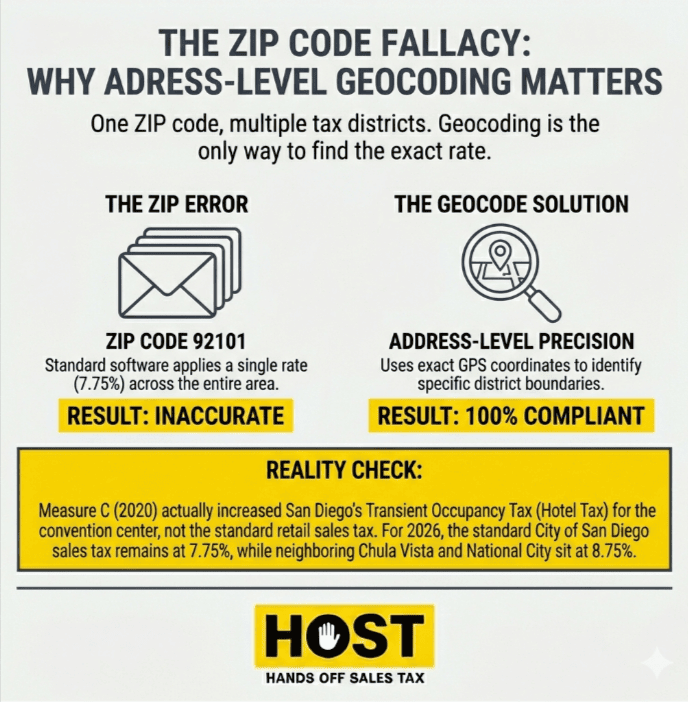
The real nightmare? These boundaries ignore ZIP codes entirely. Two addresses sharing 92101 can have different rates depending on which side of a district line they fall. For e-commerce, this demands address-level geocoding that goes far beyond ZIP code lookup.
Current Sales Tax Rates Across San Diego County
Major Cities at a Glance
7.75% Jurisdictions:
- Most of San Diego City (major neighborhoods like Mission Valley, Pacific Beach, La Jolla)
- Carlsbad
- Most unincorporated county areas
8.25% Jurisdictions:
- La Mesa
- Oceanside
8.75% Jurisdictions:
- Portions of downtown San Diego (Measure C districts)
- Chula Vista
- El Cajon
- National City
The 8.75% areas in downtown San Diego follow precise boundaries—often street-by-street, making manual determination nearly impossible without geocoding tools.
How San Diego Compares to Other California Cities:
San Diego maintains one of the lower sales tax rates among California’s major metros:
- San Diego: 7.75%
- Los Angeles: 9.5%
- San Francisco: 8.625%
- Sacramento: 8.75%
- San Jose: 9.375%
While San Diego’s base rate stays competitive, district variations can push certain neighborhoods to 8.75%, matching Sacramento’s rate.
Why San Diego Sales Tax Crushes E-Commerce Businesses
District Boundaries Laugh at ZIP Codes
The biggest compliance trap: district boundaries have nothing to do with ZIP codes. A single ZIP can contain multiple tax rates. Downtown’s 92101 covers addresses charging both 7.75% and 8.75%.
For online sellers, ZIP code-based calculation inevitably produces errors. Correct determination requires geocoding each address to precise coordinates, then comparing those against district boundary maps maintained by California’s Department of Tax and Fee Administration.
Most sales tax software attempts this. Configuration determines success. Incorrectly set systems default to ZIP lookup, systematically mischarging entire customer segments.
Rate Changes Happen Constantly
California cities regularly adjust rates or create new taxing districts through ballot measures. San Diego County has seen multiple changes in the past five years as cities address budget gaps or fund specific projects.
Staying current means monitoring CDTFA announcements, city council decisions, and election results, then updating systems within days. Miss an update and you’re collecting wrong rates, creating audit exposure.
District-Level Reporting Is Mandatory
California requires businesses to report sales by district, not just totals. Your CDTFA returns must break down sales and tax collected in each rate jurisdiction.
For businesses with significant San Diego volume, this creates hundreds of line items per filing period. Manual tracking is fantasy. Automation requires software that captures district codes at transaction time and aggregates correctly.
HOST manages these district-specific filings across all California jurisdictions, preventing the reporting errors that trigger CDTFA inquiries.
What’s Exempt from San Diego Sales Tax?
California exempts several categories from sales tax throughout San Diego County:
- Unprepared food – Groceries and food items not meant for immediate consumption
- Prescription medications and medical devices – Healthcare essentials
- Most professional services – Consulting, legal work, accounting
- Certain digital goods – Software and content delivered electronically (taxability varies)
These exemptions apply uniformly across San Diego County. Businesses must verify exemption status for specific products through CDTFA guidance, as misclassifying exempt items as taxable leads to overcharging customers and compliance headaches.
Economic Nexus in California: When You Must Collect
The $500,000 Threshold
California’s economic nexus threshold is $500,000 in annual sales to California customers. Cross this line and you must register with CDTFA and collect sales tax on all California transactions, regardless of physical presence.
This threshold exceeds most states’ typical $100,000 mark, but California’s population means businesses cross it quickly.
Physical Presence Creates Immediate Nexus
Any physical presence in California: office, warehouse, employees, inventory, creates immediate nexus regardless of sales volume. Physical presence anywhere in California requires CDTFA registration and collection on all California sales.
Marketplace Facilitator Rules
Sell through Amazon, eBay, or Etsy? The platform collects and remits California sales tax on your behalf. You don’t collect separately for those transactions.
But sales through your own website or other channels require a separate collection. Understanding which sales you handle versus platform responsibility demands channel-by-channel analysis. Platforms report facilitator sales to CDTFA, so discrepancies trigger audits.
What E-Commerce Sellers Must Know
Address Validation Is Non-Negotiable
Collecting correct San Diego sales tax requires full street addresses at checkout, not just ZIP codes. Your system must geocode addresses to determine precise districts.
Customers enter abbreviated addresses, typos, ambiguous information. Address validation tools correct these errors in real-time, ensuring accurate tax calculation and reducing failed deliveries.
Software Configuration Determines Everything
Sales tax software like TaxJar or Avalara can calculate San Diego rates correctly when configured properly. Common misconfiguration disasters include:
- Defaulting to ZIP code lookup instead of full address geocoding
- Using outdated district boundary maps
- Failing to update rates after ballot measure changes
These errors systematically overcharge customers (tanking conversion rates) or undercharge (creating audit liability). HOST offers a Free Sales Tax Software Review to identify these costly mistakes before they impact your business.
HOST: Navigating San Diego’s Sales Tax Maze
San Diego County’s district-level variations create compliance challenges that multiply across dozens of jurisdictions. Getting address-level determination right, staying current with rate changes, and reporting by district requires specialized expertise and California-specific systems.
What HOST Delivers:
- Nexus Analysis: We analyze your California sales to determine whether you’ve triggered the $500,000 threshold or have physical presence creating immediate obligations.
- CDTFA Registration: We handle registration with California’s Department of Tax and Fee Administration, navigating their specific documentation requirements.
- Address-Level Tax Determination: We ensure your systems calculate tax at the address level, capturing district variations accurately.
- District-Specific Filing: We prepare and file California returns with proper district breakdowns, ensuring CDTFA receives the detailed reporting they require.
- Rate Change Management: We monitor San Diego and California-wide rate changes, updating your collection systems immediately when districts adjust rates.
- Software Configuration Review: We audit your TaxJar, Avalara, or platform-native tax settings to identify configuration errors causing overcharging or undercharging.
We’ve focused exclusively on sales tax since 1999. Over 25 years navigating California’s district-level complexity. Through our parent company TaxMatrix, we’ve helped North America’s largest companies manage multi-jurisdiction compliance. Now we bring that expertise to e-commerce sellers navigating San Diego’s layered rate structure.
Ready to Get San Diego Sales Tax Right?
San Diego’s district-level variations make accurate collection genuinely complex. Address-level determination, district-specific reporting, and staying current with rate changes require systems and expertise built specifically for California’s requirements.
Whether you’re crossing California’s $500,000 nexus threshold, expanding into San Diego markets, or discovering your software has been miscalculating rates, professional sales tax management eliminates guesswork and prevents costly mistakes.
Contact HOST today to discuss your California compliance needs or schedule a free consultation. We’ll ensure you’re collecting the right rates in every San Diego district, filing with proper breakdowns, and staying current with changes, so you can focus on growing California sales without compliance stress.
Want to learn more? Get our “10 Sales Tax Mistakes E-Commerce Sellers Make” e-book.
Frequently Asked Questions
What is the sales tax rate in San Diego?
The sales tax rate in San Diego ranges from 7.75% to 8.75% depending on the specific address. Most of San Diego County charges 7.75%, while cities like Chula Vista, El Cajon, and National City charge 8.75%. Specific districts within the City of San Diego also charge 8.75%.
Why do different parts of San Diego have different sales tax rates?
Different cities and special districts within San Diego County impose additional local taxes beyond the state and county base rates. These local taxes, typically 0.50% to 1.00%, fund city services, infrastructure, transit, or specific projects approved by voters through ballot measures.
Do sales tax rates vary by ZIP code in San Diego?
No, and this creates major compliance headaches. Sales tax districts ignore ZIP code boundaries completely. A single ZIP code can contain multiple tax rates depending on city limits and special district boundaries. Accurate tax determination requires full street address geocoding, not ZIP code lookup.
When must I collect San Diego sales tax for online sales?
You must collect California sales tax (including San Diego rates) once you exceed $500,000 in total annual California sales (economic nexus) or have any physical presence in California. This applies to all California customers regardless of where in the state they’re located.
Can I use my e-commerce platform’s built-in tax calculator for San Diego?
Most platforms offer basic tax calculation, but accuracy depends entirely on configuration. Platforms must use full address geocoding (not ZIP code lookup) and update rates when districts change. Many businesses discover their platform has been systematically miscalculating San Diego rates, creating either overcharging that damages conversion or undercharging that creates audit liability.
How often do San Diego sales tax rates change?
Rates typically change on April 1 or October 1 following ballot measures where voters approve new local taxes or extend existing ones. San Diego County has seen multiple rate changes in recent years as cities address budget needs or fund specific projects. Staying current requires monitoring California Department of Tax and Fee Administration announcements and city ballot results.
