
What is Iowa sales tax, and why does it matter for your e-commerce business? Iowa charges a 6% state sales tax on most retail transactions, with local jurisdictions adding up to 1% in nearly every corner of the state. For online sellers crossing Iowa’s $100,000 economic nexus threshold, understanding collection requirements, exemptions, and filing deadlines isn’t optional, it’s the difference between smooth operations and expensive penalties.
From nexus analysis to registration and ongoing filings, the right partner keeps compliance seamless. Hands Off Sales Tax (HOST) manages Iowa sales tax obligations so you can focus on growth instead of decoding rate changes or responding to state notices.
Iowa Sales Tax: The Foundation
Iowa sales tax is a consumption tax on retail sales of tangible personal property and certain services. Consumers pay it at checkout. Businesses collect it, then remit it to the Iowa Department of Revenue.
The state rate sits at 6%. Most localities tack on a 1% local option sales tax, bringing the combined rate to 7% in virtually every Iowa city. This makes Iowa one of the more predictable states for rate calculations, which means you’re almost always collecting 7%.
Iowa collected approximately $3.7 billion in sales tax revenue in fiscal year 2023, representing roughly 35% of total state general fund revenue. That money funds schools, roads, healthcare, and public safety across the state.
Understanding Iowa Use Tax
Iowa ‘use’ tax complements sales tax, it’s the other side of the same coin. While sales tax applies when Iowa retailers sell to customers, use tax kicks in when you purchase taxable items from out-of-state vendors who don’t collect Iowa sales tax.
The use tax rate mirrors the sales tax rate: 6% state tax (no local option use tax applies). If you buy office furniture from an out-of-state supplier who doesn’t collect Iowa tax, you owe use tax on that purchase.
Businesses owing $1,200 or more annually in use tax must register for a sales and use tax permit and report it on their sales tax return as “taxable purchases.” Those owing less than $1,200 annually can file the Iowa Non-Permit Use Tax Return.
Common use tax scenarios for e-commerce sellers include purchasing inventory from wholesalers outside Iowa, buying office equipment or software from vendors without Iowa nexus, or paying for out-of-state services like web development or consulting.
The Iowa Department of Revenue expects businesses to review all purchases and self-report use tax when applicable. Failing to do so creates liability for the unpaid tax plus penalties and interest, often discovered during audits.
Iowa State Sales Tax Rate
Iowa’s state sales tax rate is 6%. This base rate applies statewide to all taxable transactions, with no variation by county or city at the state level.
The 6% rate has remained stable since 2008, when it increased from 5%. This consistency makes Iowa sales tax relatively predictable compared to states with frequent rate changes or complex multi-tier systems.
Local Option Sales Tax in Iowa
Iowa permits counties to impose a local option sales tax (LOST) of up to 1%. As of 2025, virtually all 99 Iowa counties have enacted the 1% local option, meaning the combined state and local rate is 7% in approximately 99% of Iowa jurisdictions.
This near-universal adoption simplifies compliance. You’re collecting 7% in Des Moines, Cedar Rapids, Davenport, Sioux City, and nearly every other Iowa location. Only a handful of unincorporated areas operate at just the 6% state rate.
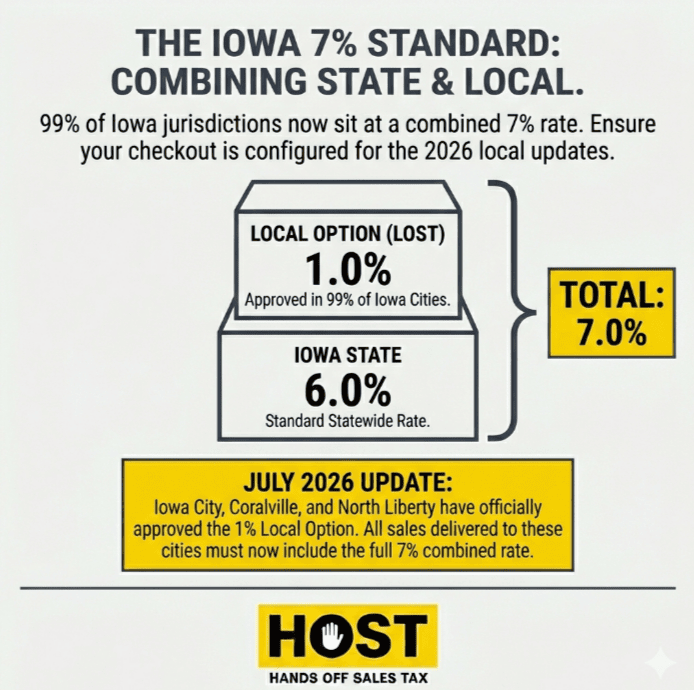
For e-commerce sellers, the practical takeaway is straightforward: assume 7% unless you’ve verified a specific address falls into one of the rare 6%-only zones. Rate calculation errors (even small ones) accumulate across thousands of transactions and trigger audit attention.
HOST’s nexus analysis and filing services include accurate rate determination across all Iowa jurisdictions, ensuring you collect correctly without manual county-by-county research.
What’s Taxable in Iowa?
Iowa taxes most retail sales of tangible personal property and certain enumerated services. Understanding what falls under Iowa’s tax base prevents costly mistakes.
Taxable Items and Services
Tangible Personal Property: Nearly all physical goods sold at retail are taxable: clothing, electronics, furniture, appliances, sporting goods, building materials.
Prepared Food: Restaurant meals, catering, and prepared foods are taxable at the full combined rate.
Digital Products: Iowa taxes specified digital products including digital books, music, movies, and games delivered electronically.
Enumerated Services: Iowa taxes specific services including:
- Vehicle repair, maintenance, and alteration
- Garment repair and alteration services
- Parking and storage services
- Installation of tangible personal property
- Pet grooming
- Admission to amusement facilities and athletic events
- Pay television and streaming services
- Personal transportation services (rideshare, taxis, limousines)
Most professional services, such as legal, accounting, consulting, and medical, remain exempt.
Tax-Exempt Items
Groceries: Unprepared food for home consumption is exempt. This includes meat, produce, dairy, bread, and packaged foods eaten at home. Prepared foods, candy, soft drinks, and dietary supplements remain taxable.
Prescription Medications: Drugs prescribed by licensed healthcare providers are exempt. Over-the-counter medications are taxable.
Manufacturing Equipment: Machinery and equipment used directly in processing or manufacturing are exempt.
Agricultural Inputs: Seed, fertilizer, pesticides, and farm equipment used in agricultural production are exempt.
Construction Services: Services performed on new construction, reconstruction, alteration, expansion, or remodeling of buildings or structures are exempt. Repair services remain taxable.
Tax-Free Weekend: Iowa holds an annual sales tax holiday (typically the first weekend in August) exempting clothing and footwear priced under $100 per item.
Resale Exemption
Businesses purchasing inventory for resale to customers can buy tax-free by providing a valid Iowa resale certificate. This prevents pyramiding, taxing the same item at multiple supply chain stages.
Misusing resale certificates, like claiming exemption on items purchased for personal use, constitutes sales tax fraud and triggers audits with significant penalties.
Economic Nexus in Iowa: When You Must Collect
The 2018 South Dakota v. Wayfair Supreme Court decision allowed states to require remote sellers to collect sales tax based on economic activity, even without physical presence.
Iowa’s economic nexus threshold is $100,000 in gross sales delivered into Iowa during the current or previous calendar year. Once you exceed this threshold, you have nexus and must register, collect, and remit Iowa sales tax.
Calculating Your Iowa Sales Threshold
Track your total gross sales to Iowa customers (including exempt sales) not just taxable transactions. If you sold $105,000 worth of goods to Iowa addresses in 2024, you crossed the threshold and must register, even if $20,000 of those sales were exempt items.
Once you exceed the $100,000 threshold, you must register and begin collecting Iowa sales tax starting on the first day of the next calendar month that begins at least 30 days from when you exceeded the threshold. The Iowa Department of Revenue will not hold you liable for sales tax you did not collect prior to this date.
Physical Nexus Still Applies
Economic nexus isn’t your only trigger. Physical presence creates nexus immediately at any sales volume:
- Maintaining inventory in Iowa (including FBA fulfillment centers)
- Having employees, offices, or retail locations in Iowa
- Using Iowa-based third-party contractors or sales representatives
- Attending Iowa trade shows regularly
Amazon’s fulfillment network can trigger nexus without your direct knowledge. If Amazon stores your inventory at a Bondurant facility, you have Iowa nexus regardless of sales volume.
HOST’s comprehensive nexus analysis examines both economic and physical presence indicators across all states, identifying exactly where you’ve triggered collection obligations before states send notices.
Registering for Iowa Sales Tax
Once you’ve established nexus, registration with the Iowa Department of Revenue becomes mandatory.
Registration Process
Register online through Iowa’s GovConnectIowa system. You’ll need:
- Federal Employer Identification Number (FEIN) or Social Security Number
- Business legal name and DBA (if applicable)
- Physical business address and mailing address
- Ownership information and structure (LLC, corporation, sole proprietor)
- Estimated monthly Iowa taxable sales
- Bank account information for electronic payments
Processing typically takes 5-10 business days. Iowa issues a sales tax permit with an Iowa tax identification number.
Streamlined Sales Tax Option: Iowa participates in the Streamlined Sales Tax (SST) program, which simplifies multi-state registration. If you need to register in multiple SST member states, you can use the Streamlined Sales Tax Registration System (SSTRS) to complete one application covering all participating states. You can also work with a Certified Service Provider (CSP) who handles compliance in all registered states on your behalf.
Filing Frequency
Iowa assigns filing frequency based on your estimated monthly tax liability:
- Monthly: Average monthly tax over $100
- Quarterly: Average monthly tax between $25-$100
- Annual: Average monthly tax under $25
New registrants typically start with monthly filing until establishing a pattern. Iowa may adjust your frequency annually based on actual remittances.
HOST handles Iowa sales tax registration entirely, completing all paperwork, following up with the state, and ensuring you’re assigned the appropriate filing frequency from day one.
Filing and Payment Deadlines
Iowa sales tax returns are due on the last day of the month following the reporting period for monthly and quarterly filers, and January 31 for annual filers:
- January sales: Due February 28 (or last day of February)
- Q1 sales (Jan-Mar): Due April 30
- Annual 2024: Due January 31, 2025
Note: Some sources indicate the 20th of the month as a deadline for certain filers. Verify your specific deadline with the Iowa Department of Revenue or through your GovConnectIowa account.
Payment must accompany the return. Iowa accepts electronic payments through GovConnectIowa.
Penalties for Late Filing
Iowa imposes a 5% penalty on unpaid tax immediately when a return is late, plus an additional 0.5% per month (up to 24 months maximum). Interest accrues at Iowa’s statutory rate (currently around 5% annually) on all unpaid balances.
Filing a return showing zero tax due on time, even if you collected nothing that period, avoids penalties.
Common Iowa Sales Tax Challenges for E-Commerce Sellers
Destination-Based Sourcing
Iowa uses destination-based sourcing for remote sales. Tax rate is determined by the customer’s location, not your business location. When shipping to Iowa customers, calculate tax based on their delivery address.
Marketplace Facilitator Law
Iowa’s marketplace facilitator law requires platforms like Amazon, eBay, Etsy, and Walmart Marketplace to collect and remit Iowa sales tax on behalf of third-party sellers. If you sell through these platforms, the platform handles Iowa collection automatically.
However, you remain responsible for direct website sales, sales through non-facilitator platforms, and any wholesale transactions.
Software Misconfiguration Risks
Sales tax automation software calculates rates at checkout, but misconfiguration creates costly errors:
- Charging Iowa sales tax on exempt groceries
- Failing to apply the correct local rate in rare 6%-only jurisdictions
- Double-taxing when both your shopping cart and marketplace collect tax
- Treating wholesale transactions as retail
HOST offers a Free Sales Tax Software Review to audit your TaxJar, Avalara, or other automation tools, identifying mistakes before they impact customers or trigger audits.
HOST: Your Partner for Iowa Sales Tax Compliance
Iowa sales tax compliance seems straightforward. 6% state plus 1% local; however, nexus monitoring, registration, filing, exemption management, and software configuration create operational complexity that diverts focus from growth.
What HOST Delivers for Iowa Sellers
Nexus Analysis: We analyze your Iowa sales data to determine whether you’ve exceeded the $100,000 threshold or have physical presence creating nexus.
Sales Tax Registration: We handle Iowa registration through GovConnectIowa, complete all paperwork, and ensure you’re assigned the appropriate filing frequency.
Ongoing Filings: We prepare and file Iowa sales tax returns monthly, quarterly, or annually based on your assigned frequency, including all required schedules and local breakdowns.
Notice Management: We interpret and respond to Iowa Department of Revenue notices, protecting you from penalties while resolving issues efficiently.
Audit Defense: We’re your trusted partner in resolving Iowa sales tax audits, organizing documentation, and defending your position.
Software Optimization: We review your sales tax automation tools to ensure correct Iowa rate calculation and exemption handling.
We’ve been 100% focused on sales tax since 1999, over 25 years managing compliance so businesses can focus on revenue. Founded by Mike Espenshade, with parent company TaxMatrix serving North America’s largest companies, we bring enterprise expertise to e-commerce sellers of all sizes.
Ready to Simplify Iowa Sales Tax Compliance?
Understanding Iowa sales tax, the 6% state rate, 1% local option, economic nexus threshold, and filing requirements is essential for compliant operations. But managing these obligations manually drains time without generating revenue.
Whether you’re crossing Iowa’s $100,000 threshold for the first time, expanding into new states, or overwhelmed by multi-state filing obligations, professional help eliminates guesswork and prevents costly mistakes.
Contact HOST today to discuss your Iowa sales tax needs or schedule a free consultation. We handle the tax so you can focus on sales.
Want to learn more? Get our “10 Sales Tax Mistakes E-Commerce Sellers Make” e-book.
Frequently Asked Questions
What is the Iowa sales tax rate?
Iowa’s state sales tax rate is 6%. Most localities add a 1% local option sales tax, bringing the combined rate to 7% in approximately 99% of Iowa jurisdictions.
When do I need to collect Iowa sales tax?
You must collect Iowa sales tax once you exceed $100,000 in gross sales to Iowa customers during the current or previous calendar year, or if you have physical presence in Iowa (inventory, employees, offices, or other substantial connections).
Are groceries taxed in Iowa?
Unprepared food for home consumption is exempt from Iowa sales tax. This includes meat, produce, dairy, and packaged foods eaten at home. Prepared foods, restaurant meals, candy, and soft drinks remain taxable.
How do I register for Iowa sales tax?
Register online through Iowa’s GovConnectIowa system. You’ll need your FEIN or SSN, business information, and estimated monthly sales. Processing typically takes 5-10 business days. HOST can handle Iowa registration for you, managing all paperwork and follow-up.
What is Iowa’s economic nexus threshold?
Iowa’s economic nexus threshold is $100,000 in gross sales delivered into Iowa during the current or previous calendar year. Once exceeded, you must register and begin collecting tax starting on the first day of the next calendar month that begins at least 30 days after exceeding the threshold.
Are digital products taxed in Iowa?
Yes. Iowa taxes specified digital products including digital books, music, movies, and games delivered electronically. Iowa is among states actively taxing digital goods as part of its sales tax base.
