
What is the sales tax in Mississippi? The state charges 7% on most retail purchases, which is one of the highest base rates in the nation. Add local taxes, and you’re looking at combined rates up to 8% in some areas.
For e-commerce businesses, understanding these rates goes beyond arithmetic. Economic nexus thresholds, local variations, and product exemptions create compliance obligations that directly impact your pricing, registration requirements, and filing schedule.
Hands Off Sales Tax (HOST) manages Mississippi sales tax compliance, from nexus analysis and registration to ongoing filings. We want you to focus on growth instead of tax codes.
Mississippi’s 7% Foundation
Mississippi imposes a 7% state sales tax on retail sales of tangible personal property and certain services. This rate applies uniformly across all 82 counties. Mississippi is one of five states charging 7% at the state level (along with Indiana, Rhode Island, and Tennessee), with only California’s 7.25% rate exceeding it.
The Mississippi Department of Revenue administers collections. Businesses with nexus must register for a sales tax permit, collect the appropriate rate, and remit on a schedule determined by revenue volume.
Mississippi’s rate has held steady at 7% since 2018, when lawmakers increased it from 5% as part of broader tax reform that eliminated the franchise tax on businesses.
Local Taxes Add Up
Beyond the state’s 7%, counties and municipalities can impose additional local sales taxes and it is typically 0.25% to 1%.
Combined rates range from 7% in areas without local tax to 8% where local additions max out. The average combined rate across Mississippi sits around 7.07%.
Jackson charges 8% total when combining state and local. Gulfport hits 7.25%. Tupelo reaches 7.25%. Hattiesburg tops out at 7.5%.
Unlike states with dozens of special districts creating rate chaos, Mississippi keeps it relatively straightforward. Still, businesses need address-level precision to charge correctly based on customer location.
What Mississippi Taxes
Mississippi taxes most retail sales of tangible personal property, like clothing, electronics, furniture, appliances, and general merchandise.
Certain services face taxation too, including hotel accommodations, telecommunications, residential electricity, pest control services, plumbing, electrical work, HVAC services, computer software services, dry cleaning, parking lots, cable and subscription TV, and tire repair or recapping. This differs from many states that largely exempt services.
Key Exemptions
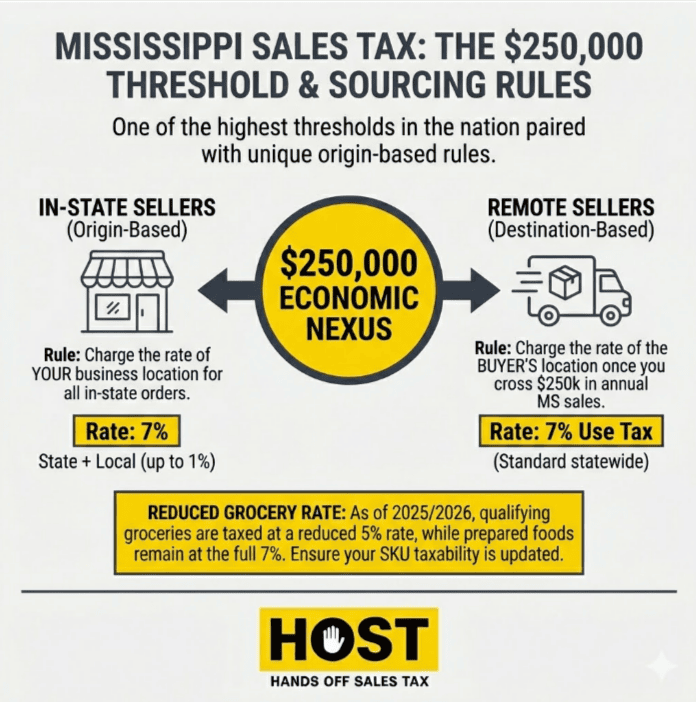
Groceries: Food for home consumption is exempt, though prepared restaurant food remains taxable. Note that as of July 2025, qualifying groceries are taxed at a reduced 5% rate rather than being fully exempt.
Prescription Medications: Prescription drugs and insulin are exempt. Over-the-counter medications remain taxable.
Manufacturing Equipment: Machinery and equipment used directly in manufacturing qualify for exemption, encouraging industrial investment.
Agricultural Products: Farm equipment, feed, seed, fertilizer, and similar inputs are exempt.
Medical Devices: Prosthetic devices, wheelchairs, and other physician-prescribed medical equipment qualify.
Gray Areas
Software-as-a-Service (SaaS) taxability depends on server location. SaaS hosted on a Mississippi server and accessed by customers in the state is taxable. Cloud-hosted software accessed remotely from outside Mississippi is not taxable.
Shipping charges create another wrinkle. In Mississippi, delivery charges are generally taxable when the shipped items are taxable—but only if the shipping charge is part of the sale price. Separately stated shipping may be exempt if you can document exact costs.
For diverse product catalogs, determining taxability requires analysis. HOST provides consultation services to clarify what’s taxable in your situation, preventing over-collection that damages customer relationships or under-collection that creates audit liability.
Economic Nexus: The $250,000 Trigger
The 2018 South Dakota v. Wayfair decision fundamentally changed sales tax for online retailers. Mississippi adopted the economic nexus immediately. The threshold: $250,000 in gross revenue from Mississippi sales within the previous 12 months.
Cross that line, and you must register for a sales tax permit, collect from Mississippi customers, and file on schedule.
Mississippi’s threshold runs higher than most states, where $100,000 is standard. Smaller sellers may not trigger obligations as quickly. But growth or expanding product lines warrant close monitoring.
Physical presence still creates nexus—maintaining inventory in a Mississippi warehouse, employing staff who work from Mississippi, or operating a retail location all establish a physical nexus regardless of sales volume.
Marketplace facilitator laws add complexity. Selling through Amazon, eBay, or Etsy means the platform handles collection and remittance for those sales. But sales through your own website remain your responsibility once you meet the threshold.
Origin-Based Sourcing
Mississippi is an origin-based sales tax state. If you’re based in Mississippi and sell to customers within the state, you charge sales tax based on your business location—not the customer’s location. This simplifies compliance for Mississippi-based sellers, as you apply the same rate (your location’s combined state and local rate) to all in-state sales.
However, if you’re a remote seller (based outside Mississippi) with nexus in the state, you generally charge sales tax based on destination (the customer’s location).
HOST’s nexus analysis service examines your complete sales footprint across all channels and states to determine precisely where you’ve triggered obligations.
Registering in Mississippi
Once you’ve established nexus, registration is required before making your first sale. The Mississippi Department of Revenue manages registration through the Taxpayer Access Point (TAP), their online portal.
You’ll need your FEIN, business structure details, contact information, activity description, and estimated monthly sales volume (which determines filing frequency).
Processing typically takes 7-10 business days. Mississippi charges no registration fee, making it administratively simpler than states with annual permit renewal fees.
For businesses managing compliance across multiple states, registration becomes time-consuming. Each state uses different portals, requires different documentation, and imposes different timelines. HOST handles Mississippi registration and all other state registrations, managing paperwork so you can focus on business.
Filing Frequencies and Deadlines
Mississippi assigns filing frequencies based on average monthly tax liability:
Monthly Filers: Businesses averaging over $300 per month file monthly by the 20th of the following month. Most active e-commerce businesses fall here.
Quarterly Filers: Businesses averaging $50-$300 monthly file quarterly by the 20th following quarter end.
Annual Filers: Businesses averaging under $50 monthly file annually by January 20th.
The Department of Revenue assigns frequency at registration, though they may adjust based on actual collections.
Late filing triggers a 10% penalty with a $50 minimum. Interest accrues monthly at the state-prescribed rate.
Managing filing deadlines across dozens of states creates operational burden. A missed Mississippi deadline while focusing on California or Texas can trigger penalties that erode margins. HOST manages all filing deadlines across every jurisdiction, preparing and filing returns so nothing slips through.
Common Challenges
Local Rate Determination: While Mississippi’s local tax structure is simpler than many states, determining which rate applies to a specific address still requires accurate location data.
Marketplace vs. Direct Sales Tracking: Businesses selling through marketplaces (where platforms collect tax) and direct channels (where you collect) must carefully segregate sales in reporting.
Exemption Certificate Management: Business-to-business sales may be exempt with valid exemption certificates. Managing collecting, validating, storing for audits, creates administrative overhead.
Product Taxability Complexity: Determining whether digital products, SaaS, bundled offerings, or specific categories are taxable requires tax expertise most e-commerce teams lack.
Multi-State Compliance Burden: Mississippi is rarely your only obligation. Managing compliance across 45+ states simultaneously, each with different rates, rules, frequencies, and deadlines consumes 30+ hours monthly for many businesses.
HOST’s team manages these frequently confusing state notices so you don’t have to decipher them yourself.
HOST: Your Mississippi Sales Tax Partner
At Hands Off Sales Tax, we’ve focused exclusively on sales tax services for over 25 years. Our team manages Mississippi compliance and all other state obligations so you can focus on growing your business.
Nexus Analysis: We examine your sales data to determine where you’ve met thresholds, including Mississippi’s $250,000 benchmark.
Sales Tax Registration: We handle Mississippi and all other applicable states, completing paperwork and ensuring proper licensing.
Automated Filing: We prepare and file your Mississippi returns. Monthly, quarterly, or annually, and handle all other jurisdictions.
Local Tax Management: We calculate and remit correct combined rates for every Mississippi transaction.
Software Optimization: We review your TaxJar, Avalara, or other tools to calculate Mississippi rates correctly.
Notice Management: We interpret and respond to Mississippi Department of Revenue notices efficiently.
Audit Defense: We’re your trusted partner in resolving audits, organizing documentation and defending your position.
Voluntary Disclosure Agreements: If you discover past obligations, we file VDAs to limit lookback periods and abate penalties.
We’ve been 100% focused on sales tax since 1999. 25 years helping businesses navigate compliance. Founded by Mike Espenshade, with parent company TaxMatrix serving North America’s largest companies, we bring enterprise expertise to e-commerce sellers of all sizes.
Ready to Get Mississippi Off Your Plate?
Mississippi’s 7% state rate and local additions create compliance obligations the moment you cross the $250,000 threshold. From registration and rate determination to ongoing filings and notice management, every aspect demands attention that diverts focus from growth.
Whether you’re just crossing the threshold, already managing multi-state compliance, or discovering past obligations, the right partner eliminates guesswork and prevents costly mistakes.
Contact us today to discuss your Mississippi sales tax needs or schedule a free consultation. Let us handle the tax so you can focus on sales.
Want to learn more? Get our “10 Sales Tax Mistakes E-Commerce Sellers Make” e-book.
Frequently Asked Questions
What is the sales tax rate in Mississippi?
Mississippi charges 7% state sales tax. Local jurisdictions can add up to 1%, creating combined rates from 7% to 8% depending on location.
Do I need to collect Mississippi sales tax as an online seller?
Yes, if you meet Mississippi’s economic nexus threshold of $250,000 in gross revenue from Mississippi sales within the previous 12 months. Physical presence also creates nexus regardless of sales volume.
Are groceries taxed in Mississippi?
Food for home consumption is taxed at a reduced 5% rate as of July 2025. Prepared restaurant food remains taxable at the full 7% rate.
How do I register for a Mississippi sales tax permit?
Register through the Mississippi Taxpayer Access Point (TAP) online portal. You’ll need your FEIN, business information, and estimated sales volume. Processing typically takes 7-10 business days.
How often do I need to file Mississippi sales tax returns?
Filing frequency depends on average monthly tax liability. Monthly filers (averaging over $300/month) file by the 20th of the following month. Quarterly filers ($50-$300/month) file by the 20th after quarter end. Annual filers (under $50/month) file by January 20th.
What happens if I miss a Mississippi sales tax filing deadline?
Mississippi imposes a 10% penalty on tax due for late returns, with a minimum penalty of $50. Interest also accrues monthly at the state-prescribed rate, making timely filing essential.
