
Is there sales tax on food in Florida? That depends on whether you’re buying groceries or grabbing lunch. Grocery staples walk out tax-free, while restaurant meals and prepared foods carry Florida’s 6% state sales tax plus local add-ons.
For restaurants, caterers, and food retailers, these distinctions aren’t academic, they’re operational. Miscategorizing a sandwich leads to under-collection (hello, audit) or over-collection (goodbye, customer trust).
Hands Off Sales Tax (HOST) specializes in these gray areas. We’ve spent 25+ years helping Florida food businesses determine what’s taxable, configure systems correctly, and file returns accurately, so you can serve customers instead of decode tax codes.
Florida’s Food Tax Framework: The Basic Rule
Florida exempts food for home consumption from sales tax. Walk into Publix, buy eggs, bread, milk, and produce, you pay no tax. This covers most grocery items under Florida law.
But Florida charges 6% state sales tax (plus local taxes) on prepared food sold for immediate consumption. Order a deli sandwich, sit down at a restaurant, grab takeout, tax applies. Combined rates run 6% to 7.5% depending on the county.
The distinction of grocery versus prepared creates the complexity. Florida Statute 212.08 and Florida Administrative Code Rule 12A-1.011 provide the framework, but real-world application requires understanding dozens of scenarios.
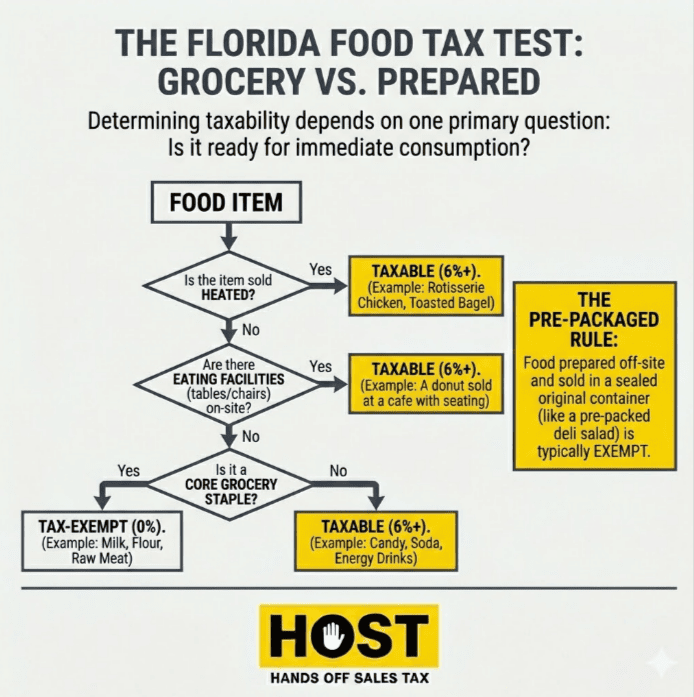
Grocery Store Food: What’s Tax-Exempt
Most food for home preparation escapes Florida sales tax:
Core Staples:
- Fresh produce, meat, seafood
- Dairy products, eggs
- Bread and unheated bakery items
- Cereals, grains, pasta
- Canned and frozen foods
- Cooking oils, condiments
Beverages:
- Milk, 100% juices
- Bottled water (non-carbonated)
- Coffee and tea
But here’s where it gets specific: Florida taxes soft drinks, plus any beverage containing fruit or vegetable juice labeled with “ade,” “beverage,” “cocktail,” “drink,” or “flavored.” Malted drinks and ice cream drinks? Also taxable.
Baby Products:
- Baby food and formula
The exemption applies whether items are fresh, frozen, or canned. Frozen pizza at the store? Tax-exempt. Canned soup? Tax-exempt. Rice, flour, cooking oil? All exempt.
When Grocery Store Food Becomes Taxable
Florida taxes certain items even at grocery stores:
Always Taxable:
- Candy and confectionery
- Soft drinks and energy drinks
- Carbonated water
- Alcoholic beverages
Hot Prepared Foods:
- Rotisserie chicken
- Hot pizza slices
- Heated sandwiches
- Soup sold hot
Cold Prepared Foods: Sandwiches made to order face sales tax. Pre-made salads from the deli case? Generally taxable. But a pound of sliced turkey or potato salad sold as components? Gray area depending on whether they’re meal-complete or require home preparation.
Restaurant and Prepared Food: Always Taxable
Florida taxes all prepared food from restaurants, cafeterias, and similar establishments:
Dine-In, Takeout, Delivery: All meals face the 6% state tax plus local discretionary tax. Whether you’re eating a $5 breakfast in-house or getting a $200 dinner delivered, the rate applies equally.
Catering Services: Catering is taxable. Food, service, equipment rental included.
Food Trucks and Mobile Vendors: Mobile vendors follow identical rules. All prepared food sales are taxable.
The “Prepared Food” Definition That Causes Confusion
Florida defines prepared food as food sold ready for consumption without further preparation. This spawns edge cases:
Grocery Store Bakeries:
- Unheated donuts: Tax-exempt
- Room-temperature cookies: Tax-exempt
- Whole cakes sold cold for takeaway: Tax-exempt
- Individual cake slices with seating: Potentially taxable
- Custom-decorated cakes: Tax-exempt if cold takeaway
Here’s a wrinkle: Bakeries without eating facilities dodge sales tax entirely, even on prepared items. A baker selling at a farmer’s market with no seating? Everything’s tax-exempt. That same pastry sold at a coffee shop with tables? Taxable. The seating makes all the difference.
Coffee Shops:
- Brewed coffee (hot): Taxable
- Coffee beans (bagged): Tax-exempt
- Pastries sold with coffee: Depends on bundling
Sandwich Shops:
- Made-to-order sandwich: Taxable
- Cold pre-packaged sandwich: Potentially taxable as prepared food
- Bread loaf sold separately: Tax-exempt
- Six-foot party sub: Taxable (prepared food)
The determining factor: Did someone prepare it for immediate consumption, or did you buy raw ingredients requiring significant preparation?
Florida defines this using “customary practices prevailing at the dealer’s facility.” For caterers, the “premises” where food is taxable isn’t where it’s prepared, it’s where it gets served.
Special Cases: Vending Machines, Convenience Stores, Gas Stations
Vending Machines: Florida taxes candy, soft drinks, and prepared foods from vending machines. Packaged crackers, chips, or nuts may qualify as exempt food products rather than candy.
Convenience Stores: Bag of chips from the shelf? Tax-exempt. Fountain drink? Taxable. Hot dog from the roller grill? Taxable. Packaged sandwich from the cooler? Potentially taxable as prepared food.
Gas Station Food Marts: Most packaged snacks are tax-exempt. Fountain drinks, Slurpees, hot foods, taxable. The challenge: configuring point-of-sale systems to categorize hundreds of SKUs correctly.
Florida Sales Tax Holidays: Temporary Food Exemptions
Florida occasionally implements sales tax holidays before hurricane season. These disaster preparedness periods have exempted certain supplies including some normally-taxable food items like pet food, specific canned goods, and ice.
However, prepared foods from restaurants remain taxable even during holidays. These events create compliance complexity. Retailers must reprogram systems temporarily, then revert afterward.
What Food Businesses Must Know About Florida Sales Tax
Geographic Variability: Florida’s 6% state rate is uniform, but counties add discretionary sales surtax ranging from 0.5% to 1.5%. Some counties charge higher rates, with the maximum combined rate reaching 7.5%. Calculating the correct combined rate requires knowing the precise transaction location.
One reprieve: For large purchases, the local surtax only applies to the first $5,000. Amounts above that face only the 6% state rate.
The Grocery Department Exception: Restaurants operating separate grocery departments don’t collect tax on exempt food products, provided they maintain separate records for that department. This lets restaurant-attached markets sell tax-exempt groceries alongside taxable prepared foods.
Complimentary Food Rules: Complimentary chips, bread, or desserts served with a meal? They’re part of the taxable meal sold, no separate use tax due. But restaurants giving away free food without any purchase requirement must pay use tax on their cost. “Buy one, get one free” deals? Sales tax applies to the meal purchased, not the free one.
Certificate Management: Restaurants buying from wholesalers provide resale certificates to avoid paying tax on food they’ll prepare and resell taxably. Managing these certificates and ensuring proper documentation creates an administrative burden.
Nexus Beyond Physical Presence: Post-Wayfair, even food businesses without physical Florida locations may have economic nexus if they exceed $100,000 in Florida sales. Meal kit services, online gourmet retailers, and virtual restaurants all face potential Florida obligations.
Audit Vulnerability: Florida’s Department of Revenue actively audits food establishments. Common violations: undertaxing prepared foods, incorrectly exempting candy or soft drinks, failing to collect on catering. Penalties compound quickly: interest, penalty percentages, defense costs.
HOST: Your Partner for Florida Food Tax Compliance
Whether you’re running a restaurant chain, convenience store, food truck, or expanding into Florida markets, HOST manages operational sales tax complexity.
What HOST Delivers:
Nexus Analysis: We analyze your Florida footprint to determine whether you’ve met physical or economic nexus thresholds.
Sales Tax Registration: We handle Florida Department of Revenue registration, obtaining your Certificate of Registration.
Product Taxability Review: We categorize your menu or product mix correctly: prepared versus unprepared, taxable versus exempt, eliminating guesswork.
Sales Tax Filing: We file your Florida DR-15 returns monthly, maintaining compliance and ensuring timely remittance.
Software Configuration: We review and optimize your POS or e-commerce platform to collect correct amounts on each transaction.
Audit Defense: When Florida DOR issues audit notices, we organize documentation, respond to requests, and defend your position.
Notice Management: We interpret and respond to confusing DOR notices, resolving issues before escalation.
We’ve focused exclusively on sales tax since 1999. Through our parent company TaxMatrix, we’ve served North America’s largest food service companies. Now we bring that expertise to businesses of all sizes.
Get Florida Food Tax Compliance Right From the Start
Florida’s food tax rules create daily challenges. Miscategorizing a single item across thousands of transactions creates substantial liability. Configuring systems incorrectly means recording everything when audits reveal errors.
Whether you’re launching a restaurant, expanding a grocery chain into Florida, or managing food delivery, the right partner ensures compliant operations from day one.
At HOST, we combine Florida-specific expertise with technology integration, transparent communication, and personalized support. Instead of simply explaining the rules, we implement solutions that work with your existing systems.
Ready to ensure correct collection on every transaction? Contact HOST today to discuss your Florida food business needs or schedule a free consultation.
Want to learn more? Get our “10 Sales Tax Mistakes E-Commerce Sellers Make” e-book.
Frequently Asked Questions
Is there sales tax on groceries in Florida?
No. Florida exempts most food products sold for home consumption. This includes produce, meat, dairy, eggs, bread, canned goods, and frozen foods. However, candy, soft drinks, and prepared hot foods are taxable even at grocery stores.
Do Florida restaurants charge sales tax?
Yes. All prepared food sold by restaurants faces Florida’s 6% state sales tax plus local discretionary tax (typically 0.5% to 1.5% depending on the county). This applies to dine-in, takeout, and delivery orders.
Is there sales tax on takeout food in Florida?
Yes. Takeout and delivery orders face the same sales tax as dine-in meals. Whether you eat on premises or take it home, prepared food from restaurants is taxable at the full combined state and local rate.
What food items are always taxable in Florida?
Candy, soft drinks, energy drinks, carbonated beverages, alcoholic drinks, and all prepared foods sold by restaurants are always taxable. Hot prepared foods from grocery store delis are also taxable.
Are bakery items taxable in Florida?
It depends. Unheated bakery items like bread, donuts, cookies, and whole cakes sold cold for takeaway are generally tax-exempt. However, individual slices sold with seating available or items sold hot may be taxable as prepared food.
Does Florida tax food delivery services?
Yes. When restaurants or platforms like DoorDash deliver prepared meals, the food itself is taxable. Delivery fees may also be taxable if bundled with the food sale, though some platforms separately state non-taxable delivery charges.
