
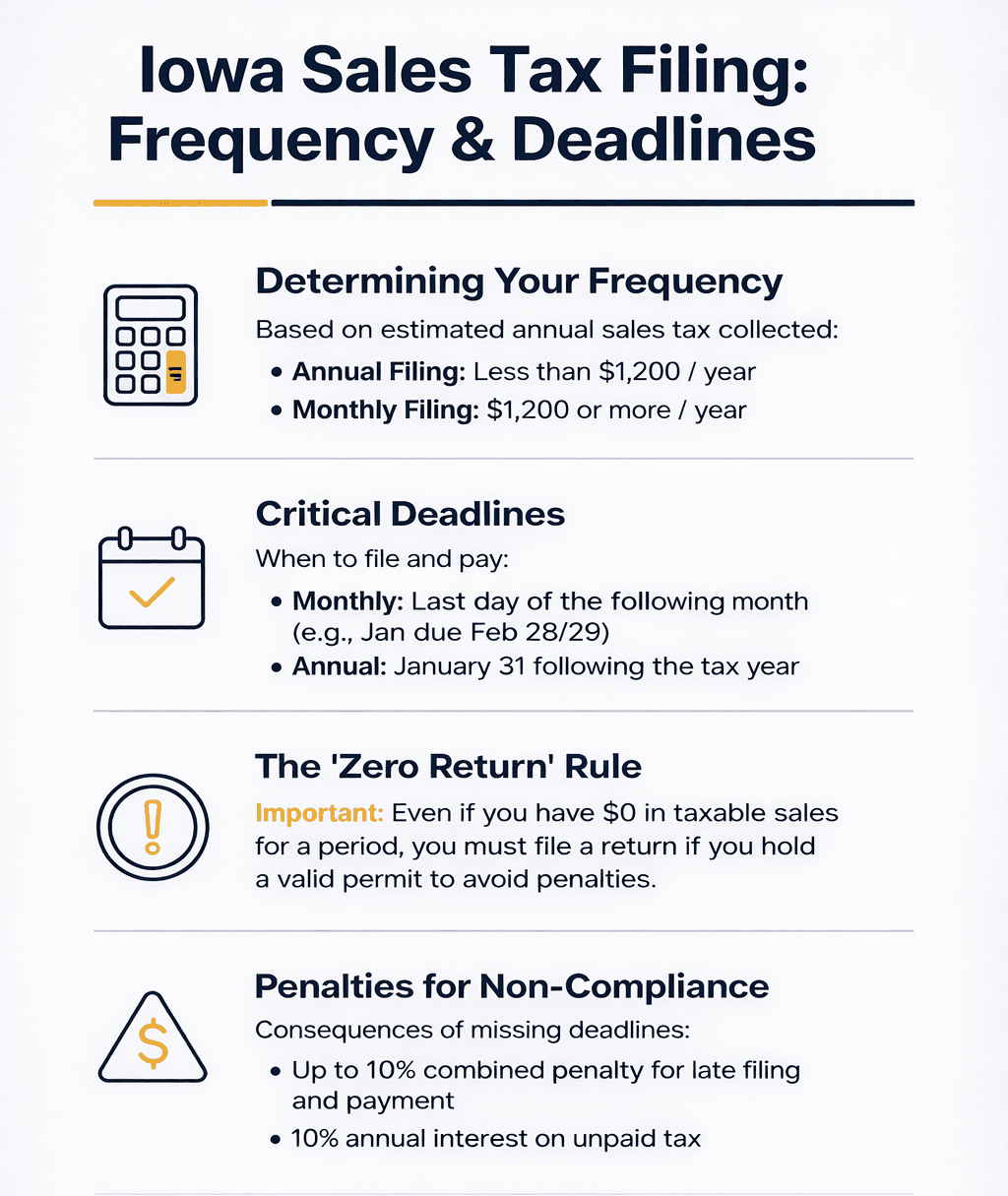
Understanding Iowa sales tax filing frequency is essential for keeping your business out of hot water. The Iowa Department of Revenue assigns filing frequencies based on your tax liability, determining whether you file monthly, annually, or seasonally. Miss a deadline, and you’re looking at penalties, interest charges, and possibly an audit.
Iowa simplified its filing system in 2022, eliminating quarterly filings entirely. Now businesses face a straightforward choice: monthly or annual filing, determined solely by whether you collect $1,200 or more in sales tax annually.
This guide breaks down how to determine your filing frequency, when deadlines hit, and how to stay compliant without losing sleep. Hands Off Sales Tax (HOST) helps businesses navigate these complexities, ensuring you meet obligations efficiently and stay penalty-free.
Overview of Iowa Sales Tax Filing Frequencies
The Iowa Department of Revenue assigns filing frequencies based on how much sales and use tax you collect annually. It’s not arbitrary. Your numbers determine your schedule.
Filing Frequency Breakdown
Annual Filing:
- Threshold: Collect less than $1,200 in sales and use tax per year
- Requirement: One return for the entire calendar year
- Due Date: January 31 following the tax year
- Paper Filing Allowed: Annual filers aren’t required to file electronically. You can submit paper returns if preferred
Monthly Filing:
- Threshold: Collect $1,200 or more in sales and use tax annually
- Requirement: File every calendar month
- Due Date: Last day of the month following each reporting period
- Electronic Filing Required: All monthly filers must use GovConnectIowa
Seasonal Filing:
- Threshold: Collect $1,200+ annually, but only during four or fewer months
- Requirement: File only for active months (can be non-consecutive)
- Due Date: Last day of the month following each reporting period
- Important: To become a seasonal filer, you must cancel your current permit and register for a new one. You cannot simply change status through the Business Change Form
Understanding these thresholds helps you file on time and avoid unwelcome surprises. Iowa’s 2022 legislative changes (Senate File 2367) eliminated quarterly filing entirely, creating a cleaner two-tier system designed to reduce burden on small businesses.
Calculating Your Filing Frequency
Determining your filing frequency starts with honest math about your tax liability.
Calculate Your Numbers:
- Total Annual Collection: Add up all sales and use tax collected over the past calendar year
- Average Monthly Liability: Divide that total by 12
- Determine Your Status:
- Average under $100/month (under $1,200 annually) = Annual filing
- Average $100+/month ($1,200+ annually) = Monthly filing
- Hit $1,200+ but only in four or fewer months = Seasonal filing
The Department’s Role:
The Iowa Department of Revenue assigns your filing frequency based on reported liability. They’ll notify you of your status and any changes. Monitor those communications because missing one could mean filing on the wrong schedule.
Keep accurate records. Your filing frequency isn’t set in stone; significant changes in tax collections can shift your schedule. Most businesses can register online through GovConnectIowa in about 15 minutes, and you can typically begin collecting sales tax immediately after submitting your application.
The Zero Return Requirement
Here’s a critical detail many businesses miss: Iowa requires zero returns even when you have no sales.
If you hold a valid Iowa sales tax permit, you must file a return for your assigned period—whether you collected tax or not. No sales in January? File anyway, reporting $0. Skip it, and you’ll face penalties for failure to file.
This surprises businesses operating seasonally or experiencing slow months. The permit obligates you to report, regardless of activity. Annual filers report once yearly; monthly filers report twelve times, even for months with zero sales.
Want to avoid filing when inactive? Cancel your permit using Business Cancellation Form (92-034). Just remember: you’ll need to re-register before making taxable sales again.
Due Dates That Matter
Iowa’s due dates are straightforward, but missing them costs money.
Monthly Filers: Returns due by the last day of the month following the reporting period. January sales? File by February 28 (or 29 in leap years).
Annual Filers: Returns due January 31 following the tax year. All 2025 sales get reported by January 31, 2026.
Seasonal Filers: Same as monthly. Last day of the month following each active period. June sales? Due by July 31.
Weekend and Holiday Exception: If due dates fall on weekends or holidays, the deadline extends to the next business day. This grace period applies to all filing frequencies.
Iowa Sales Tax Holiday: Iowa holds an annual sales tax holiday on the first Friday and Saturday in August. Clothing and footwear items under $100 are exempt from both state and local sales tax (accessories like jewelry don’t qualify). Retailers should note this in planning—it impacts August filing calculations.
The Cost of Being Late
Late filing gets very expensive. The Iowa Department of Revenue doesn’t mess around with penalties.
Penalty Structure:
- Late Filing: If you don’t file by the due date and paid less than 90% of the correct tax, you owe 5% of the unpaid tax
- Late Payment: If you paid less than 90% by the due date, add another 5% penalty on the unpaid amount
These penalties stack. File late and pay less than 90%? You’re looking at 10% in penalties. The 90% rule provides relief for businesses that substantially paid on time but missed the exact deadline.
Interest Charges:
Iowa charges interest on unpaid taxes. For 2025, the annual interest rate is 10%. That’s approximately 0.0274% daily, and compounds fast.
The solution? File and pay on time. Set reminders, automate payments, or hire someone to handle it. The cost of compliance is always less than the cost of penalties.
Common Filing Frequency Mistakes
Even diligent business owners stumble on these filing frequency errors:
- Forgetting Zero Returns The most common mistake. Businesses assume no sales means no filing. Wrong. File $0 returns or face penalties.
- Using Old Quarterly Filing Information Pre-2022 resources may reference quarterly filing. Ignore them. Iowa eliminated quarterly filing, so it’s monthly or annual now.
- Switching to Seasonal Without Canceling Permit You cannot simply request seasonal status through a change form. You must cancel your existing permit and register fresh as a seasonal filer. Missing this step causes compliance headaches.
- Missing Exemption Certificate Documentation Keep exemption certificates on file for every exempt sale. Without proper documentation, the Department may assess tax during audits, even if the sale was legitimately exempt.
- Miscalculating the $1,200 Threshold Include ALL sales and use tax collected: taxable and exempt sales, wholesale, everything. Businesses sometimes calculate only taxable sales, triggering incorrect frequency assignments.
- Ignoring Multi-State Complexity If you operate in multiple states, Iowa is just one piece of a complicated puzzle. Each state has different thresholds, due dates, and filing requirements. Managing compliance across jurisdictions consumes significant time. Typically 30+ hours monthly for multi-state sellers.
Adjusting Your Filing Frequency
Business changes. Your tax liability changes with it. When collections increase or decrease significantly, your filing frequency may need adjustment.
When to Request Changes:
- Your annual collections drop below $1,200 (consider switching to annual)
- You start collecting $1,200+ annually (time for monthly filing)
- You’re only active in four or fewer months (seasonal filing might fit)
How to Request Changes:
- Log into your GovConnectIowa account
- Submit a Filing Frequency Change request under Manage Tax Accounts
Alternatively, complete Iowa Business Tax Change Form (92-033) and mail or fax it to the Department.
Special Note for Seasonal Filers: Switching TO seasonal filing requires canceling your current permit and registering for a new seasonal permit. The standard change form won’t work. This procedural requirement prevents errors and ensures seasonal filers meet specific criteria.
The Department reviews requests and notifies you of approved changes. Your filing frequency should accurately reflect your current business reality, not last year’s numbers.
GovConnectIowa Makes Filing Easier
Iowa’s online portal, GovConnectIowa, streamlines tax management. It’s not perfect, but it beats paper forms and phone calls.
Key Benefits:
- Centralized Management: File returns, make payments, view history, all in one place
- Third-Party Access: Grant accountants or tax professionals access to manage accounts on your behalf
- User Control: Add, remove, or update access permissions for personnel
- Paperless Communication: Electronic delivery means less mail clutter
Getting Started:
- Visit GovConnectIowa and click “Create a Logon”
- Register your business and obtain necessary permits (typically takes about 15 minutes)
- Request access to your tax accounts with permit numbers and business details
- Use the portal to file, pay, and manage obligations
Electronic filing saves time and reduces errors. Once you’re set up, monthly filings take minutes instead of hours. Monthly filers must use the electronic system; annual filers can choose paper or electronic filing.
Best Practices for Staying Compliant
Compliance isn’t complicated, it just requires consistency.
Record-Keeping:
- Document everything: Sales transactions, dates, amounts, taxable items
- Retain supporting documents: Invoices, receipts, exemption certificates
- Use reliable systems: Accounting software tracks sales and tax systematically
Good records protect you during audits and make filing accurate. Iowa’s streamlined sales tax membership (since October 2005) means simplified record-keeping requirements—but documentation remains critical.
Stay Informed:
- Consult official resources: Check the Iowa Department of Revenue regularly
- Attend webinars: The Department partners with the University of Northern Iowa for free business tax webinars
- Subscribe to updates: Get email alerts about tax law changes
Get Professional Help When Needed:
Tax regulations get complex fast. Specialized services like Hands Off Sales Tax (HOST) provide tailored solutions, letting you focus on running your business instead of decoding tax codes.
How HOST Simplifies Iowa Sales Tax Compliance
Managing Iowa sales tax filing doesn’t have to consume your time. HOST handles the complexity with expert-led solutions.
Comprehensive Services:
- Sales Tax Registration: Get registered in Iowa and other states where compliance is required
- Nexus Determination: Identify where you have tax obligations and ensure compliance
- Filing and Remittance: Seamless filing of returns with on-time remittance, including zero returns when needed
- Audit Defense: Expert representation if you face an audit
- Free Sales Tax Software Review: Evaluate your setup to ensure accuracy
HOST provides solutions for businesses of all sizes, eliminating compliance stress through expert guidance and automated processes. We handle multi-state complexity, seasonal filing transitions, and zero return tracking. You focus on growth; we handle the tax.
Stay Compliant Without the Headaches
Understanding Iowa sales tax filing frequency keeps your business penalty-free and audit-ready. Following best practices, keeping accurate records, and staying updated on tax law changes ensures compliance.
But managing sales tax obligations consumes time and resources you could invest elsewhere. That’s where Hands Off Sales Tax comes in. Whether you need help with filing, nexus determination, audit defense, or exemption certificate management, HOST provides expert guidance and hassle-free solutions.
Don’t let sales tax slow you down. Reach out to HOST today for a consultation and ensure your business stays compliant while you focus on what matters: growing your company and serving your customers.
