
Missing a Florida sales tax deadline means real money out of your pocket. The Florida Department of Revenue assigns filing frequencies based on how much tax you collect, and understanding your schedule isn’t optional. It’s the difference between smooth operations and scrambling to explain penalty notices.
This guide cuts through the confusion around Florida’s filing requirements, deadlines, and penalties. Hands Off Sales Tax (HOST) takes the guesswork out of compliance, ensuring you file accurately and on time every single period.
Florida’s Sales Tax Structure
Florida’s base sales tax sits at 6% for most goods and services. But certain items play by different rules:
- New mobile homes: 3%
- Amusement machine receipts: 4%
- Commercial real property rentals: 2%
- Electricity: 6.95%
Then there’s the county surtax, which is an additional 0.5% to 1.5% depending on where you deliver goods. Miami-Dade adds 1%, bringing the total to 7%. Some counties skip the surtax entirely. Your combined rate depends on your customer’s location, not yours.
Florida operates on destination-based sourcing, meaning you charge the rate for where the product lands, not where your warehouse sits. Track those delivery addresses carefully.
How Filing Frequency Actually Works
The DOR doesn’t randomly assign filing schedules. Your frequency depends on annual sales and use tax collections:
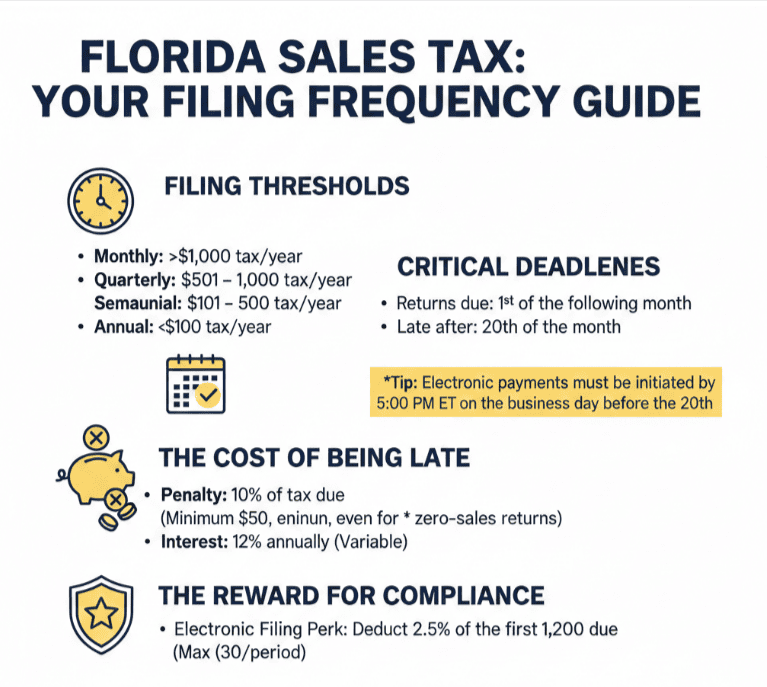
- Monthly: Collecting over $1,000 annually
- Quarterly: $501 to $1,000 annually
- Semiannual: $101 to $500 annually
- Annual: $100 or less annually
New businesses typically start quarterly unless you request otherwise. The DOR reviews accounts every year and adjusts frequencies based on actual collections. Growing fast? Expect monthly filing to show up in your inbox.
Think your frequency doesn’t match your business anymore? Call the DOR’s Taxpayer Services at 850-488-6800. They’ll evaluate whether a change makes sense.
Deadlines That Actually Matter
Here’s where businesses trip up most: Returns are due on the 1st of the month following your reporting period, but they’re not considered late until after the 20th.
January sales? Due February 1st, late after February 20th.
That grace period disappears if the 20th hits a weekend or holiday. Your deadline shifts to the next business day.
Electronic Filing Changes Everything
Filing electronically is strategic. You must initiate and confirm payments by 5:00 PM Eastern Time on the business day before the 20th to avoid penalties. Miss that window by five minutes, and you’re late.
If your business paid $5,000 or more in sales tax during Florida’s prior fiscal year (July 1 – June 30), electronic filing becomes mandatory by law starting with your January return filed in February. Non-compliance triggers additional penalties.
The upside? Florida lets you schedule electronic payments up to 30 days ahead. Set it, confirm it, and move on.
File on time electronically and Florida rewards you: 2.5% of the first $1,200 in tax due comes back as a collection allowance, maxing at $30 per reporting period. For monthly filers, that’s $360 annually. Free money for doing what you should already be doing.
What Late Filing Actually Costs You
Florida doesn’t mess around with penalties. File late and you’re hit with 10% of the tax due, minimum $50 even if you owe nothing for that period. Zero sales this period? File anyway. Florida requires zero returns, and skipping them costs you $50.
Interest piles on top at a floating rate adjusted every January 1 and July 1. For January through June 2025, that rate is 12% annually, or 0.000328767 per day.
Here’s the math: $1,000 in tax, 30 days late = $9.86 in interest. Small numbers add up fast when you’re juggling multiple missed deadlines.
Real-world example: You owe $5,000 in tax and file 30 days late. That’s a $500 penalty plus roughly $50 in interest. $550 gone for missing one deadline. Scale that across quarterly periods, and you’re hemorrhaging money that should be funding growth.
Changing Your Filing Frequency
The DOR reviews your account annually and notifies you of any changes. But you don’t have to wait for them.
If your business slows down or your tax collections drop significantly, request a frequency adjustment. The DOR evaluates eligibility on a case-by-case basis. Call 850-488-6800 with your account details ready.
Adjusting frequency isn’t about convenience, it’s about alignment. Filing monthly when you barely collect quarterly thresholds wastes time. Filing annually when you should be monthly creates massive liabilities.
Compliance Without the Headache
Keep Bulletproof Records
Your sales records, invoices, receipts, and exemption certificates are your audit defense. The Florida DOR emphasizes documentation for tax-exempt sales because that’s where disputes happen.
Maintain organized records for every transaction. Digital systems work best. Paper trails work too, if you’re consistent.
Stay Informed on Changes
Florida tax laws shift. Rates adjust. Requirements evolve. Regularly check the DOR’s website for updates, or better yet, let professionals monitor changes for you.
The DOR offers tutorials and webinars, but let’s be honest. You’re running a business, not becoming a tax scholar.
Electronic Filing Isn’t Optional
The DOR pushes electronic filing for good reason: it’s faster, more accurate, and financially rewarding. Businesses that paid $5,000 or more in sales tax during the prior fiscal year are legally required to file electronically. It’s not optional.
File and pay electronically on time, and you can deduct 2.5% of the first $1,200 due (maxing at $30 per reporting period). For monthly filers, that’s $360 annually in collection allowances. Essentially free money for staying compliant.
Professional Assistance Saves More Than It Costs
Tax compliance isn’t your core competency. Mistakes cost more than hiring experts.
Hands Off Sales Tax (HOST) specializes in sales tax compliance. Period. We determine correct filing frequencies, prepare returns, ensure timely payments, and handle state communications. You focus on revenue; we handle the compliance burden.
How HOST Simplifies Florida Sales Tax
Managing filing frequency gets complex when regulations change, deadlines multiply, and penalties loom. HOST eliminates that complexity.
Filing Frequency Optimization: We evaluate your tax collections and filing history to confirm you’re assigned the correct schedule. If adjustments are needed, we handle DOR communications.
End-to-End Filing Support: From preparing returns to ensuring payments hit on time, our experts manage state and local tax returns, exemption certificates, and rate changes.
Nexus Analysis: We determine exactly where you have tax obligations based on sales volume and physical presence across all states.
Sales Tax Registration: Need to register in Florida or elsewhere? We handle end-to-end paperwork and state communications.
Audit Defense: When audits or compliance reviews happen, we provide expert support, organize documentation, and prevent costly errors.
Voluntary Disclosure Agreements: Discovered past tax obligations? We file VDAs to limit lookback periods and significantly reduce penalties.
Free Sales Tax Software Review: Using TaxJar, Avalara, or other automation? We review configurations to ensure accuracy. Incorrectly configured systems create overpayments and compliance nightmares.
Stop Worrying About Sales Tax Deadlines
Florida sales tax compliance demands attention to detail, accurate record-keeping, and meeting deadlines consistently. Whether filing monthly, quarterly, semiannually, or annually, the penalties for getting it wrong add up fast.
Hands Off Sales Tax provides expert guidance for accurate filings, optimized frequency, and ongoing compliance. Don’t risk misfiling or overpaying. Let HOST handle the complexities. Contact us today for a consultation and eliminate sales tax stress.
Get our “10 Sales Tax Mistakes E-Commerce Sellers Make” e-book.
Frequently Asked Questions
What determines my Florida sales tax filing frequency?
The Florida DOR assigns frequencies based on total annual sales and use tax collections: over $1,000 = monthly; $501-$1,000 = quarterly; $101-$500 = semiannually; $100 or less = annually.
What are the penalties for late filing in Florida?
Florida imposes a 10% penalty with a $50 minimum, even if no tax is owed. Interest accrues daily at 12% annually (January-June 2025), calculated at 0.000328767 per day.
Can I change my filing frequency?
Yes. Contact the Florida DOR’s Taxpayer Services at 850-488-6800 to request an adjustment. They evaluate eligibility based on your actual tax collections.
What’s the deadline for Florida sales tax returns?
Returns are due on the 1st of the month following each reporting period and late after the 20th. Electronic filers must initiate payments by 5:00 PM ET on the business day before the 20th.
How can HOST help with Florida sales tax compliance?
HOST provides filing frequency optimization, sales tax registration, ongoing filing support, nexus analysis, audit defense, voluntary disclosure agreements, and free sales tax software reviews, ensuring complete compliance without the operational burden.
