
Florida sales tax penalties turn small oversights into serious financial problems fast. Miss a deadline, underreport collections, or simply didn’t know you had nexus? The state’s Department of Revenue doesn’t care why. They care that you fix it.
The difference between a manageable penalty and a budget-crushing assessment often comes down to understanding the rules and acting before problems compound. That’s where we come in.
At Hands Off Sales Tax (HOST), we’ve spent over 25 years helping businesses navigate sales tax obligations across all states. Whether you need registration help, ongoing filings, or penalty resolution, we handle the complexity so you focus on what you do best.
What Is Sales Tax in Florida?
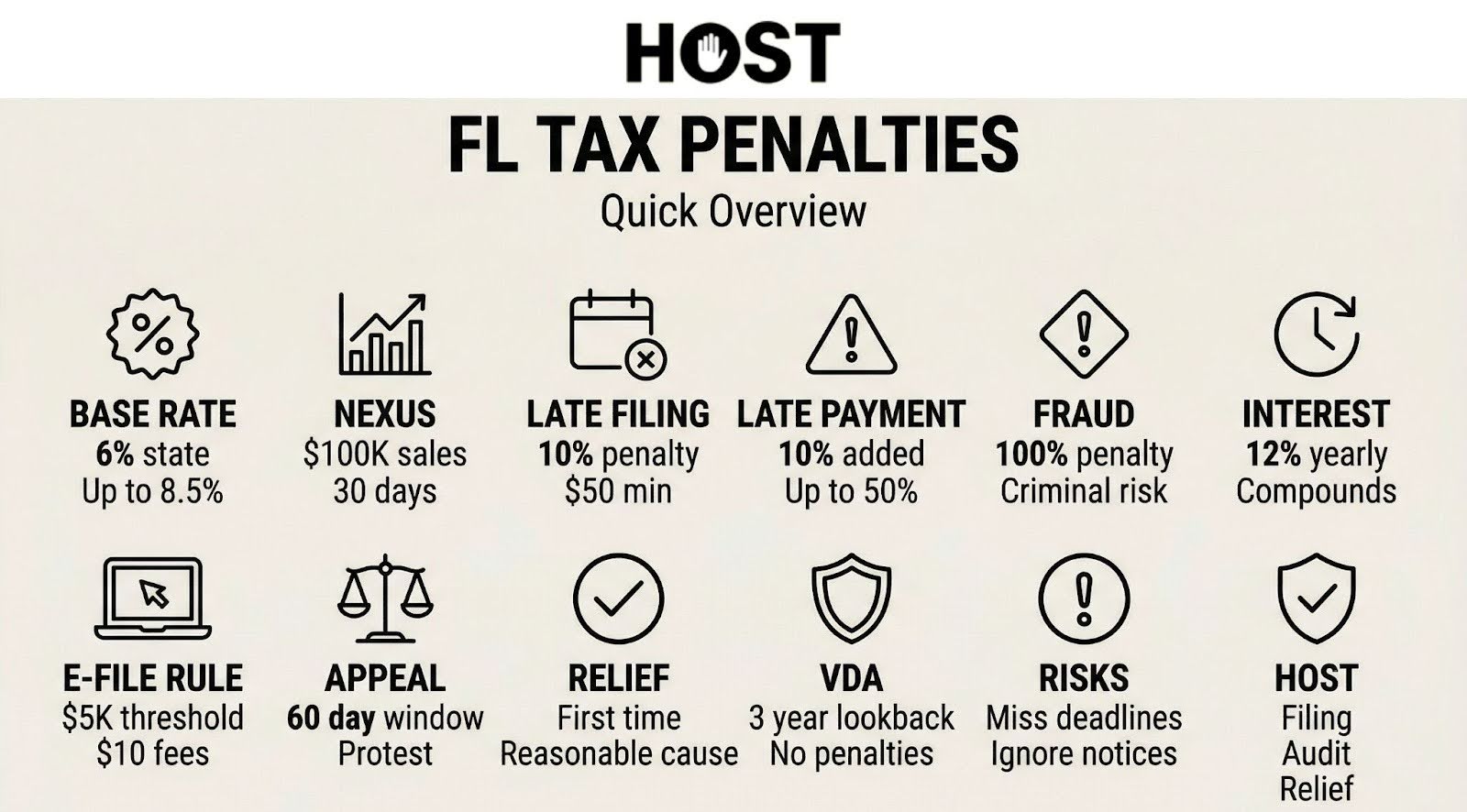
Florida imposes a 6% state sales tax on most retail transactions. Counties add discretionary surtaxes ranging from 0.5% to 2%, pushing combined rates as high as 8.5% in some areas.
The Florida Department of Revenue administers collection and enforcement. Once you have nexus, you must register, collect the appropriate tax, and remit it monthly, quarterly, or annually based on volume.
Economic nexus triggers at $100,000 in Florida sales during the previous calendar year. Cross that threshold, and you have 30 days to register and start collecting.
Common Florida Sales Tax Penalties
Late Filing Penalty
Florida charges 10% of the tax due when you file after the deadline, even if you eventually pay everything. If you file more than 60 days late, the penalty becomes whichever is greater: 10% of the tax due or $50.
That $50 minimum hits hard when you’re filing zero returns. No sales this period? File anyway. Florida doesn’t give passes for skipping paperwork.
Late Payment Penalty (Additional)
File on time but don’t pay the full amount? Florida tacks on another 10% penalty on the unpaid tax. This compounds over time, reaching a maximum of 50% of the tax owed.
The 50% cap applies to total combined penalties from both late filing and late payment, not each separately. Small comfort when you’re watching fees accumulate.
Fraud and Evasion Penalties
Florida imposes a 100% penalty when fraud or willful intent to evade taxes is proven. This requires demonstrating deliberate misrepresentation, not just negligence.
The state rarely pursues fraud penalties for honest mistakes. But repeated violations, falsified records, or intentional underreporting? That triggers investigations with consequences that double your liability overnight.
Criminal Consequences: Collecting sales tax without remitting it is treated as “stolen revenue” under Florida law. The consequences escalate based on the amount:
- Less than $300: Second-degree misdemeanor (first/second offense), third-degree felony (third offense)
- $300 to $20,000: Third-degree felony (up to 5 years)
- $20,000 to $100,000: Second-degree felony (up to 15 years)
- $100,000 or more: First-degree felony (up to 30 years)
Additionally, failing to file for six consecutive months becomes a third-degree felony regardless of amount owed. Florida doesn’t care about cash flow problems. Collected sales tax belongs to the state from the moment you receive it.
Interest Charges
Beyond penalties, Florida charges interest on unpaid taxes at a variable rate. According to the Florida Department of Revenue, the current rate is 12% per year, compounding monthly.
Interest accrues from the original due date until you pay in full. Even if you successfully appeal penalties, interest typically keeps running on the underlying tax debt.
Real-World Example: You owe $5,000 in sales tax and file 30 days late. That’s a $500 late filing penalty (10%), plus roughly $50 in interest. Total cost for missing one deadline: $550. Scale that across multiple periods, and compliance failures become expensive fast.
Electronic Filing Penalties
Businesses that paid $5,000 or more in sales tax during Florida’s prior fiscal year (July 1 – June 30) must file and pay electronically.
Fail to comply, and Florida tacks on $10 for not filing electronically plus another $10 for not paying electronically, on top of any other penalties. These $10 fees apply per violation, adding unnecessary costs to an already expensive mistake.
What Triggers a Florida Sales Tax Audit?
The Department uses data analytics to identify audit targets. Certain patterns consistently attract scrutiny.
Sharp fluctuations in reported sales without clear business reasons raise flags. If collections drop 40% one quarter and spike 60% the next without seasonal justification, expect questions.
Florida compares your reported taxable sales against industry benchmarks. If your tax collections seem disproportionately low relative to gross revenues, it suggests underreporting.
Constantly amending past returns signals potential compliance issues. Corrections happen, but a pattern indicates poor internal controls or intentional manipulation.
Florida monitors marketplace data and shipping records to identify out-of-state sellers who’ve crossed the economic nexus threshold but haven’t registered.
How to Appeal Florida Sales Tax Penalties
If you receive a penalty assessment you believe is incorrect, Florida offers formal appeal processes with specific deadlines.
Administrative Review
Request an informal conference with the Department within 60 days of receiving the penalty notice. Many penalties result from clerical errors or misunderstandings about exemptions. Providing clear evidence like proof of timely filing or documentation of exempt transactions, resolves issues at this stage.
Formal Protest
If the informal conference doesn’t work, file a formal written protest within 60 days. The protest must include specific grounds for dispute and supporting evidence. The Department reviews your protest and issues a Notice of Decision.
Administrative Hearing
Request a hearing before the Division of Administrative Hearings within 60 days of the Notice of Decision. An administrative law judge reviews evidence and issues a recommended order. This resembles court proceedings: witness testimony, document exhibits, legal arguments. Professional representation significantly improves outcomes here.
Throughout the appeals process, interest continues accruing on any unpaid tax. However, penalties are often stayed pending appeal resolution if you demonstrate good faith compliance efforts.
Penalty Waiver and Abatement Options
Florida allows penalty waivers in specific circumstances, though the burden of proof rests entirely on you.
First-Time Penalty Relief
Florida offers penalty relief for businesses with clean compliance histories. The criteria are specific:
For monthly filers: If you’ve had no noncompliant filing events in the past 12 months and no unresolved tax liabilities, Florida may waive penalties for a first violation provided you resolve the issue within 30 days of notification.
For quarterly filers: Same standard applies. Clean 12-month history qualifies you for potential relief.
Two or more violations: Once you’ve had multiple noncompliant events in a 12-month period, only “extraordinary circumstances” qualify for penalty abatement. The bar gets significantly higher.
This first-time relief provision rewards consistent compliance. One mistake doesn’t destroy your track record, but patterns of noncompliance eliminate your options.
Reasonable Cause
If you can demonstrate that failure to comply resulted from circumstances beyond your control, Florida may waive penalties. Acceptable reasons include natural disasters that prevented filing, serious illness or death of the person responsible for tax compliance, unavoidable postal delays with proof of timely mailing, or reliance on erroneous written advice from the Department.
Reasonable cause doesn’t include financial hardship, ignorance of the law, or general business difficulties.
Voluntary Disclosure Agreements
If you discover past non-compliance before the Department contacts you, a Voluntary Disclosure Agreement (VDA) can limit lookback periods and waive penalties.
Florida typically limits the lookback to three years for VDA participants and waives penalties entirely if you agree to register, pay back taxes with interest, and maintain future compliance.
HOST specializes in negotiating VDAs with Florida and other states, helping businesses resolve past liabilities while minimizing financial impact.
Best Practices to Avoid Penalties
Prevention beats resolution every time. And Florida actually rewards compliance.
Collection Allowance: Get Paid for Doing It Right
Florida offers a vendor collection allowance of 2.5% on the first $1,200 of tax due each period: up to $30 per reporting location monthly. File and pay on time electronically, and you keep this discount.
Over a year, that’s $360 back in your pocket for simply meeting your obligations. Miss deadlines, and you forfeit this benefit while accumulating penalties. The math makes compliance the obvious choice.
Mark Your Deadlines
Set up multiple reminders two weeks before filing dates. Returns are due on the first day of the month following the reporting period, with payment due on the 20th.
Critical detail for electronic filers: You must initiate your electronic payment and receive confirmation by 5 PM ET on the business day before the 20th. Miss that window, and you’re late even if you tried to file on the 20th itself.
Automate Wisely
Sales tax automation software calculates rates and generates returns, but proper configuration matters. HOST offers a Free Sales Tax Software Review to identify configuration issues that could lead to underreporting.
Keep Detailed Records
Florida requires businesses to keep detailed records of all sales, exemptions, and tax collected for three years. Inadequate documentation makes defending against audits or penalties nearly impossible.
Register Promptly
The 30-day registration window after crossing economic nexus is firm. Waiting until you’re “ready” exposes you to penalties from day one. HOST provides comprehensive nexus analysis services to identify exactly when you’ve triggered obligations.
Respond to Notices Immediately
Ignoring Department correspondence never improves your situation. Notices have strict response deadlines, and missing them forfeits your appeal rights. HOST’s notice management service interprets state notices and responds appropriately.
Can’t Pay? Communicate Anyway
If you can’t pay the full amount, contact the Department immediately to discuss payment plan options. Florida allows structured payment arrangements that prevent collection actions like liens, bank levies, or license revocation. Ignoring the debt guarantees the worst outcome, communication creates options.
When to Get Professional Help
Some situations demand professional expertise beyond general accounting knowledge.
If you’ve received an audit notice, accumulated multiple periods of unfiled returns, or face fraud allegations, the financial stakes justify specialist involvement.
Businesses expanding into Florida often underestimate compliance complexity. Florida’s discretionary surtaxes create over 300 distinct tax jurisdictions, each with specific rates. Getting this wrong from day one creates penalty exposure that compounds over time.
HOST: Your Partner for Florida Sales Tax Compliance
Florida sales tax penalties represent avoidable costs that drain resources without adding value. Whether facing current assessments or wanting to prevent future issues, professional support ensures compliance without diverting focus from your core business.
What HOST Delivers:
- Nexus Analysis: We determine exactly when you triggered Florida obligations and identify any lookback exposure
- Sales Tax Registration: We handle Florida registration paperwork, including navigating discretionary surtax jurisdictions
- Ongoing Filing: We prepare and file your Florida returns on schedule, eliminating late filing penalties
- Penalty Resolution: We negotiate with the Florida Department of Revenue to minimize or eliminate penalty assessments
- Audit Defense: We represent you throughout Florida audits, organizing documentation and challenging incorrect assessments
- VDA Negotiation: We secure voluntary disclosure agreements that limit lookback periods and waive penalties
Founded by Mike Espenshade in 1999, HOST has focused exclusively on sales tax for over 25 years. Through our parent company TaxMatrix, we’ve served some of North America’s largest companies, and now we bring that expertise to e-commerce businesses of all sizes.
Ready to Resolve Your Florida Sales Tax Issues?
Florida sales tax penalties shouldn’t threaten your business or consume your time. Whether facing penalty assessments, struggling with ongoing compliance, or expanding into Florida for the first time, the right partner eliminates uncertainty and protects your interests.
Contact HOST today to discuss your Florida sales tax situation. Our team will analyze your specific circumstances and recommend solutions that minimize risk while keeping you compliant.
You handle the sales, we handle the tax.
Frequently Asked Questions
What is the penalty for filing Florida sales tax returns late?
Florida charges a 10% penalty on the tax due when you file late. If you file more than 60 days late, the penalty increases to the greater of 10% of the tax due or $50.
Can Florida sales tax penalties be waived?
Yes, Florida may waive penalties if you demonstrate reasonable cause—circumstances beyond your control that prevented compliance despite exercising ordinary business care. Natural disasters, serious illness, or reliance on erroneous written advice from the Department can qualify.
How long does Florida have to assess sales tax penalties?
Florida generally has three years from the due date of the return to assess additional tax and penalties. However, if you file a fraudulent return or don’t file at all, there’s no statute of limitations.
What happens if I can’t pay my Florida sales tax penalties?
Contact the Florida Department of Revenue immediately to discuss payment plan options. Ignoring the debt leads to collection actions including liens, levies, and revocation of your sales tax permit. HOST can help negotiate manageable payment arrangements.
Does Florida charge interest on sales tax penalties?
No, Florida charges interest only on the underlying tax debt, not on penalties. However, the current 12% annual interest rate means even small tax liabilities grow quickly when left unpaid.
How do I know if I have nexus in Florida?
You have economic nexus in Florida if your sales to Florida customers exceeded $100,000 in the previous calendar year. Physical presence, including inventory in Florida warehouses or employees working in the state, also creates nexus. HOST provides comprehensive nexus analysis to identify all your obligations.
