
A Texas sales tax audit notice in your mailbox feels like a sucker punch. You’re running a business, not navigating tax mazes; yet here you are, staring at paperwork that could cost you thousands.
The stakes are real. Approximately 50% of Texas audits result in assessments, and without proper preparation, you’re facing penalties that compound, interest backdated to original due dates, and assessments that spiral beyond what you actually owe.
Hands Off Sales Tax (HOST) has spent over 25 years helping businesses navigate these exact scenarios. Whether you’re holding that first audit notice or deep in negotiations with an auditor, understanding the process (and your options) makes all the difference.
What Triggers Texas Sales Tax Audits?
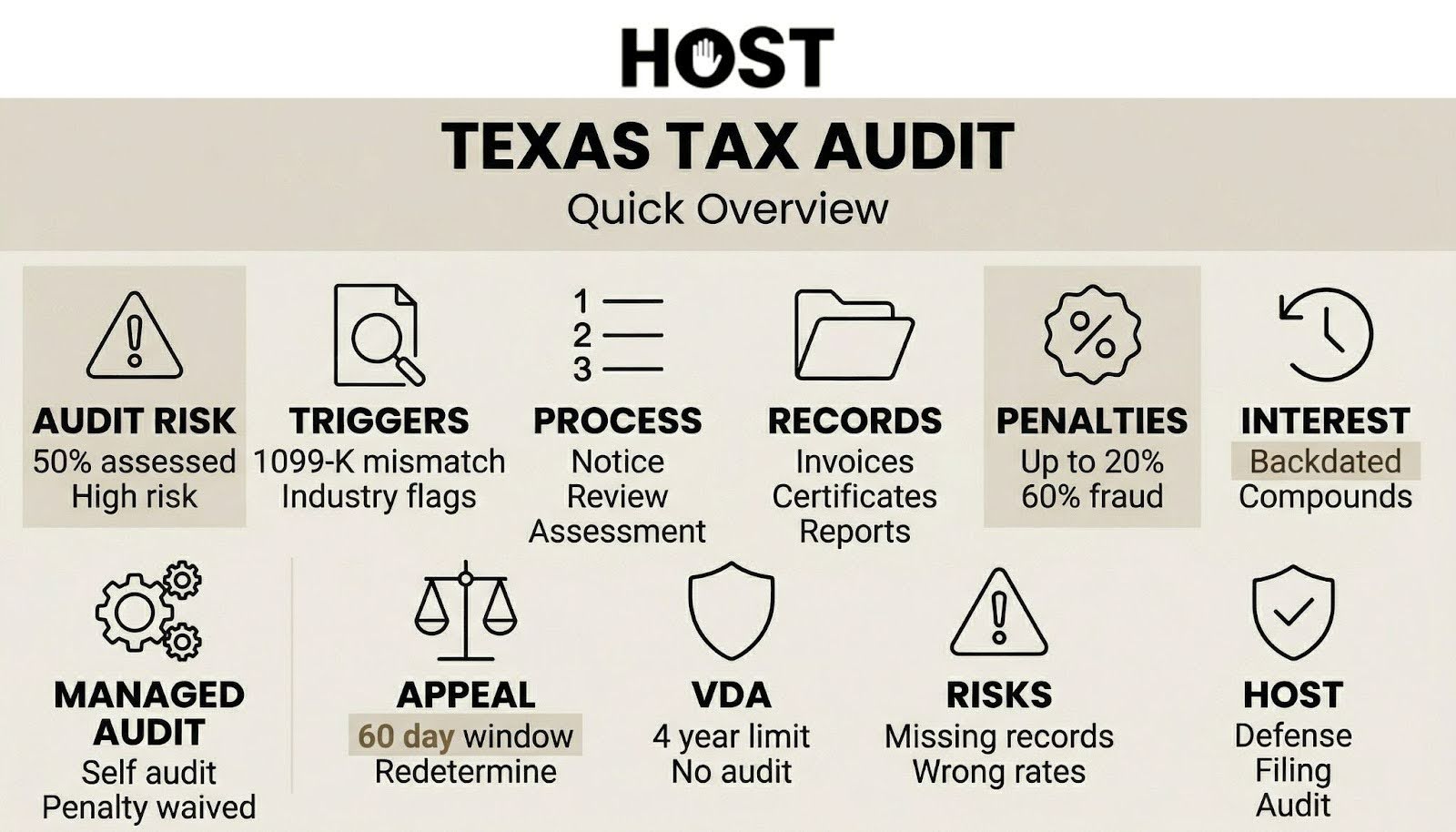
Texas doesn’t audit randomly. The Comptroller uses specific selection methods:
Priority One Accounts get scrutinized first. The state’s largest taxpayers based on reported sales tax.
Prior Productive Accounts face heightened risk. If your business owed $10,000+ in a previous audit, expect another visit within three to four years.
Red Flags trigger investigations: 1099-K mismatches, unusual exemption patterns, discrepancies between sales and industry benchmarks.
Industry Targeting hits hard. Restaurants serving alcohol face particularly high audit rates due to cash transactions. Construction companies, auto dealers, bars, and SaaS businesses also face heightened scrutiny.
Local Jurisdiction Complexity: Texas has over 900 local jurisdictions with 1,600+ different taxing combinations. One wrong local rate across city or county lines becomes an audit issue.
The Audit Process: What Actually Happens
Initial Notice
You’ll receive Form 00-750, the Audit Questionnaire. Respond promptly. Ignoring it establishes liability even without your participation.
Entrance Conference
The auditor wants to understand your operations, accounting systems, and record-keeping. This conversation determines what documentation they’ll request and sets the audit timeline.
Fieldwork
Auditors examine your records comprehensively or through sampling. If sampling, they must explain how errors project across the entire audit period.
Required records include sales invoices, purchase invoices, general ledgers, financial statements, resale/exemption certificates, and point-of-sale reports.
Proposed Assessment
The auditor provides schedules identifying potential overpayments or underpayments. Their write-up must explain the legal basis for any proposed assessment.
Common Audit Problems
Missing Exemption Certificates destroy your defense. Texas requires properly executed certificates in your possession at transaction time. Good news: you get sixty days after written notification to obtain missing certificates.
Inadequate Records force auditors into estimation mode. One documented case showed a business without acceptable records facing a 50% penalty on top of estimated tax and interest. The judge had no choice but to rule against them.
Local Tax Rate Errors create exposure even when state tax is correct. Texas’s multi-layered system: state, county, city, special districts, makes precision critical.
Financial Consequences That Hurt
Penalties
Standard penalties: $50 per late report, 5% for payments 1-30 days late, additional 5% beyond 30 days.
Audit deficiencies carry a 10% penalty. If you don’t pay within 10 days of finalization, another 10% stacks on—potentially 20% total.
Fraud or intentional evasion? Penalties reach 60% of the tax deficiency.
Tax Collected But Not Remitted: The Comptroller treats this violation extremely seriously. If you collected sales tax from customers but failed to remit it to the state, expect aggressive enforcement including criminal exposure.
Interest That Compounds
Here’s the painful part: interest accrues beginning 61 days after the original due date, not the audit date. The rate is the prime rate plus one percent, adjusted annually.
So if you filed a return due June 21, 2021, and an August 2023 audit finds $5,000 underpaid, interest backdates to August 21, 2021 and compounds until full payment.
The Managed Audit Alternative
Texas’s Managed Audit Program lets cooperative taxpayers conduct their own audit under Comptroller oversight.
Benefits: Control the timeline, waive penalties entirely, reduce or eliminate interest (fraud excluded).
Reality: The data work and documentation demands are brutal. Most businesses hire professionals to run the managed audit, obtaining benefits without the technical nightmare.
Requirements: Submit written request within 60 days of receiving the Audit Notification Letter. The Comptroller evaluates your cooperation history before approving.
Your Appeal Rights
Disagree with findings? You have options.
Redetermination Hearing
You must file a request for redetermination within 60 days from the date on the audit notice. This initiates an independent review outside the Audit Division. Missing this 60-day deadline makes the assessment final, allowing Texas to issue tax liens, freeze bank accounts, revoke permits, and initiate aggressive collections.
State Office of Administrative Hearings (SOAH)
If redetermination fails, escalate to SOAH: Texas’s tax court. An Administrative Law Judge hears your case. Most settle before trial, but litigation readiness provides negotiating leverage.
Voluntary Disclosure: Stop Problems Before They Start
Texas’s VDA program lets businesses resolve past liabilities before audit, preventing audits entirely.
The advantage: Four-year lookback cap, regardless of how long you had nexus or failed to file. The program typically eliminates penalties and interest.
Critical timing: The state cannot already be investigating you. Once audit proceedings begin, VDA disappears.
Perfect for remote sellers, e-commerce companies, and growing businesses that didn’t realize they’d triggered nexus obligations.
Why Professional Help Matters
Texas auditors work for the state. Auditor performance metrics include “tax dollars assessed per hour” statistics that factor into promotion decisions.
Staffing fluctuated from 589 to 445 auditors over five years. New, inexperienced auditors combined with unchanged volume targets means aggressive approaches and service issues requiring supervisor escalation.
Personal Liability Risk
Under Texas Tax Code §111.024, business owners and officers can be held personally liable if the business transfers assets to avoid taxes or willfully underpays. Tax debts can grow so large the business cannot pay them. When that happens, Texas pursues the owner personally for back taxes, penalties, and interest.
This isn’t theoretical. Business owners regularly face personal liability when audits reveal substantial unpaid taxes. Your personal assets like home, savings, investments, become collection targets.
Professional representation:
- Manages all communications preventing costly admissions
- Structures defense with Texas-specific tactics
- Identifies overlooked credits reducing assessments
- Negotiates penalty abatements and settlements
- Files corrections if bad information was provided
- Protects against personal liability exposure
- Escalates to redetermination and SOAH when necessary
How HOST Helps With Texas Audits
Audit Defense
Preparation & Strategy: We identify red flags before auditors find them, organize documentation, and develop strategic responses.
Complete Representation: We’re your direct liaison with Comptroller auditors, managing communications and defending your positions.
Penalty Reduction: Through reasonable cause arguments and negotiation, we pursue full penalty abatement and interest reduction.
Dispute Resolution: We handle redetermination requests, hearings, and appeals with documentation and legal arguments needed for fair outcomes.
Proactive Compliance
Nexus Analysis: We analyze business activities: physical presence, employee travel, warehousing, and sales thresholds, determining where you’ve triggered Texas obligations.
Voluntary Disclosure Agreements: We handle the entire VDA process including anonymous pre-clearance, negotiation, amended returns, and final disclosure.
Sales Tax Registration: We manage Texas Comptroller registration, completing paperwork and navigating state-specific requirements.
Ongoing Filing: We prepare and file Texas returns (monthly, quarterly, annually), ensuring accuracy that reduces future audit risk.
Certificate Management: We build systems to capture, validate, and store exemption certificates. Your best defense.
Real Results: $350,000+ Assessment Reduced
A Texas auto dealer mid-audit faced $350,000+ in assessments for incomplete exemption documentation on out-of-state and wholesale vehicle sales.
Once representation took over:
- Restructured the audit approach
- Located supplemental documentation
- Negotiated reduced projection methodology
- Presented reasonable cause arguments
Result: Significant reduction at audit stage, further decrease on redetermination appeal. Case resolved at a fraction of original liability, penalties fully waived, manageable payment plan established.
Act Now to Protect Your Business
Texas audits carry real consequences. Half result in assessments, penalties compound, interest backdates. But with preparation, strategic representation, and expert negotiation, businesses minimize liability and achieve favorable outcomes.
We’ve helped businesses navigate Texas audits for over 25 years, combining deep technical expertise with proven negotiation skills.
Don’t face Texas auditors alone. Contact Hands Off Sales Tax today to discuss your audit situation and learn how we protect businesses from excessive assessments.
Learn more about our Audit Defense services or schedule a consultation to discuss your specific situation.
Frequently Asked Questions
How long does a Texas sales tax audit take?
Duration varies based on business size, record quality, and complexity. Simple audits with organized records conclude in months. Complex cases with missing documentation or disputes extend 12-18 months or longer. Managed audits progress faster with organized records and prompt responses.
Can penalties be waived in Texas sales tax audits?
Yes, often. Auditors automatically consider waivers, particularly when returns were filed on time and businesses demonstrate good faith. Reasonable cause arguments, managed audit participation, and voluntary disclosures frequently lead to full abatement. Interest is harder to waive but can be reduced depending on timing and appeals.
What happens if I can’t provide all requested records?
Insufficient documentation forces auditors to estimate liability using alternative methods, typically resulting in higher assessments. You may need to recreate records with forensic accountants, banks, vendors, or point-of-sale systems. Professional representation becomes especially valuable when records are incomplete.
What is the statute of limitations for Texas sales tax audits?
Texas has a four-year statute for assessing sales and use tax. Exceptions extend this for false or fraudulent returns, failure to file, or agreeing to extensions. Always review audit notices for potential violations that could force the Comptroller to drop the audit.
What happens if I collected sales tax but didn’t remit it?
The Comptroller treats this extremely seriously. Collecting tax from customers but failing to remit it creates criminal exposure beyond standard audit penalties. This violation often triggers personal liability against business owners and aggressive enforcement including potential prosecution.
Should I handle a Texas audit myself or hire help?
While representation isn’t legally required, Texas audits are notably more challenging than other states. Auditors work for the state with performance metrics incentivizing assessments, regulations are complex, and mistakes during audits significantly increase liability. Professional representation typically reduces assessments substantially, often more than offsetting costs.
What if I disagree with the audit assessment?
You have 60 days from the audit notice to file a redetermination request. This triggers independent review and opportunity to present additional documentation or arguments. If redetermination doesn’t resolve disputes, escalate to State Office of Administrative Hearings for formal hearing before an Administrative Law Judge. Missing the 60-day deadline makes assessments final and allows aggressive collections.
