
The Naperville IL sales tax rate creates layers of complexity that catch businesses off guard. Between state requirements, local add-ons, and downtown-specific levies, knowing what to collect requires precision, not guesswork.
For businesses serving Naperville customers, these layered rates mean one address error leads to under-collection or over-collection. Both cause problems during audits.
That’s where Hands Off Sales Tax (HOST) helps. We navigate multi-jurisdiction complexity across all 45+ states with sales tax, ensuring you collect correctly in Naperville and everywhere else you operate.
Understanding Naperville’s Sales Tax Structure
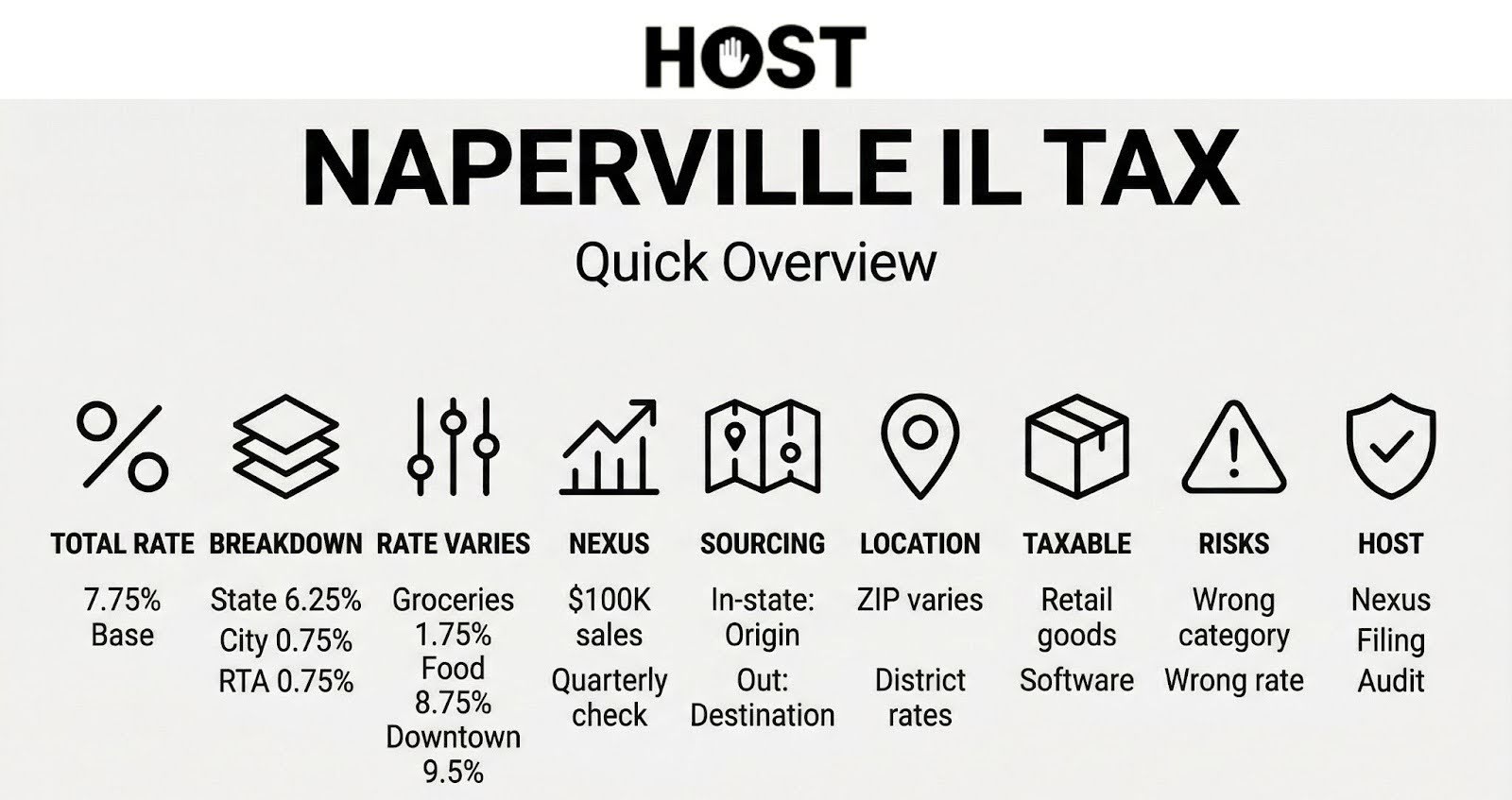
Naperville’s combined sales tax rate is 7.75% for general merchandise. This rate consists of:
- Illinois state sales tax: 6.25%
- City of Naperville Home Rule Sales Tax: 0.75%
- Regional Transportation Authority (RTA) tax: 0.75%
The City of Naperville, as a home-rule community, implemented the 0.75% Home Rule Sales Tax (HRST) to fund capital projects and debt payments. This locally imposed tax provides consistent funding for infrastructure improvements.
The HRST does not apply to automobile sales, groceries, or qualified healthcare items.
Product-Specific Tax Rates in Naperville
Not all purchases face the same tax rate:
General Merchandise: 7.75% total rate
Electronics, appliances, clothing, furniture, and most tangible personal property. All clothing purchases are fully taxable with no exemptions regardless of price.
Groceries and Qualified Medical Items: 1.75% total rate
Food not prepared for immediate consumption receives reduced-rate treatment. Qualifying drugs and medical appliances also fall under this lower rate.
Food for Immediate Consumption (Standard): 8.75% total rate
Restaurant meals, carry-out orders, and prepared foods face an additional 1% citywide food and beverage tax funding the Special Events & Cultural Amenities (SECA) program.
Food for Immediate Consumption (Downtown): 9.50% total rate
Businesses in the downtown area collect an additional 0.75%, bringing the total food and beverage tax to 1.75%. This funds construction and maintenance of public parking facilities within downtown boundaries.
Software and Digital Products
Prewritten software delivered electronically and Software-as-a-Service (SaaS) are generally taxable in Illinois. This applies to cloud-based software subscriptions, downloadable software, and electronic access to software platforms.
Custom software created for a specific client typically receives different treatment than prewritten software sold to multiple customers. The specifics of your software delivery model determine your tax obligations.
If you’re selling software or digital services into Naperville, HOST can analyze your specific situation and ensure correct tax treatment across all jurisdictions.
Sales Tax Variations by ZIP Code
Naperville spans multiple ZIP codes, and rates vary by location:
The average combined tax rate across all ZIP codes is approximately 8.25%. The variation stems from special district taxes overlaying certain areas.
Special Business District Tax Rates
Beyond ZIP code variations, Naperville has designated business districts with higher rates:
Heinen Business District: 8.25% total rate (7.75% base + 0.50% district tax)
Block 59 Business District: 8.75% total rate (7.75% base + 1.00% district tax)
If your retail location falls within these specific business districts, you must collect the higher rate. The boundaries are precisely defined, and businesses just outside these districts collect the standard 7.75% rate.
For accurate compliance, you need address-level validation. Simply knowing the city isn’t enough. The specific street address determines which special taxes apply.
Illinois Economic Nexus Requirements
Even without physical presence in Illinois, you may be required to collect Naperville sales tax based on economic activity.
Illinois requires remote sellers to collect sales tax if they exceed $100,000 in gross sales to Illinois customers in the preceding 12 months. As of January 1, 2026, Illinois eliminated the 200-transaction threshold, simplifying nexus to a single sales-based threshold.
Remote retailers must assess their sales quarterly on the last day of March, June, September, and December, to determine if they meet or exceed the $100,000 threshold for the preceding 12-month period.
Once you cross this threshold, you must:
- Register for an Illinois sales tax permit through MyTax Illinois
- Begin collecting appropriate state and local sales tax on taxable sales shipped to Illinois addresses
- File returns and remit collected taxes according to your assigned schedule
Sales made through marketplace facilitators like Amazon are excluded from your threshold calculation when the facilitator properly collects tax on your behalf. Direct sales through your own website always count.
HOST provides comprehensive nexus analysis to determine exactly where you’ve triggered collection obligations across all states.
Origin-Based vs. Destination-Based Sourcing
Illinois uses different sales tax sourcing rules depending on whether a sale is intrastate or interstate.
Intrastate Sales (Origin-Based)
Illinois uses origin-based sales tax sourcing for intrastate sales. When both seller and buyer are in Illinois, you charge the sales tax rate at your business location, not the customer’s address.
If your business operates in Peoria and you sell to a Naperville customer, you charge the Peoria rate, not Naperville’s.
Interstate Sales (Destination-Based)
For interstate sales, Illinois uses destination-based sourcing. If you’re located outside Illinois and sell to an Illinois customer, you charge the tax rate at the buyer’s location.
This dual-sourcing approach creates complexity. Misconfiguring your sales tax software for Illinois sourcing rules leads to systematic errors affecting every transaction.
Common Compliance Challenges
Product Classification Errors
Determining whether an item qualifies as general merchandise (7.75%), groceries (1.75%), or prepared food (8.75% or 9.50%) requires understanding Illinois tax law. A single misclassification affects your entire inventory of that product type.
Downtown Boundary Confusion
Restaurants must know precisely whether their location falls within the downtown food and beverage tax district. The downtown boundaries are specifically defined, and businesses just outside those lines collect different rates.
Software Configuration Issues
Sales tax automation tools require proper setup for Illinois’ origin-based intrastate sourcing combined with destination-based interstate sourcing. Without correct configuration, your software may apply wrong rates to every Illinois transaction.
Filing Frequency Confusion
Illinois assigns filing frequencies based on average monthly tax liability:
- Monthly filing: Average monthly liability exceeding $200
- Quarterly filing: Average monthly liability between $50 and $200
- Annual filing: Average monthly liability below $50
As your business grows, your filing frequency may change. The Illinois Department of Revenue will notify you of frequency changes, but missing the transition or filing on the wrong schedule triggers penalties. Businesses with average monthly liability of $20,000 or more must make quarter-monthly accelerated payments on the 7th, 15th, 22nd, and last day of each month.
These challenges explain why many businesses spend 30+ hours monthly managing sales tax compliance. Time that generates zero revenue.
How HOST Simplifies Multi-State Compliance
Hands Off Sales Tax takes the sales tax burden completely off your plate:
Nexus Analysis: We analyze your sales data to determine exactly where you’ve met economic or physical nexus thresholds across all states, including Illinois’ $100,000 requirement.
Sales Tax Registration: We handle registration paperwork with the Illinois Department of Revenue and all other applicable jurisdictions, managing follow-up and communications.
Ongoing Sales Tax Filings: We prepare and file your returns monthly, quarterly, or annually, including all local and special district returns for places like Naperville.
Sales Tax Software Review: We offer a Free Sales Tax Software Review to identify costly configuration errors like overtaxing exempt items, applying wrong sourcing rules, or double-taxing due to system overlaps.
Notice Management: When you receive confusing letters from the Illinois Department of Revenue or any state tax agency, we interpret what they mean and respond appropriately.
Audit Defense: We act as your trusted partner in resolving sales tax audits, organizing documentation and defending your position to minimize liability.
Voluntary Disclosure Agreements: If you discover past obligations in Illinois or other states, we file VDAs to limit lookback periods and abate penalties.
We’ve been 100% focused on sales tax since 1999. That’s over 25 years managing compliance so you can keep your hands on your business. Through our parent company TaxMatrix, we’ve helped some of North America’s largest companies navigate sales tax requirements, and now we bring that expertise to small and mid-sized e-commerce sellers.
Ready to Simplify Your Naperville Sales Tax Compliance?
Understanding the Naperville IL sales tax rate is just the beginning. Accurately collecting across multiple ZIP codes, product categories, and special districts while managing Illinois’ unique sourcing rules and economic nexus thresholds demands expertise and constant attention.
Every hour spent researching tax rates, configuring software, or filing returns is an hour not spent growing your business. Mistakes lead to audits, penalties, and back taxes that can devastate cash flow.
Contact HOST today to discuss your sales tax needs or schedule a free consultation. Let us handle the tax so you can focus on sales.
Want to learn more? Get our “10 Sales Tax Mistakes E-Commerce Sellers Make” e-book.
Frequently Asked Questions
What is the current sales tax rate in Naperville, Illinois?
The combined sales tax rate in Naperville is 7.75% for general merchandise, consisting of 6.25% Illinois state tax, 0.75% City of Naperville Home Rule Sales Tax, and 0.75% Regional Transportation Authority tax. However, rates vary for groceries (1.75%), prepared food (8.75%), and downtown restaurant sales (9.50%).
Do I need to collect Naperville sales tax if I’m located outside Illinois?
Yes, if your business exceeds $100,000 in gross sales to Illinois customers in the preceding 12 months. Illinois’ economic nexus law requires remote sellers meeting this threshold to register, collect, and remit sales tax regardless of physical presence. The 200-transaction threshold was eliminated effective January 1, 2026.
How do I determine which Naperville tax rate to charge?
The correct rate depends on product type, customer location, and whether the sale is intrastate or interstate. Illinois uses origin-based sourcing for intrastate sales and destination-based sourcing for interstate sales. Address-level validation is essential for accuracy.
Is software taxable in Naperville?
Yes, prewritten software delivered electronically and Software-as-a-Service (SaaS) are generally taxable in Illinois. This includes cloud-based subscriptions and downloadable software. Custom software created for specific clients may receive different treatment.
What’s the difference between the citywide and downtown food and beverage tax?
The citywide food and beverage tax is 1.0% and applies to prepared food throughout Naperville. Businesses in the defined downtown district collect an additional 0.75% (total 1.75%) to support downtown parking facility construction and maintenance.
How can I ensure I’m charging correct sales tax rates across Illinois?
Sales tax rates vary significantly across Illinois’ 13,000+ jurisdictions, with frequent changes throughout the year. Most businesses use sales tax automation software, but proper configuration is critical. HOST offers a Free Sales Tax Software Review to identify configuration mistakes before they become audit problems, and we handle ongoing compliance to ensure you’re always collecting correctly.
