
Managing sales tax in Schaumburg means navigating a 10% combined rate that layers state, county, municipal, and special district taxes. For businesses selling into this northwest Chicago suburb of approximately 76,800 residents, getting the rate right prevents audit nightmares.
Cross Illinois’ $100,000 economic nexus threshold, and collection becomes mandatory, even without a physical presence. That’s where Hands Off Sales Tax (HOST) eliminates the complexity, handling nexus analysis, registration, and filing so you focus on growth instead of tax codes.
Breaking Down Schaumburg’s 10% Sales Tax Rate
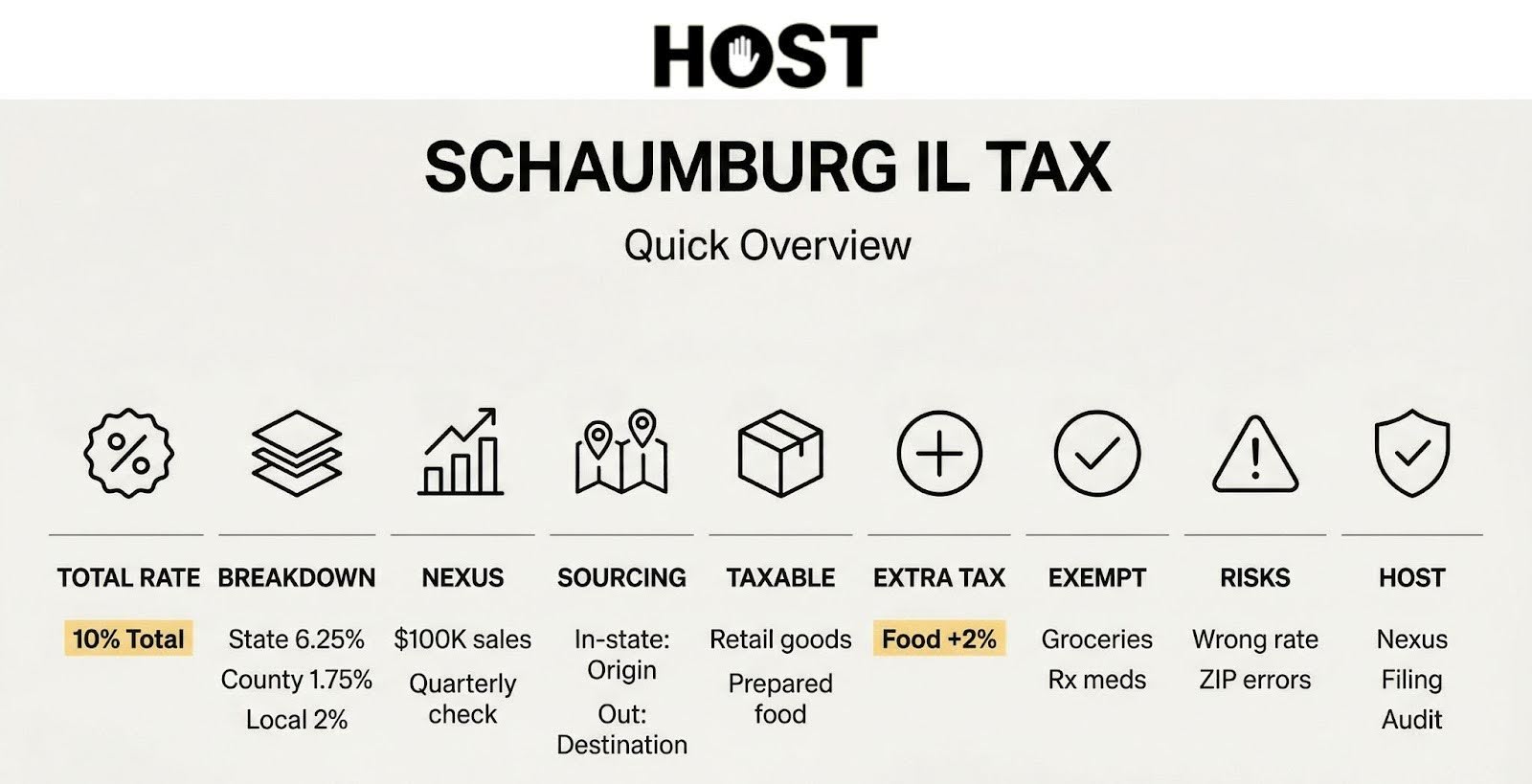
The 10% Schaumburg sales tax rate stacks four distinct layers. Understanding each helps you calculate correctly and explain the charges to customers.
Illinois State Sales Tax: 6.25%
Illinois levies a 6.25% statewide sales tax on most retail transactions, funding education, infrastructure, and public services across the state.
Cook County Sales Tax: 1.75%
Cook County adds 1.75% to transactions within its boundaries. Since Schaumburg sits primarily in Cook County, this layer funds regional services including healthcare and forest preserves.
Schaumburg Municipal Tax: 1%
The Village of Schaumburg imposes a 1% local sales tax supporting police, fire protection, and local infrastructure.
Special District Tax: 1%
An additional 1% special district tax funds the Regional Transportation Authority (RTA), supporting public transit across the Chicago metropolitan area.
Total: 10%
A $100 purchase in Schaumburg costs customers $110 after tax. $6.25 to Illinois, $1.75 to Cook County, $1 to Schaumburg, and $1 to the RTA.
How Illinois Economic Nexus Affects Your Business
The 2018 Wayfair decision rewrote the rules. Physical presence no longer determines who collects Illinois sales tax. Sales volume does.
The $100,000 Threshold
Illinois requires remote sellers to collect sales tax once they exceed $100,000 in gross receipts from Illinois customers in the preceding 12 months. Illinois eliminated the 200-transaction threshold effective January 1, 2026, simplifying compliance.
Now your business creates a collection obligation based solely on sales volume. Hit $100,000 in annual Illinois sales (whether through 50 transactions or 5,000) and you must register.
Quarterly Monitoring Required
Illinois requires businesses to assess nexus quarterly on the last day of March, June, September, and December. Calculate gross receipts for the prior 12-month period. Once you exceed $100,000, begin collecting on the first day of the quarter immediately following.
Miss this deadline? You’re facing penalties, interest, and back-tax liability.
What Counts Toward the Threshold
The $100,000 threshold includes all gross receipts from tangible personal property sales to Illinois customers. Both taxable and exempt transactions. Wholesale sales to registered resellers don’t count. Neither do sales through marketplace facilitators like Amazon when those platforms properly collect tax.
HOST’s nexus analysis service examines your sales data across all states, pinpointing exactly where obligations exist.
Origin vs. Destination Sourcing in Illinois
How you calculate which rate to charge depends on whether your transaction is intrastate or interstate.
Intrastate Sales: Origin-Based
For sales where both seller and buyer are in Illinois, the state uses origin-based sourcing. You charge the sales tax rate at your business location, not the customer’s address.
Your Schaumburg business selling to a Chicago customer? Charge Schaumburg’s 10% rate even if Chicago’s combined rate differs.
Interstate Sales: Destination-Based
When your business is outside Illinois selling to Illinois customers, destination-based sourcing applies. You charge the tax rate at the customer’s location.
A Texas-based online retailer shipping to Schaumburg must collect Schaumburg’s 10% rate. Shipping to Naperville requires Naperville’s rate. For remote sellers, accurate address validation becomes critical.
Beyond Sales Tax: Schaumburg’s Complete Tax Landscape
While the 10% sales tax applies to most purchases, Schaumburg businesses navigate several additional taxes that catch newcomers off guard.
The 2% Food and Beverage Tax
The Village of Schaumburg charges a 2% food and beverage tax on prepared foods and drinks, collected at point of sale and remitted directly to the village, not through the Illinois Department of Revenue.
Restaurants in Schaumburg effectively charge customers 12% total tax on meals: the 10% standard sales tax plus the 2% food and beverage tax. This dual obligation requires separate tracking and remittance. Any business preparing or serving food and beverages for immediate consumption must register: restaurants, bars, cafeterias, and caterers all qualify.
Groceries and Essentials Get Relief
Not everything faces the full 10% rate. Grocery items are exempt from Schaumburg’s 1% home-rule tax, facing only 8% total (6.25% state + 1.75% Cook County). Prescription drugs and licensed vehicles receive the same exemption, providing meaningful savings on essential purchases.
Additional Business Taxes
Motor Fuel Tax: Gas stations collect an additional 3 cents per gallon local motor fuel tax on top of state and federal taxes, remitted monthly to the village via the Local Motor Fuel Tax Form.
Telecommunications: Phone and telecom services face a 6% simplified telecommunications tax, administered and collected by the State of Illinois.
Cannabis Retailers: Dispensaries operating in Schaumburg collect 3% Municipal Cannabis Retailers’ Occupation Tax plus 3% Cook County cannabis tax, layered on top of state cannabis excise taxes ranging from 10-25% depending on THC content.
Electricity Tax: As of May 2024, the village imposes 0.61 cents per kilowatt-hour on the first 2,000 kWh consumed monthly, with different rates applying to higher usage tiers.
The DuPage County Exception
Schaumburg straddles two counties. While most of the village sits in Cook County (10% rate), portions extend into DuPage County where rates range from 8% to 8.75%. Address-level validation ensures you charge the correct rate. ZIP codes alone don’t determine jurisdiction boundaries.
For rate verification: Cook County Revenue (312-603-6870), DuPage Tax Revenue (630-407-5540), or Illinois Department of Revenue (800-732-8866).
Common Mistakes That Trigger Audits
Applying Wrong Sourcing Rules
Illinois-based retailers incorrectly charging their location’s rate to out-of-state customers, or remote sellers mistakenly using their own state’s rate for Illinois sales. Each creates compliance gaps.
Misconfiguring Tax Software
Popular platforms require precise configuration to calculate Illinois rates correctly. Failing to enable destination-based sourcing for interstate sales, or incorrectly mapping ZIP codes to tax jurisdictions, causes systematic errors across thousands of transactions.
ZIP codes don’t perfectly align with tax jurisdictions. Some Schaumburg ZIP codes cross into neighboring municipalities with different rates.
Ignoring the Food and Beverage Tax
Restaurant owners focusing on state sales tax obligations sometimes miss Schaumburg’s separate 2% food and beverage tax entirely, creating immediate non-compliance.
Delaying Registration
Businesses that cross Illinois’ $100,000 threshold often delay registration, assuming they have time. Illinois actively pursues remote sellers. Discovery during an audit means back taxes, penalties, and interest sometimes spanning years.
HOST’s Free Sales Tax Software Review identifies configuration errors before they become audit problems, examining how your software calculates rates, handles sourcing, and manages exemptions.
Why Professional Sales Tax Management Matters
Sales tax compliance across 45+ states with varying rules demands expertise most businesses lack in-house. Managing compliance internally costs businesses an average of 30+ hours monthly. Time not spent on product development, marketing, or customer service.
How HOST Simplifies Schaumburg Sales Tax Compliance
Hands Off Sales Tax has focused exclusively on sales tax services for over 25 years.
Nexus Analysis: We analyze your sales data and operational footprint to determine exactly where you’ve triggered collection obligations in Illinois and every other state.
Sales Tax Registration: We handle registration with the Illinois Department of Revenue and applicable local jurisdictions, completing all paperwork and navigating state-specific requirements.
Automated Filing: We prepare and file your returns monthly, quarterly, or annually based on each jurisdiction’s requirements, including Cook County and Schaumburg obligations.
Notice Management: When confusing letters arrive from the Illinois Department of Revenue, we interpret what they mean and respond appropriately.
Audit Defense: We organize documentation, handle communications with auditors, and work to minimize liability during sales tax audits.
Software Configuration: We review and optimize your existing sales tax automation tools to ensure they calculate Schaumburg’s 10% rate correctly and apply appropriate sourcing rules.
Through our parent company TaxMatrix, we’ve helped North America’s largest companies manage sales tax requirements. Now we bring that enterprise expertise to small and medium-sized businesses.
Ready to Get Schaumburg Sales Tax Right?
Understanding Schaumburg’s 10% combined rate is just the starting point. Applying it correctly across intrastate and interstate sales, managing dual obligations for food and beverage businesses, and staying current with Illinois’ evolving nexus rules requires ongoing attention.
Every miscalculation risks customer disputes. Every missed filing deadline triggers penalties. Every quarter you delay registration after crossing nexus thresholds increases back-tax exposure.
You don’t have to navigate this alone. Hands Off Sales Tax ensures your business collects the right amount, files on time, and maintains clean compliance. Freeing you to focus on what you do best!
Contact us today to discuss your Illinois sales tax needs or schedule a free consultation. Let us handle the tax so you can handle the sales.
Want to learn more? Download our “10 Sales Tax Mistakes E-Commerce Sellers Make” e-book.
Frequently Asked Questions
What is the sales tax rate in Schaumburg, Illinois?
The Schaumburg sales tax rate is 10%, consisting of 6.25% Illinois state tax, 1.75% Cook County tax, 1% Schaumburg municipal tax, and 1% special district tax.
When am I required to collect Illinois sales tax?
You must collect Illinois sales tax once you exceed $100,000 in gross receipts from Illinois customers in the prior 12 months. Illinois eliminated the 200-transaction threshold effective January 1, 2026.
Does Schaumburg charge additional taxes on restaurant meals?
Yes. Schaumburg imposes a 2% food and beverage tax on prepared foods and drinks, collected in addition to the 10% standard sales tax, creating a 12% total tax on dining.
Are groceries taxed at the full 10% rate in Schaumburg?
No. Grocery items are exempt from Schaumburg’s 1% home-rule tax, facing only 8% total (6.25% state + 1.75% Cook County). Prescription drugs and licensed vehicles receive the same exemption.
How do I determine which Illinois sales tax rate to charge?
For intrastate sales (both seller and buyer in Illinois), use origin-based sourcing. Charge your location’s rate. For interstate sales (you’re outside Illinois selling to Illinois customers), use destination-based sourcing. Charge the customer’s location rate.
What happens if I don’t collect Schaumburg sales tax correctly?
Incorrect collection creates audit exposure, penalties, and potential back-tax liability. Illinois actively pursues remote sellers who should be collecting but aren’t. Working with sales tax experts like HOST ensures you’re collecting the right amounts in every jurisdiction.
Can sales tax software handle Schaumburg’s rate automatically?
Quality sales tax automation tools can calculate Schaumburg’s 10% rate correctly when properly configured. However, misconfiguration is common. Incorrect sourcing rules, ZIP-code-only calculations, or outdated rate tables cause errors. HOST’s Free Sales Tax Software Review identifies these problems before they become audit issues.
