
Running a service business in Texas means navigating sales tax rules that catch most owners off guard. The assumption? “I provide services, not products, so no sales tax.” Wrong. Texas explicitly taxes 17 specific service categories spanning industries from data processing to landscaping.
That’s where Hands Off Sales Tax (HOST) comes in. We determine which services trigger collection, handle multi-state registration, and manage ongoing filings so you stay compliant while focusing on revenue.
Understanding Texas Sales Tax on Services
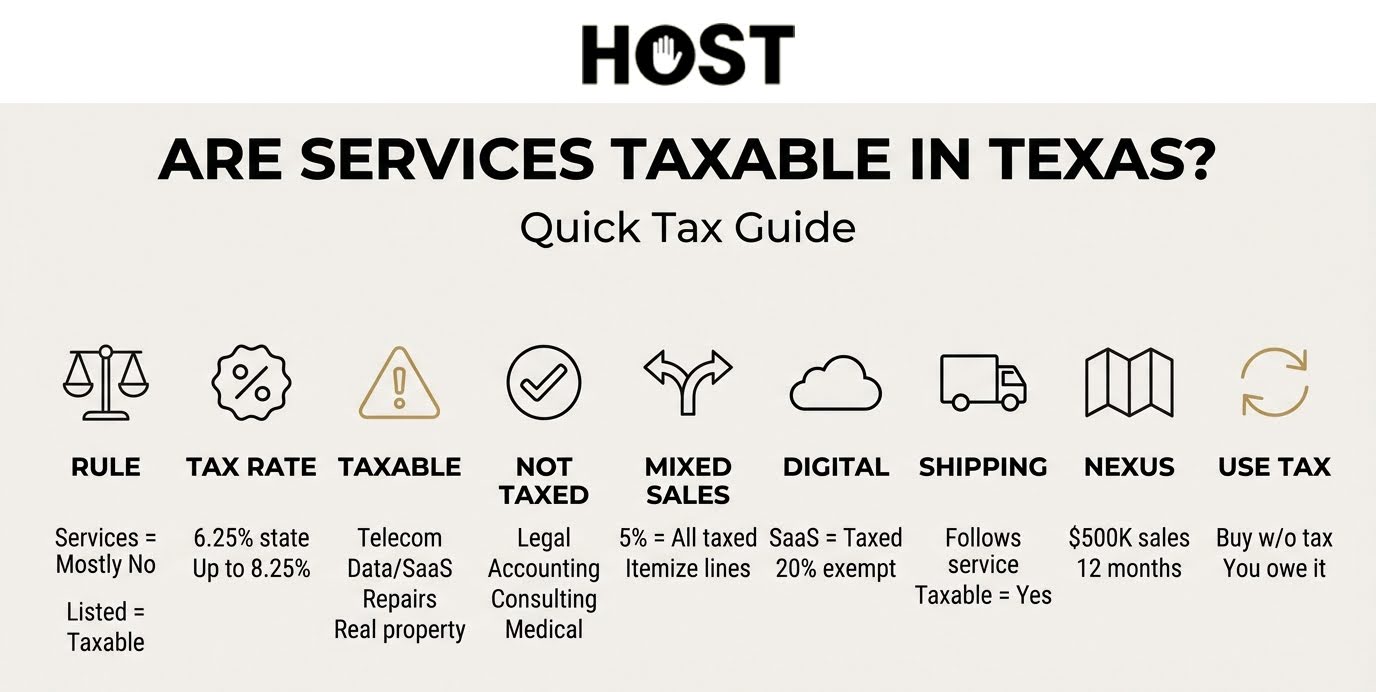
Texas imposes 6.25% state sales tax on retail sales of tangible property and specifically enumerated services. Local jurisdictions add up to 2%, creating a maximum 8.25% combined rate.
Here’s the twist: unlike tangible goods (generally taxable unless exempted), most services are exempt unless explicitly listed as taxable. This reverse presumption means you must verify whether your offerings appear on Texas’s taxable list.
The General Rule
Default position: most professional and personal services aren’t subject to sales tax. Legal services, accounting, consulting, medical care, fitness training, real estate commissions, which are typically tax-free.
However, 17 categories face mandatory collection under Texas Tax Code Section 151.0101. These exceptions create obligations for specific industries.
The 17 Taxable Service Categories
Texas doesn’t leave room for interpretation. The state explicitly lists which services require collection:
- Amusement Services – Concert tickets, online gaming, recreational memberships, escape rooms, sightseeing tours, fortune telling.
- Cable Television Services – Video programming distribution via cable, satellite, or streaming platforms.
- Personal Services – Massage parlors, Turkish baths, escort services. Excludes licensed physical therapists. Also includes laundry, dry cleaning, and garment services like alterations and clothing repair.
- Motor Vehicle Parking and Storage – Parking garages, valet services, vehicle storage facilities.
- Repair, Remodeling, and Maintenance of Tangible Personal Property – Labor for repairing watches, electronics, appliances. Embroidering logos. Altering garments. Upholstering furniture. Shoe repair.
- Telecommunications Services – Phone services, internet protocol services, conference calling.
- Credit Reporting Services – Creating or delivering credit reports when the credit applicant’s address is in Texas.
- Debt Collection Services – Collecting delinquent debts, adjusting claims, repossessing property. Excludes child support and current account collection.
- Data Processing Services – Using computers for data entry, compilation, storage, manipulation. This includes SaaS providers and application service providers.
Texas provides a 20% exemption here. Only 80% of charges face tax. Accounts payable processing, data conversion, web hosting qualify as taxable.
Important exemption: As of October 1, 2021, payment processing services are explicitly excluded from taxable data processing. Services that exclusively encrypt electronic payment information for payment card networks or settle electronic payment transactions are not taxable.
Critical distinction: Using a computer as a tool for professional services doesn’t create taxability. Architects using CAD for building plans or accountants preparing financial statements aren’t performing taxable data processing.
- Information Services – Database access, newsletters, research reports, news clipping services. Like data processing, 20% is exempt.
- Insurance Services – Specified insurance-related services per Comptroller rules.
- Real Property Services – Pest control, garbage collection, janitorial services, landscaping, lawn maintenance, surveying.
Exception: Self-employed individuals with no employees and receipts under $5,000 in the last four quarters are exempt from landscaping tax.
- Security Services – Any service requiring Private Security Bureau licensing, including alarm installation, monitoring, private investigation, armed couriers, and locksmith services.
- Telephone Answering Services – Call answering, message forwarding, receptionist services.
- Nonresidential Real Property Repair and Remodeling – Commercial building services. Residential repairs remain exempt.
Exception: Repairs to property damaged in federally or state-declared disasters may qualify for exemption.
- Internet Access Service – As of July 1, 2020, Texas no longer taxes separately stated internet access charges due to federal law. However, if internet access is bundled with taxable services like telecommunications or cable TV and you cannot establish a reasonable allocation through your books and records, the entire bundled charge becomes taxable.
- Taxable Labor – Fabrication and Processing – This category captures labor for creating, assembling, or modifying tangible property. Photographers, draftsmen, artists, tailors, woodworkers, caterers, and anyone assembling products like toys or furniture must collect tax on their labor charges.
- Utility Services – Services provided by transmission and distribution utilities are taxable when the transmission or delivery goes directly to end-use customers whose electricity consumption is subject to sales tax.
What’s NOT Taxable
To clarify confusion, these professional services remain exempt:
- Legal services
- Accounting and bookkeeping
- Medical and healthcare services
- Business consulting (when unrelated to software/tangible products)
- Fitness instruction and coaching
- Real estate services
- Counseling and therapy
- Residential construction and repair
- Custom software development for specific clients
The distinction: these don’t transfer tangible property and don’t fall into Texas’s enumerated categories.
Mixed Transactions: The 5% Rule
Many businesses bundle taxable and exempt services. Texas has specific rules:
The 5% Rule: If the taxable portion exceeds 5% of the total price, the entire charge becomes taxable unless you separately state charges on your invoice.
Solution: Itemize. List taxable and exempt services as distinct line items. This lets you collect tax only on the taxable portion.
Example: Marketing consultant charges $10,000:
- $8,000 for strategic consulting (exempt)
- $2,000 for graphic design resulting in printed materials (taxable)
The taxable portion represents 20%, exceeding the 5% threshold. Without itemization, the full $10,000 becomes taxable. With separate line items, only the $2,000 faces tax.
Shipping and Handling With Services
If you charge shipping, delivery, or handling fees in connection with taxable services, those charges are also taxable. The general rule: if the underlying service is taxable, all transportation and delivery charges incurred both before and after providing the service are taxable, even when stated separately on the invoice.
Use Tax: Your Obligation as a Purchaser
Service providers face a dual compliance burden. While you collect sales tax from customers on taxable services, you also owe use tax on taxable items you purchase for your business when the supplier doesn’t collect Texas sales tax.
For example, if you’re a landscaping company purchasing equipment or supplies from an out-of-state vendor who doesn’t charge Texas sales tax, you owe use tax on those purchases. This obligation exists separately from your sales tax collection responsibilities and creates additional reporting requirements during audits.
Digital Services and SaaS
Texas takes an aggressive stance on digital products. Software-as-a-Service, downloadable software, digital media, and cloud services are all taxable.
SaaS qualifies as taxable data processing. Whether customers access hosted software via internet, mobile apps, or other means, subscription fees trigger obligations.
Digital goods like downloaded music, movies, ebooks, apps, or games are treated as tangible personal property.
Important: Texas provides a 20% exemption on data processing, meaning only 80% of SaaS subscriptions face the 6.25% state tax plus local taxes.
Economic Nexus: The $500,000 Threshold
Providing taxable services to Texas customers from out-of-state? You face collection obligations once you exceed the threshold.
Texas’s Standard: Gross revenue exceeding $500,000 from sales of tangible property and taxable services into Texas during the preceding 12 months.
Key details:
- No transaction count – Only dollars matter
- Includes exempt sales – Sales-for-resale count toward $500,000
- All channels included – Your website, marketplaces, every platform
- Rolling 12-month period – Continuously monitor trailing 12 months
Once you exceed the threshold, register and begin collecting no later than the first day of the fourth month after crossing $500,000.
HOST’s nexus analysis tracks your sales across all states, pinpointing exactly when thresholds cross and registration deadlines arrive.
Registration and Filing
Registration Process
Apply for a Texas Sales Tax Permit through the Comptroller’s office. You’ll need your FEIN, business address, estimated monthly taxable sales, and business activity description.
Filing Frequency
The Comptroller assigns frequency based on monthly collections:
- Quarterly: Under $500/month
- Monthly: $500-$20,000/month
- Semi-monthly: Over $20,000/month
Returns are due on the 20th of the month following the reporting period.
Vendor Discount for Timely Filing
Here’s a practical benefit: permitted sales taxpayers who file and pay on time can claim a 0.5% discount on the tax amount. For businesses remitting significant monthly collections, this adds up to meaningful savings simply for meeting deadlines.
Documentation
Maintain records for at least four years:
- Invoices separating taxable and exempt services
- Exemption certificates from qualifying customers
- Sales reports by jurisdiction
- Payment records and filing confirmations
Common Compliance Mistakes
- Assuming All Services Are Exempt – Many believe no tangible goods means no tax obligations. This leads to years of unfiled returns and audit exposure.
- Failing to Separately State Mixed Transactions – Bundling taxable and exempt services under one line item can make your entire invoice taxable.
- Misclassifying Data Processing vs. Professional Services – The line is nuanced. Accountants preparing financial statements use computers as tools (exempt), while AP/AR processing is taxable.
- Not Tracking Economic Nexus – Out-of-state providers often don’t realize they’ve crossed $500,000 until an audit notice arrives.
- Incorrect Rate Calculation – With 1,800+ local jurisdictions, calculating rates by customer location is complex. Use the Texas Comptroller’s Sales Tax Rate Locator to verify correct combined rates for each transaction.
- Ignoring Use Tax Obligations – Service providers frequently overlook their obligation to pay use tax on business purchases, creating audit exposure on both sides of the equation.
Exemptions and Special Situations
Services to Exempt Organizations – Services to qualifying exempt organizations don’t require collection. Always obtain Form 01-339 before treating transactions as exempt. Government agencies and qualifying nonprofits with Comptroller exemption letters are common examples.
Natural Disaster Repairs – Repairs to property damaged in declared disasters may be exempt.
Resale Situations – Services purchased for resale can be exempt with proper documentation.
Audit Risk for Service Providers
Service providers face heightened audit risk because of complex taxable versus exempt rules. The Texas Comptroller actively pursues businesses that:
- Provide both taxable and nontaxable services
- Operate in industries with unclear taxability
- Crossed economic nexus without registering
- Show discrepancies between gross receipts and reported taxable sales
- Improperly claim exemptions or miss use tax obligations
Even small classification errors (when multiplied over three years) result in substantial assessments.
HOST: Your Partner for Texas Compliance
Sales tax compliance for service businesses pulls focus from revenue-generating activities. Determining which services are taxable, tracking economic nexus, calculating rates across 1,800+ jurisdictions, and managing ongoing filings consumes time without adding profit.
What HOST Delivers:
Nexus Analysis: We analyze your sales data and service offerings to determine exactly where you have collection obligations.
Service Classification: Our team determines which services fall into taxable categories and which remain exempt.
Sales Tax Registration: We handle Texas Comptroller registration, completing paperwork and managing communications. Learn more about registration services.
Automated Filing: We prepare and file returns on your assigned schedule across all jurisdictions. See our filing services.
Mixed Transaction Guidance: We help structure invoices to minimize tax burden by properly separating components.
Software Integration: We optimize your TaxJar, Avalara, or other automation tools. Get a free software review.
Audit Defense: We represent you in audits, organizing documentation and defending your position. Learn about audit defense.
VDA Services: If you discover past obligations, we file Voluntary Disclosure Agreements to limit lookback periods and abate penalties.
We’ve focused exclusively on sales tax since 1999. That’s over 25 years helping service businesses navigate compliance. Founded by Mike Espenshade, with parent company TaxMatrix serving North America’s largest companies, we bring enterprise expertise to providers of all sizes.
Ready to Get Texas Service Tax Off Your Plate?
Determining which services are taxable, tracking nexus, and managing compliance shouldn’t drain your time or create stress. Every hour spent researching rules and filing returns is an hour not spent growing your business.
Whether you’re a Texas-based provider unsure about obligations, an out-of-state business approaching the nexus threshold, or a multi-state operation overwhelmed by filing requirements, professional help eliminates risk and reclaims time.
Contact HOST today to discuss your Texas service tax needs or schedule a free consultation. We’ll analyze your service offerings, determine obligations, and handle everything from classification through ongoing filings.
You handle the services, we handle the tax.
Want to learn more? Get our “10 Sales Tax Mistakes E-Commerce Sellers Make” e-book.
Frequently Asked Questions
Are most services taxable in Texas?
No. Most services are exempt unless explicitly listed as taxable. Texas enumerates 17 specific categories requiring collection. Professional services like legal, accounting, consulting, and medical generally remain exempt.
Is SaaS taxable in Texas?
Yes. Texas treats Software-as-a-Service as taxable data processing. However, Texas provides a 20% exemption, meaning only 80% of SaaS subscriptions face sales tax.
When does an out-of-state service provider need to collect Texas sales tax?
Out-of-state providers must collect once they exceed $500,000 in gross revenue from Texas sales during the preceding 12 months. Registration must begin no later than the first day of the fourth month after crossing the threshold.
How do I handle invoices with both taxable and exempt services?
Separately itemize taxable and exempt services with distinct line items. If the taxable portion exceeds 5% and you don’t separately state it, the entire invoice becomes taxable.
Are consulting services taxable in Texas?
Generally no. Consulting is exempt when it consists of professional advice unrelated to tangible goods or software. However, if bundled with taxable items and not separately stated, the entire charge may become taxable.
What’s the difference between taxable data processing and exempt professional services?
Data processing involves using computers to enter, store, or manipulate customer data—this is taxable. Professional services that merely use computers as tools are exempt. For example, accountants preparing financial statements (exempt) versus performing accounts payable processing (taxable).
