
Tax optimization determines whether businesses thrive or merely survive. Between federal obligations, state requirements, and the labyrinth of sales tax compliance, overlooking strategic planning costs companies thousands (sometimes millions) in unnecessary payments and penalties.
For e-commerce businesses, sales tax represents both burden and opportunity. With over 12,000 tax jurisdictions across the U.S., understanding how to minimize liabilities while staying compliant separates profitable operations from those drowning in administrative quicksand.
Hands Off Sales Tax (HOST) specializes in sales tax optimization that reduces both your tax burden and compliance costs. From nexus analysis to automated filings across 45+ states, the right approach transforms sales tax from resource drain into manageable, predictable expense.
Understanding Tax Optimization vs. Tax Avoidance
Tax optimization means strategically managing decisions to minimize liabilities within legal boundaries. This differs fundamentally from tax avoidance (exploiting loopholes) or tax evasion (illegal non-payment).
Effective optimization involves timing deductions, choosing appropriate business structures, leveraging available credits, and ensuring accurate compliance. For e-commerce sellers, this includes optimizing sales tax collection, registration timing, and software configuration to avoid overpayment or costly mistakes.
Choose the Right Business Structure
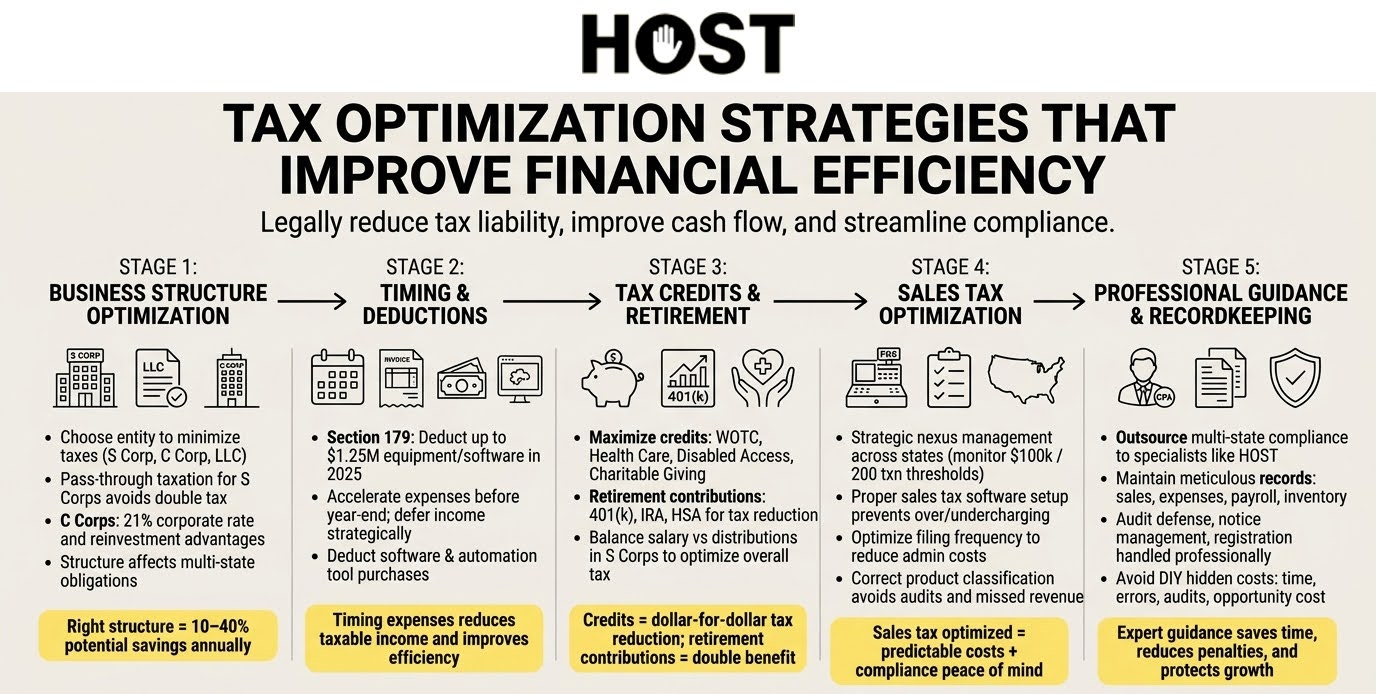
Your business entity dramatically affects tax obligations. According to tax planning research, business owners could save 10% to 40% annually by selecting the optimal structure.
S Corporations allow pass-through taxation, avoiding double taxation while enabling reasonable salary deductions. C Corporations benefit from the 21% corporate rate, potentially advantageous for businesses reinvesting profits. LLCs provide flexibility, allowing owners to choose tax treatment while maintaining liability protection.
Each structure carries different implications for income and sales tax obligations. HOST’s consultation services help businesses understand how entity structure affects overall tax position, including multi-state sales tax requirements.
Maximize Deductions Through Timing
Strategic expense timing significantly impacts tax liability. Section 179 allows businesses to immediately deduct qualifying equipment or software purchases up to $1,250,000 for the 2025 tax year.
Businesses reduce taxable income by accelerating expenses before year-end. Purchasing equipment, paying bills, or prepaying expenses. Conversely, deferring income to the following year (when cash flow permits) shifts tax liability forward.
For e-commerce businesses, timing software purchases and sales tax automation tools as deductible expenses optimizes tax positions while improving operational efficiency.
Leverage Available Tax Credits
Tax credits provide dollar-for-dollar reductions in tax bills. Business owners often overlook valuable credits including:
- Small Business Health Care Tax Credit for providing employee health insurance
- Work Opportunity Tax Credit for hiring from targeted groups
- Disabled Access Credit up to $5,000 for accessibility improvements
- Charitable Contribution Credit for qualifying nonprofit donations
According to Elliott Davis tax advisors, strategic charitable giving through Donor-Advised Funds allows businesses to secure immediate tax benefits while deciding later which charities to support.
Sales Tax Optimization: The E-Commerce Imperative
For online sellers, sales tax optimization represents one of the most impactful yet overlooked opportunities. The 2018 Wayfair decision fundamentally changed e-commerce taxation, requiring businesses to collect based on economic nexus thresholds rather than physical presence alone.
Strategic Nexus Management
Understanding where you’ve triggered nexus (and where you haven’t) is foundational. Each state sets different thresholds, typically $100,000 in sales or 200 transactions annually.
Optimization opportunity: Monitoring sales closely in states approaching nexus thresholds allows strategic timing of registration. Register too early, you incur unnecessary filing obligations and costs. Register too late, you face penalties and back taxes.
HOST’s Nexus Analysis service examines your sales footprint across all jurisdictions, identifying exactly where obligations exist and providing strategic guidance on registration timing to minimize costs while maintaining compliance.
Sales Tax Software Configuration
Sales tax automation tools like TaxJar and Avalara calculate taxes at checkout, but misconfiguration creates costly problems:
- Treating non-taxable items as taxable (overcharging customers)
- Missing required local taxes (undercollecting and creating audit liability)
- Double-taxing due to system overlap
- Incorrectly handling wholesale transactions
These errors either cost you money directly or damage customer relationships. According to Zamp’s sales tax research, automation reduces errors significantly; but only when properly configured.
HOST offers a Free Sales Tax Software Review to audit existing configurations, identifying costly mistakes before they impact your bottom line.
Optimize Filing Frequency
States assign filing frequencies monthly, quarterly, or annually based on sales volume. Lower-volume sellers file less frequently, reducing administrative costs.
Optimization strategy: In states where you’re approaching the threshold for more frequent filing, consider whether strategic sales timing or marketplace channel shifts could keep you in a lower filing frequency bracket.
Additionally, some states offer discounts for early filing or timely payment. While small (typically 1-2%), these add up across multiple jurisdictions and years.
Product Classification Optimization
States tax products differently. Clothing is tax-exempt in some states, food items have reduced rates in others, and digital products face inconsistent treatment nationwide.
Correctly classifying products ensures you’re not overtaxing customers (hurting conversions) or undertaxing (creating audit exposure). According to Numeral’s e-commerce tax guide, product classification details can be extremely granular, requiring expertise to navigate.
HOST’s team brings 25+ years of experience with product taxability across all states, helping businesses properly classify inventory, optimize tax collection, and defend classifications during audits.
Retirement Account Contributions
For tax year 2025, businesses and individuals can maximize tax-advantaged retirement contributions:
- 401(k)/403(b): $23,500 limit ($31,000 for those 50+ with catch-up contributions)
- Traditional/Roth IRA: $7,000 limit ($8,000 for those 50+)
- Health Savings Accounts (HSAs): $4,300 for individuals, $8,550 for families (if using high-deductible health plans)
These contributions reduce taxable income dollar-for-dollar (for traditional accounts), while Roth options provide tax-free growth for future distributions.
For business owners taking distributions from S Corporations, balancing salary (subject to payroll tax) with distributions (not subject to payroll tax) optimizes overall tax position. However, the IRS scrutinizes unreasonably low salaries, so maintaining comparable market rates is essential.
Multi-State Tax Optimization
E-commerce businesses expanding geographically face increasingly complex obligations. Each new state brings registration fees, filing obligations, different rates and exemptions, and state-specific notice management needs.
Companies spend an average of 30+ hours per month managing sales tax across multiple states. Time that generates zero revenue.
Optimization approach: Outsourcing multi-state compliance to specialists like HOST eliminates the productivity drain. Our team handles registration, filing, rate updates, notice management, and audit defense across all 45+ sales tax states, allowing businesses to focus on growth rather than compliance.
The Hidden Costs of DIY Tax Management
Many businesses attempt self-managed tax optimization, believing it saves money. However, hidden costs accumulate:
- Time costs: Hours spent researching, calculating, and filing—time that could generate revenue
- Error costs: Miscalculations leading to underpayment penalties or customer overcharges
- Audit costs: Without expert guidance, audit defense becomes expensive and risky
- Opportunity costs: Missing optimization strategies that specialists identify routinely
According to corporate tax planning research, proactive tax planning provides more control, confidence, and capital for business growth but only when executed correctly with appropriate expertise.
HOST: Your Sales Tax Optimization Partner
Sales tax compliance doesn’t have to drain resources or create constant anxiety. Every hour spent researching nexus rules, configuring software, or filing returns is an hour not spent growing your business.
HOST transforms sales tax from burden into predictable, optimized expense through:
Nexus Analysis: We determine precisely where you’ve triggered collection obligations across all states, identifying optimization opportunities in registration timing and filing frequency.
Sales Tax Registration: We handle registrations in all required jurisdictions, managing paperwork and state communications to minimize costs and maximize efficiency.
Automated Filing: We file returns across all jurisdictions monthly, quarterly, annually, including local and special district returns, ensuring nothing falls through cracks.
Software Optimization: We review and optimize TaxJar, Avalara, or other automation tools to calculate correctly while avoiding customer overcharges or compliance gaps.
Notice Management: We interpret and respond to state notices, protecting you from penalties while resolving issues efficiently without diverting your focus.
Audit Defense: We organize documentation, manage state communications, and defend your position during audits, minimizing liability through expert representation.
We’ve focused exclusively on sales tax since 1999. That’s over 25 years helping businesses navigate compliance while optimizing costs. Founded by Mike Espenshade, with parent company TaxMatrix serving North America’s largest companies, we bring enterprise expertise to e-commerce sellers of all sizes.
Take Action: Optimize Your Tax Position Today
Tax optimization requires both strategy and execution. The best opportunities exist at year-end for income tax and throughout the year for sales tax compliance.
Whether you’re crossing economic nexus thresholds in new states, struggling with software configuration, or overwhelmed by multi-state filing requirements, professional guidance eliminates guesswork and prevents costly mistakes.
Ready to optimize your sales tax position? Contact HOST today to discuss your compliance needs and discover how we handle complexity so you can focus on growth.
Want to learn more? Get our “10 Sales Tax Mistakes E-Commerce Sellers Make” e-book to identify hidden optimization opportunities.
Frequently Asked Questions
What’s the difference between tax optimization and tax avoidance?
Tax optimization uses legal strategies to minimize tax liability through deductions, credits, timing, and structural decisions. Tax avoidance exploits loopholes in ways that may violate the spirit of tax law, while tax evasion involves illegal non-payment. Optimization is legitimate strategic planning within legal boundaries.
How much can proper sales tax optimization save my business?
Savings vary by business size and complexity, but companies typically save 20-40% on compliance costs through outsourcing versus in-house management. Additionally, avoiding a single audit (which can cost $10,000-$50,000+ in back taxes and penalties) provides substantial ROI. Optimized software configuration prevents overcharging customers, improving conversion rates.
When should I register for sales tax in a new state?
Register when you’ve exceeded that state’s economic nexus threshold, which is typically $100,000 in sales or 200 transactions annually, though thresholds vary. Registering too early creates unnecessary filing obligations and costs. Registering late exposes you to penalties and back taxes. Professional nexus analysis identifies optimal registration timing.
Can sales tax software handle all my optimization needs?
Software automates calculations but requires proper configuration and expert oversight. According to e-commerce tax compliance research, common software mistakes include incorrect product classification, missing local taxes, and double-taxation errors. Professional review ensures software optimizes rather than complicates compliance.
What business structure minimizes overall tax liability?
The optimal structure depends on your specific situation: revenue, profits, growth plans, and exit strategy. S Corporations often benefit smaller businesses through pass-through taxation. C Corporations can advantage high-growth companies reinvesting profits. LLCs provide flexibility to choose tax treatment. Consult tax professionals to evaluate your unique circumstances.
How do I know if I’m overpaying on sales tax compliance?
Signs include: spending 30+ hours monthly on sales tax tasks, facing frequent state notices, uncertainty about where you should collect, software miscalculations, or recent audit findings. If managing sales tax consumes significant time without revenue generation, professional management typically reduces both costs and risks while freeing resources for growth activities.
