
Understanding Georgia sales tax by county means navigating 159 counties comprising over 960 taxing jurisdictions including cities, counties, and special districts, each with unique local rate combinations that push total rates from 7% to 8.9%. For e-commerce businesses selling into Georgia, these variations create real compliance headaches! One miscalculation means overcharging customers or underpaying the state.
Georgia stacks state, county, and special district taxes into combined rates that shift by exact customer address. With economic nexus triggering at $100,000 in Georgia sales or 200 transactions annually, remote sellers need precise, county-level calculations to stay compliant without killing competitiveness.
Hands Off Sales Tax (HOST) eliminates the guesswork. From nexus analysis through automated county-level filings, we handle Georgia’s multi-jurisdiction maze so you collect correctly, file on time, and sidestep audit nightmares across all 159 counties.
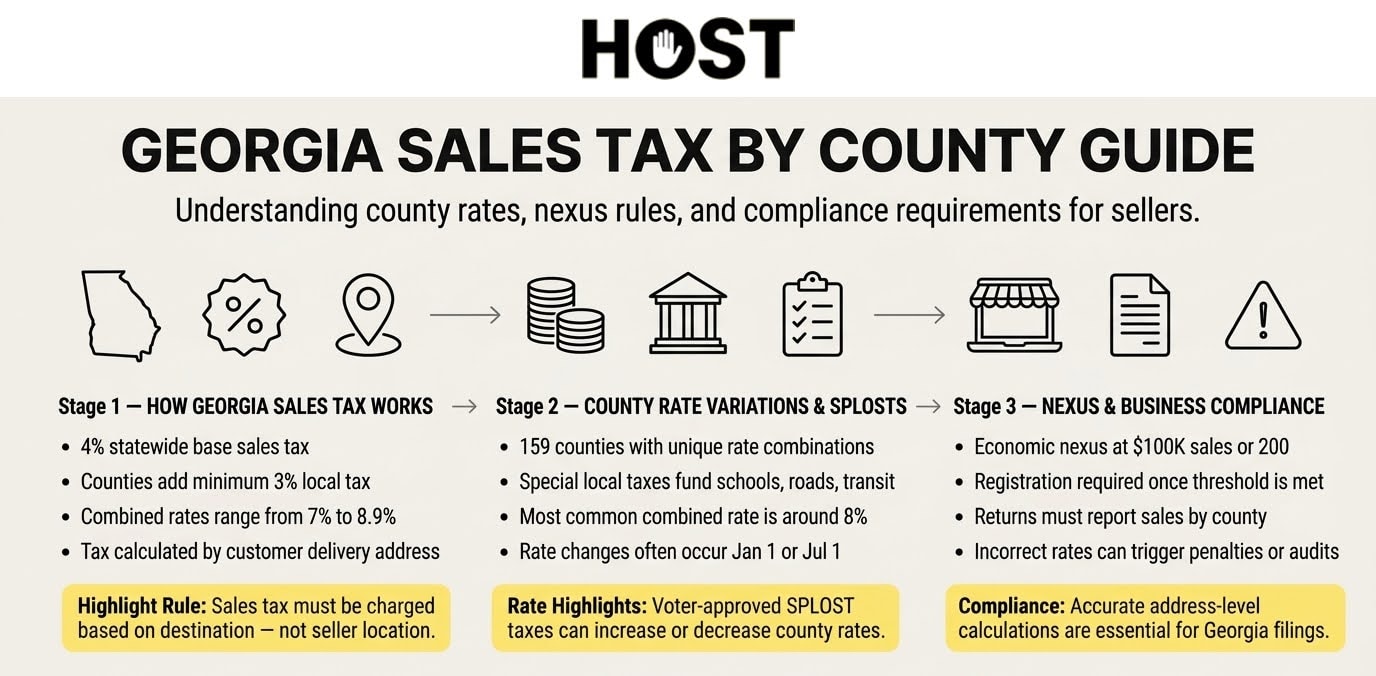
How Georgia Sales Tax Works: State Plus Local
Georgia imposes a 4% state sales tax on most retail transactions. Every county adds at least 3% in local taxes, creating a 7% minimum statewide. Most counties push higher through Special Purpose Local Option Sales Taxes (SPLOSTs), Educational SPLOSTs, and voter-approved measures.
This layered structure means identical products cost different amounts depending on where your customer lives. A $100 purchase in Fulton County faces 8.9% tax in some areas ($108.90 total), while the same item in Fayette County incurs 7% ($107.00). These differences matter when customers comparison shop or when you’re pricing competitively across regions.
Georgia requires sellers to collect tax based on destination. The rate where the product delivers, not where you’re located. For online sellers, this means calculating tax based on the customer’s exact shipping address, down to the ZIP+4 code in some cases.
Georgia Sales Tax Rates By County: What You Need to Know
Combined rates across Georgia’s 159 counties range from 7% to 8.9%. The most common rate is 8%, but dozens of counties hit 7.75% or above. High-rate areas cluster around metro Atlanta, Savannah, and Augusta, where special district taxes fund transportation, education, and infrastructure.
High-Rate Counties (7.75% – 8.9%)
- Fulton County (Atlanta metro): Up to 8.9% in certain areas, serving Georgia’s largest city
- DeKalb County: 8%, covering eastern Atlanta suburbs
- Gwinnett County: 7.75% in some municipalities
- Chatham County (Savannah): 8%
- Hall County (Gainesville): 8%
Mid-Range Counties (7% – 8%)
Most Georgia counties balance state and local needs through moderate special taxes, typically funding education or transportation. Mid-range counties often have active SPLOSTs that can sunset or renew through voter referendums, causing rate shifts every few years.
Lower-Rate Counties (7%)
Counties like Fayette, Floyd, Forsyth, and Douglas maintain rates at the statewide minimum. Even “lower” rates include the mandatory 3% county minimum plus state tax. No Georgia location offers rates below 7%.
Rate Changes and Updates
Georgia counties frequently adjust rates through voter-approved special taxes. A county might impose a new 1% E-SPLOST for school construction, pushing its rate from 7% to 8% overnight. These changes typically occur January 1 or July 1, but emergency measures can alter rates mid-quarter.
The Georgia Department of Revenue updates rate charts quarterly. Businesses must monitor these changes continuously. Using outdated rates means collecting incorrect tax amounts and facing compliance issues.
HOST monitors Georgia rate changes continuously, updating client accounts automatically so you always charge correct amounts without manual research.
Special Local Option Sales Taxes (SPLOSTs) Explained
Georgia’s complexity stems from Special Purpose Local Option Sales Taxes, which are voter-approved measures that fund specific projects. Counties can layer multiple SPLOSTs simultaneously, each with defined purposes and sunset dates.
SPLOST: Funds capital projects like roads, parks, public buildings. Typically 1% lasting 5-6 years before requiring voter reauthorization.
E-SPLOST: Dedicates revenue to school construction, technology, educational facilities. Also typically 1% with similar sunset provisions.
TSPLOST: Funds regional transportation projects. Metro Atlanta counties often maintain active TSPLOSTs.
MARTA Tax: Fulton and DeKalb counties impose 1% specifically for Metropolitan Atlanta Rapid Transit Authority operations.
Each SPLOST adds to the combined rate, explaining why similar-sized counties have significantly different totals. A county with active SPLOST, E-SPLOST, and TSPLOST might impose 8% or higher, while a neighboring county with no special taxes stays at 7%.
SPLOSTs expire after their defined period, automatically reducing the county rate unless voters approve renewal. This creates compliance challenges. A county at 8% one month drops to 7% the next when its SPLOST sunsets, and you must update calculations immediately to avoid overcharging.
Georgia Sales Tax Nexus: When You Must Collect
Physical presence creates nexus: inventory in a Georgia warehouse, employees working remotely, or attending trade shows establishes obligation to collect. But Georgia’s economic nexus rules extend requirements to remote sellers with no physical presence.
Economic Nexus Thresholds
Georgia requires sales tax collection once you exceed:
- $100,000 in Georgia sales, OR
- 200 separate transactions to Georgia customers
These thresholds apply to the current or prior calendar year. Once crossed, you must register with the Georgia Department of Revenue and begin collecting within 30 days.
Marketplaces like Amazon handle tax collection on behalf of third-party sellers through Georgia’s marketplace facilitator law. However, direct sales through your own website trigger nexus independently, requiring separate registration and filing.
HOST’s nexus analysis examines your sales data across all states, identifying exactly when and where you’ve triggered collection obligations.
Registering for Georgia Sales Tax
Once nexus exists, registration becomes mandatory. The process requires your Georgia Tax Center account, Federal EIN, business structure details, location information, NAICS code, and estimated tax liability.
Registration generates your Georgia sales tax ID number, which must appear on invoices and filings. The DOR assigns a filing frequency based on projected liability. Businesses expecting to collect $200 or more in monthly sales tax are assigned monthly filing. Smaller businesses may qualify for quarterly filing.
Common mistakes include selecting incorrect filing frequency, missing county-specific reporting requirements, and delayed registration that creates reconciliation problems. Register first, then begin collecting.
HOST handles Georgia registration end-to-end, ensuring correct filing frequency, complete jurisdiction coverage, and proper timing so you start collecting the moment registration finalizes.
Filing Georgia Sales Tax Returns
Georgia requires detailed reporting breaking down sales by county and local jurisdiction. Returns must separate gross sales, exempt sales, total taxable sales by location, and tax collected for state and each local jurisdiction.
This granular reporting means you can’t simply report a lump sum. Georgia wants county-level detail showing exactly where sales occurred and how much local tax each county should receive. The state participates in the Streamlined Sales Tax program, allowing businesses to file state and all local taxes through a single return, simplifying what could otherwise be 960 separate obligations.
Monthly Filers: Due the 20th of the following month (January sales due February 20th) Quarterly Filers: Due the 20th of the month following quarter-end Annual Filers: Due January 20th for prior year sales
Georgia grants no automatic extensions. Late filing triggers 5% penalty immediately, plus an additional 5% for each month (up to 25% total), plus 1% monthly interest on unpaid tax.
Georgia’s ST-3 return form requires line-by-line reporting for each county where you made sales. For businesses selling across all 159 counties, this creates complex filing demanding precise record-keeping.
HOST prepares and files Georgia returns completely, handling ST-3 complexity and county allocations so every dollar lands in the correct jurisdiction.
Common Georgia Sales Tax Challenges
Address-Level Rate Determination: Georgia rates vary within counties based on municipal boundaries and special districts. Software must calculate rates to ZIP+4 or street-level precision.
Exemption Certificate Management: Georgia offers exemptions for resale, manufacturing, agriculture, nonprofits, and government entities. Common exemptions include groceries, prescription medications, and manufacturing equipment. However, digital goods became taxable in 2024. Things like ebooks, music downloads, and streaming content now require collection. Each exemption requires proper certificates documented and stored for audit defense.
Shipping and Handling Charges: Shipping, delivery, freight, and handling charges are taxable in Georgia when the underlying product is taxable, even if separately stated on invoices. This catches many e-commerce sellers off guard.
Marketplace vs. Direct Sales Tracking: If you sell both through marketplaces (where the platform collects tax) and your own website (where you collect), you must track these separately.
Software Misconfiguration: TaxJar, Avalara, and similar tools calculate Georgia rates automatically when configured correctly. Common errors include treating exempt items as taxable, miscalculating SPLOST rates, or double-taxing when multiple systems overlap.
HOST offers a Free Sales Tax Software Review identifying these costly configuration errors before they impact your business.
HOST: Your Partner for Georgia Sales Tax Compliance
Managing sales tax across 159 Georgia counties, tracking rate changes, filing detailed returns, and maintaining exemption certificates demands specialized expertise and continuous attention.
What HOST Delivers:
- Nexus Analysis: We determine whether you’ve triggered Georgia collection obligations
- Georgia Registration: We handle DOR registration, obtaining your tax ID and establishing correct filing frequency
- County-Level Calculations: We ensure precise rate application across all 159 counties, updating rates automatically as SPLOSTs change
- Monthly Filing: We prepare and file Georgia ST-3 returns with complete county breakdowns, on time every month
- Audit Defense: We represent you in Georgia audits, organizing documentation and negotiating with the DOR
We’ve focused exclusively on sales tax since 1999. That’s over 25 years managing compliance so businesses can focus on growth.
Take Georgia Sales Tax Off Your Plate
Georgia’s 159 counties create compliance complexity that scales with your business. The more you sell, the more counties you touch, the more detailed your reporting requirements become.
Professional sales tax management eliminates this burden. You handle sales growth while experts handle tax compliance, providing accurate collection across every Georgia county, timely filing with complete documentation, and proactive monitoring for rate changes.
When you’re ready to simplify Georgia sales tax compliance, HOST is ready to help. Contact us today to discuss your Georgia obligations or schedule a free consultation.
Want to learn more? Get our “10 Sales Tax Mistakes E-Commerce Sellers Make” e-book.
Frequently Asked Questions
What is the sales tax rate in Georgia?
Georgia imposes 4% state sales tax plus local taxes of 3% to 5%, creating combined rates from 7% to 8.9% depending on county.
Which Georgia county has the highest sales tax rate?
The Atlanta metropolitan district in Fulton County imposes up to 8.9% in certain areas, among the state’s highest. These rates reflect multiple active SPLOSTs and special district taxes including MARTA funding.
How do I know which rate to charge Georgia customers?
Sales tax applies based on destination, so where the product ships. Calculate rates using the customer’s complete address, as rates vary by county and sometimes by municipality within counties.
Do SPLOSTs affect what I charge customers?
Yes. SPLOSTs add to the combined rate customers pay. A 1% SPLOST increases total tax from 7% to 8%, directly impacting the amount you collect and remit.
Are shipping charges taxable in Georgia?
Yes. Shipping, handling, delivery, and freight charges are taxable in Georgia when the underlying product is taxable, even if listed separately on invoices. This applies to e-commerce transactions where you charge customers for shipping.
Does Georgia have sales tax holidays?
No. Georgia does not currently offer sales tax holidays. The state ended its back-to-school tax holiday years ago, and recent revival attempts in 2024-2025 have not passed. All purchases are subject to standard rates year-round.
What happens if I charge the wrong county rate?
Overcharging means you’ve collected excess tax that must be refunded or remitted correctly. Undercharging creates liability: you owe the difference to Georgia even if you didn’t collect it from customers, plus potential penalties during audits.
