
Ohio’s 2025 Sales Tax Holiday represents one of the most expanded tax-free shopping periods in state history. Running for a full two weeks from August 1 through August 14, this holiday offers significant savings opportunities for consumers and businesses across the state.
Whether you’re stocking up on back-to-school supplies, upgrading home electronics, or making major purchases, understanding how this holiday works can put hundreds of dollars back in your pocket.
What You Need to Know About Ohio’s 2025 Sales Tax Holiday
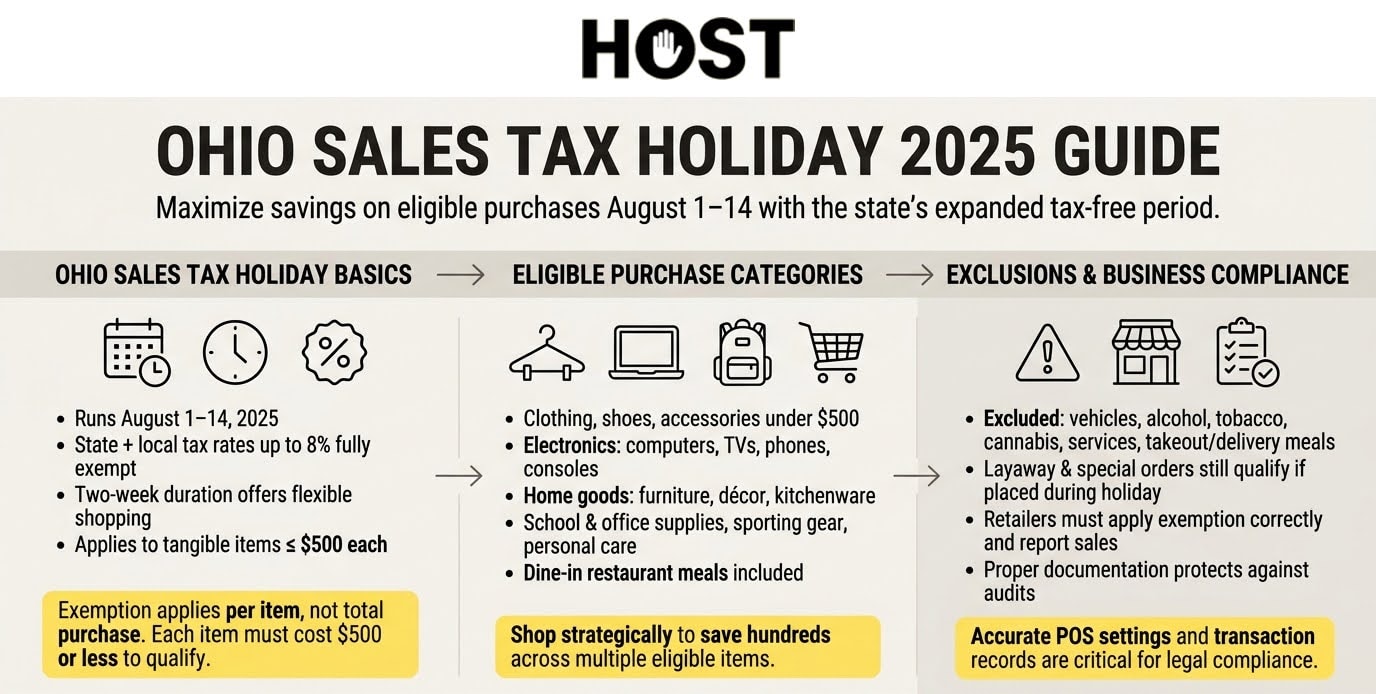
Ohio’s 2025 Sales Tax Holiday has evolved dramatically from its original three-day format focused solely on school supplies. The current iteration runs for 14 consecutive days and encompasses nearly all tangible personal property priced at $500 or less per item.
This expansion represents a major shift in state tax policy. The holiday now includes clothing, electronics, furniture, home goods, sporting equipment, and even dine-in restaurant meals. With Ohio’s combined state and local sales tax rates reaching up to 8%, the savings potential for consumers is substantial.
The exemption applies to the entire sales tax rate, including the state’s 5.75% base rate plus any county and local transit authority rates. For a family making multiple purchases during the window, these savings can add up to several hundred dollars.
Critical Dates and Timeline for 2025
When Does the 2025 Holiday Run?
The Ohio Sales Tax Holiday begins at 12:00 a.m. on Friday, August 1, 2025, and concludes at 11:59 p.m. on Thursday, August 14, 2025.
This represents the first time the tax holiday has run for a complete two-week period. The extended timeframe gives consumers greater flexibility to shop around, compare prices, and make informed purchasing decisions without the pressure of a three-day weekend rush.
Timing your purchases correctly is crucial. Items must be ordered and paid for during this window to qualify for the exemption. For online purchases, delivery can occur after August 14, but the transaction must be completed during the holiday period.
Historical Evolution of the Holiday
The sales tax holiday has undergone significant expansion since its inception. Originally created as a three-day weekend limited to school supplies and select clothing items, the program now spans two full weeks and includes a vastly broader range of products.
In 2024, lawmakers expanded the price threshold from $75 for clothing and $20 for school supplies to a uniform $500 per item limit. This 2025 iteration maintains that $500 threshold while extending the exemption period by an additional four days compared to 2024’s 10-day run.
This evolution reflects Ohio’s commitment to providing meaningful tax relief to families and supporting local businesses during the critical back-to-school shopping season.
Qualifying Purchases: What’s Included
Eligible Items Under $500
The 2025 holiday exempts nearly all tangible personal property priced at $500 or less. This broad category includes an extensive range of everyday items and major purchases.
Clothing and Apparel: All types of clothing qualify, including shoes, athletic wear, formal wear, and accessories. There are no restrictions on the type of clothing or its intended use.
Electronics: Computers, televisions, smartphones, tablets, laptops, gaming consoles, and related accessories all qualify for the exemption, making this an ideal time for tech upgrades.
Home Goods: Furniture pieces under $500, kitchenware, home décor items, small appliances, and even indoor and outdoor plants are included. This creates opportunities for home improvement projects.
School and Office Supplies: Notebooks, pens, backpacks, binders, calculators, and organizational items remain eligible, maintaining the holiday’s original back-to-school focus.
Sporting Equipment: Athletic gear, bicycles, exercise equipment, outdoor recreation items, and sports apparel all qualify under the exemption.
Personal Care Items: Health and beauty products, dietary supplements, vitamins, and pet food are included in the tax-free category.
Food and Beverages: Dine-in restaurant meals and soft drinks qualify with specific restrictions. Carry-out, delivery, and drive-thru orders do not receive the exemption.
Books and Entertainment: Physical books, music CDs, movies, and related entertainment media qualify for the tax exemption.
The $500 Price Point Rule
Understanding how the $500 threshold applies is critical for maximizing savings. The exemption is determined on an item-by-item basis, not by total purchase amount.
This means you can purchase multiple items and remain tax-free, as long as each individual item costs $500 or less. For example, purchasing two $100 shirts, two pairs of $100 pants, shoes for $100, and a jacket for $100 (totaling $600) would be completely tax-exempt.
There is no limit to the total purchase amount or the number of items you can buy. Qualification is strictly determined item by item. A $499 television is exempt. A $501 television is fully taxable. The threshold creates a hard line that applies to each product individually.
For bundled items or sets, sellers typically determine whether items are priced individually or as a single unit. A dining table with four chairs sold as a five-piece set for $600 would be taxable. The same items sold separately at $400 for the table and $50 per chair would all be exempt.
Online and Remote Purchases
Yes, the sales tax holiday fully applies to online purchases. This is crucial for modern shoppers who increasingly prefer e-commerce over in-store shopping.
Qualifying items purchased through mail, telephone, email, or internet orders are eligible for the exemption if the consumer orders and pays for the item and the retailer accepts the order during the exemption period for immediate shipment.
Importantly, delivery does not need to occur during the holiday window. Only the order placement and payment must happen between August 1-14. You can place an order on August 10 for delivery on August 20 and still receive the tax exemption.
Shipping and handling charges are also tax-free if all items in the shipment qualify as eligible items. If a shipment includes both exempt and taxable items, sellers should allocate shipping charges proportionally based on the taxable items’ total value.
This makes strategic online shopping particularly valuable. You can take advantage of the holiday without worrying about shipping timelines, allowing you to comparison shop and wait for the best deals.
Items Explicitly Excluded from the Holiday
What’s Not Covered
Despite the holiday’s broad scope, several categories remain fully taxable. Understanding these exclusions prevents surprises at checkout.
Motor Vehicles: All cars, trucks, motorcycles, and motorized vehicles remain taxable. The exemption does not apply to vehicle purchases regardless of price.
Watercraft and Motors: Boats, jet skis, outboard motors, and marine equipment are excluded from the tax holiday.
Alcoholic Beverages: Beer, wine, spirits, and all alcoholic drinks remain subject to sales tax and excise taxes during the holiday period.
Tobacco and Vapor Products: Cigarettes, cigars, chewing tobacco, vaping devices, e-liquids, and related tobacco products are excluded from the exemption.
Items Containing Marijuana: Any product containing cannabis or THC remains taxable, regardless of whether it’s sold through medical or adult-use channels.
Services: Car repairs, clothing alterations, installation services, professional work, and all service-based transactions remain taxable. The holiday applies only to tangible personal property, not services.
Carry-Out and Delivery Food: Only dine-in restaurant meals qualify for the exemption. Takeout orders, delivery meals, drive-thru purchases, and carry-out food remain taxable.
Special Circumstances and Edge Cases
Exchanges and Returns
If you purchase an eligible item during the sales tax holiday and later exchange it for the same item, no sales tax applies even if the exchange occurs after August 14.
However, if you return an item and purchase a different item after the holiday ends, sales tax will be charged on the new purchase. The exemption follows the original transaction date, not the exchange date.
If you return a taxable item during the holiday and use the credit toward a qualifying item, that second purchase will be tax-free. The timing of when you use store credit or make the exchange determines tax treatment.
Layaway and Special Orders
Items placed on layaway during the holiday period are exempt from sales tax, even if final payment and pickup occur after August 14. The key date is when the layaway agreement is established and the initial payment is made.
Similarly, items ordered during the holiday that are then backordered or specially ordered receive the same treatment as standard purchases. If you order a $400 piece of furniture on August 5 that won’t arrive until September, it remains tax-exempt because the order was placed during the qualifying period.
Sales, Discounts, and Coupons
Retailers can still accept coupons, loyalty cards, and promotional discounts during the tax holiday. If a discount brings an item’s price below $500, it qualifies for the exemption based on the discounted price.
However, promotional pricing structures like “buy one get one free” deals don’t average items together. Each item is evaluated at its actual selling price. If you buy two shirts in a BOGO promotion where one is $300 and the “free” one is allocated $0, both would be exempt. If the retailer structures it as two shirts at $150 each, both are still exempt.
The final price after all discounts determines whether the $500 threshold is met. This benefits strategic shoppers who combine manufacturer coupons, store promotions, and the tax holiday for maximum savings.
Critical Information for Businesses and Retailers
Mandatory Participation
Ohio retailers holding a vendor’s license or seller’s use tax account must comply with the exemption rules. Participation is not optional for registered businesses.
All retailers are required to adjust their point-of-sale systems to apply the tax exemption correctly and report exempt sales accurately on their tax returns. Failure to provide the exemption when required can result in penalties and customer complaints.
This mandatory participation ensures a level playing field for all retailers, preventing competitive disadvantages for businesses that comply with the exemption requirements.
Reporting Requirements
For tax filing purposes, retailers must report all sales for the period on the gross sales line, then include all qualifying holiday sales on the exempt sales line of the applicable sales tax return.
The Ohio sales tax holiday applies to the entire sales tax rate, including state, county, and local transit authority permissive rates. Retailers cannot choose to exempt only the state portion while collecting local taxes.
Proper documentation is essential. Retailers should maintain records showing which transactions qualified for the holiday exemption, particularly for items near the $500 threshold or special circumstances like exchanges or layaway.
For e-commerce businesses managing sales tax obligations across multiple states, automated sales tax filing services can ensure accurate reporting and timely compliance in all jurisdictions.
Compliance and Assistance
The Ohio Department of Taxation requires retailers to ensure point-of-sale software can properly accommodate exempt sales during the holiday. Businesses should test their systems before August 1 to identify and resolve any technical issues.
Many modern POS systems include tax holiday functionality that can be programmed with specific dates and exemption criteria. Retailers should verify these settings are correct and that staff understand how to process exempt transactions.
Businesses with questions can contact the Ohio Department of Taxation at 1-888-405-4039 or through TTY at 1-800-750-0750. The department provides technical assistance and clarification on exemption eligibility.
For businesses operating across multiple states beyond Ohio, professional sales tax consultation services can help navigate the complexity of multi-state compliance requirements.
Consumer Tips for Maximizing Savings
Strategic Shopping During the Holiday
Plan major purchases around the holiday window, particularly for items like furniture, electronics, and appliances that fall within the $500 threshold. A $499 television saves you nearly $40 in a location with an 8% combined tax rate.
Back-to-school shoppers should stock up on clothing, supplies, and technology during this period. The savings potential is substantial when outfitting multiple children for the school year.
Consider splitting large purchases into individual qualifying items when possible. Instead of buying a $600 furniture set, purchasing components separately under $500 each can provide significant tax savings.
Create a shopping list in advance and research prices across multiple retailers. The two-week window provides sufficient time to comparison shop without the pressure of a short holiday period.
Online Shopping Strategy
Since delivery dates don’t matter, ordering online during the holiday provides maximum flexibility. You can complete your purchase during the exemption window and have items delivered weeks later without paying sales tax.
This is particularly valuable for custom-ordered items, special-order furniture, or products that require extended shipping times. Place the order during the holiday, lock in the exemption, and wait for convenient delivery.
Take advantage of online price comparison tools to find the best deals, then complete purchases during the tax-free period. Many retailers offer competitive pricing during the holiday to attract customers.
Frequently Asked Questions
Can I purchase items online and have them delivered after August 14?
Yes. As long as you order and pay for the item during the holiday window (August 1-14), the delivery date doesn’t matter. You’ll still receive the tax exemption even if the item arrives weeks later.
Is there a limit to how many items I can purchase?
No. There is no limit on the number of items or total purchase amount, as long as each individual item is priced at $500 or less. You could theoretically buy 100 items totaling $50,000 and all would be tax-exempt if each item is under $500.
Do shipping and handling charges get taxed?
If all items in your order are eligible, shipping is tax-free. If your order includes both exempt and taxable items, the shipping cost is allocated proportionally between the two categories.
Can I exchange an item after the holiday ends?
Yes. If you exchange an eligible item for the same item, no tax applies even if the exchange happens after August 14. However, if you exchange for a different item after the holiday, that new item will be taxed.
Are restaurant meals included?
Dine-in restaurant meals are eligible for the exemption. Carry-out, delivery, and drive-thru orders are not included and remain taxable.
What if I’m charged tax by mistake?
You can request a refund from the retailer first. If they’re unable to resolve it, contact the Ohio Department of Taxation at 1-888-405-4039 to file a refund claim. For businesses managing sales tax across multiple states, professional notice management services can help resolve these issues quickly and efficiently.
Do sales and coupons affect eligibility?
Yes, in a positive way. If a sale or coupon brings the final price below $500, the item qualifies for the exemption based on that discounted price.
Are services covered under the holiday?
Generally, no. Services like repairs, alterations, or installations are not covered. However, repair parts under $500 may qualify if itemized separately from labor charges on the invoice. For businesses uncertain about product taxability across different states, sales tax consulting services can provide clarity on complex classification issues.
The Sales Tax Partner You Can Count On
Understanding Ohio’s sales tax holiday is just one piece of managing sales tax compliance. For businesses operating across multiple states, the complexity multiplies exponentially.
At Hands Off Sales Tax, we specialize in comprehensive sales tax solutions that keep your business compliant while you focus on growth. From nexus analysis to automated filings across 45+ states, we handle the details so you don’t have to.
Our team has been 100% focused on sales tax since 1999, bringing 25+ years of expertise to businesses of all sizes. Whether you’re an e-commerce seller navigating economic nexus rules or a retailer managing multi-state operations, we provide the clarity and support you need.
What HOST Delivers:
- Nexus Analysis: We analyze your sales data to determine where you’ve met thresholds for economic or physical nexus, including gross receipts taxes
- Sales Tax Registration: We apply for registrations with every applicable state taxing jurisdiction, handling all paperwork
- Sales Tax Filings: HOST offers filing plans to meet your needs. We file your returns (including local and “special” returns) so everything stays current
- Notice Management: We handle confusing notices from states, interpreting what they mean and responding appropriately
- Audit Defense: We’re your trusted, battle-tested partner in resolving your sales tax audit, organizing documentation and defending your position
- VDA Support: We file voluntary disclosure agreements to limit look-back periods and abate penalties
- Free Sales Tax Software Review: We review your configuration to identify and fix costly errors
Ready to take sales tax compliance off your plate? Contact us today to discuss your needs or download our free guide: “10 Sales Tax Mistakes E-Commerce Sellers Make” to learn how to avoid costly compliance errors.
