
Tennessee sales tax nexus determines whether your business must collect and remit sales tax in the Volunteer State. Cross the $100,000 threshold or store inventory in Memphis, and you’re facing collection obligations across one of the nation’s highest-tax environments. Combined rates hitting 9.75% in some counties.
Understanding where you stand isn’t academic. It’s the difference between clean compliance and audit nightmares.
Hands Off Sales Tax (HOST) handles Tennessee’s complexities, from nexus analysis to registration and ongoing filings across all 95 counties, so you can focus on growth instead of decoding tax codes.
What Sales Tax Nexus Means in Tennessee
Nexus is your business’s connection to Tennessee that triggers tax collection obligations. Establish it, and you’re registering with the Tennessee Department of Revenue, collecting state and local tax, and filing returns on schedule.
Tennessee operates two nexus frameworks: physical presence and economic activity. Either one (or both) creates collection obligations regardless of where your business calls home.
The state charges 7% base rate, but local jurisdictions tack on 2.00% to 2.75%, pushing combined rates to 9.00%-9.75% depending on the customer’s address. With 95 counties imposing local taxes, accurate rate calculation requires address-level precision.
Origin vs. destination matters: In-state Tennessee businesses charge tax based on their business location (origin-based). Remote sellers charge tax based on the customer’s shipping address (destination-based). This affects which rate you apply to every transaction.
Physical Presence: The Traditional Trigger
Physical presence has been the nexus standard for decades. Any tangible connection to Tennessee likely creates it.
Common triggers include offices, warehouses, or retail locations: owning, leasing, or operating any facility establishes immediate nexus. Inventory stored anywhere in Tennessee creates nexus, including third-party fulfillment centers like Amazon’s Memphis and Chattanooga facilities, ShipBob, ShipMonk, or any 3PL arrangement.
Employees or contractors working in Tennessee create nexus too. Sales representatives, remote workers, independent contractors, anyone performing business activities on your behalf triggers obligations.
Even temporary presence counts. Trade shows, craft fairs, pop-up shops where you make sales or solicit orders all establish nexus.
Click-through nexus catches many businesses by surprise. Using Tennessee-based affiliates or referral partners who route customers to your website creates nexus, even without physical presence. If you’re running affiliate marketing campaigns with Tennessee partners, you’ve likely triggered collection obligations.
Contract carriers and company-owned trucks acting as your agent also create nexus. Logistics arrangements many businesses overlook.
The Tennessee Department of Revenue interprets physical presence broadly. A single employee working remotely from Nashville? That’s nexus.
For FBA sellers, inventory sitting in Tennessee creates nexus from day one, requiring immediate registration and collection.
Economic Nexus: The Wayfair Impact
Tennessee’s economic nexus law stems from the 2018 South Dakota v. Wayfair Supreme Court decision, allowing states to require sales tax collection from remote sellers based purely on economic activity.
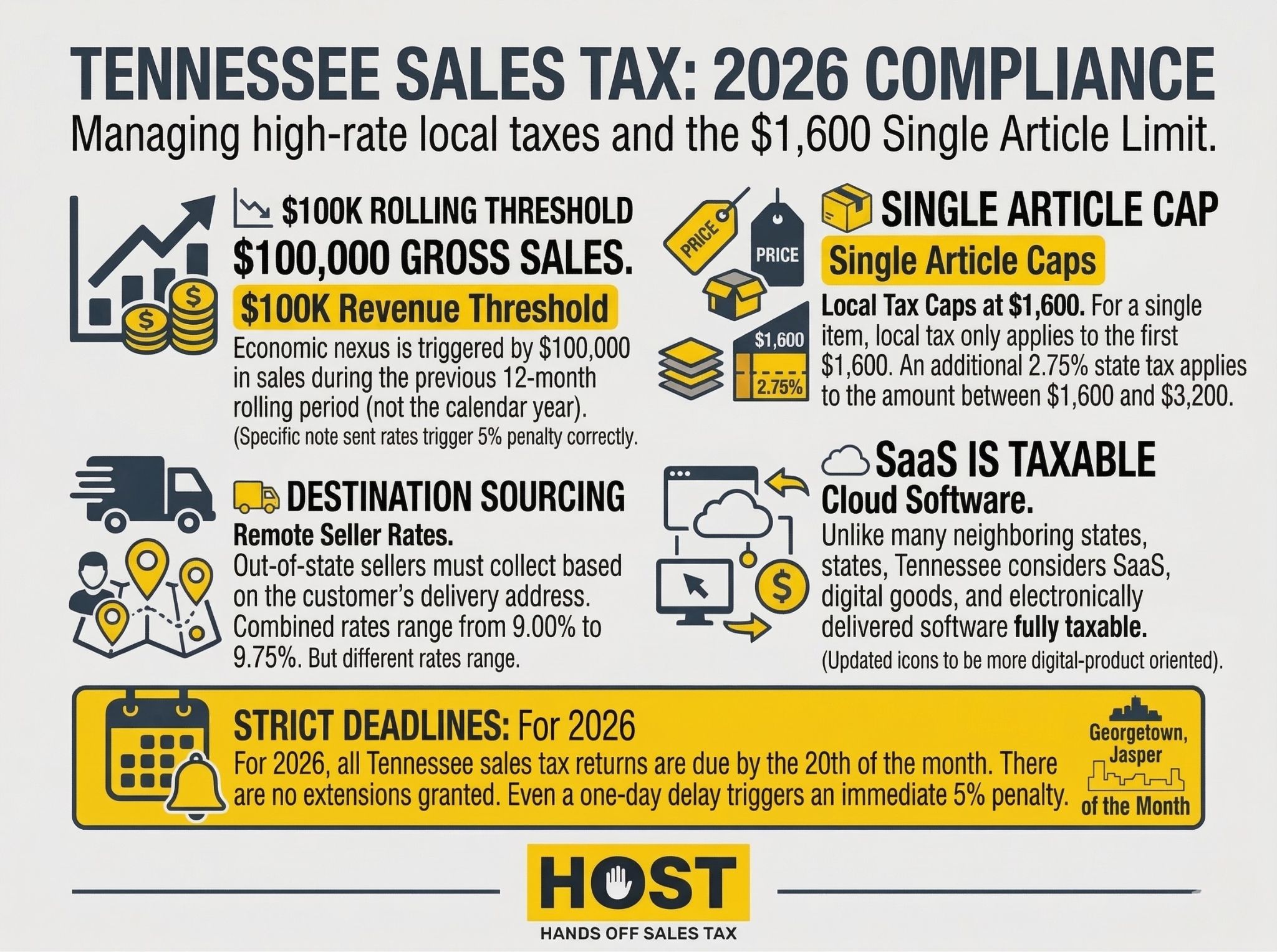
Tennessee’s threshold is straightforward: $100,000 in gross sales to Tennessee customers in the previous 12-month period.
Unlike many states, Tennessee eliminated transaction counts entirely. You only monitor revenue, not individual orders.
Economic nexus applies on a rolling 12-month basis. Hit $101,000 between October 2024 and September 2025? You established nexus in September.
Here’s the critical timeline: Tennessee requires you to register within 30 days but gives you until the first day of the third calendar month following the month you crossed the threshold to begin collecting.
Example: Cross $100,000 on January 15, 2025. Register by mid-February. Start collecting April 1, 2025.
A successful holiday season can push you over the threshold without warning, creating sudden compliance obligations across states you’ve never physically operated in.
Marketplace Facilitator Rules
Tennessee’s marketplace facilitator law shifts collection responsibility to platforms like Amazon, eBay, Etsy, and Walmart when they facilitate third-party sales.
Sell exclusively through marketplace platforms? The facilitator typically handles Tennessee sales tax collection and remittance automatically. You don’t register separately for those transactions.
But mixing sales channels creates complexity. You might sell $150,000 total in Tennessee: $120,000 through Amazon (marketplace-facilitated) and $30,000 through Shopify (direct sales).
For economic nexus, count all $150,000, triggering the threshold. But you only register and collect on the $30,000 in direct sales, since Amazon handles the rest.
This dual-channel scenario confuses many sellers. Failing to register for direct sales while assuming the marketplace “covers everything” is a common audit trigger.
Tennessee Registration Requirements
Once you’ve established nexus, registration with the Tennessee Department of Revenue is mandatory:
- Obtain a Tennessee Business Tax Number through the Tennessee Taxpayer Access Point (TNTAP) online system
- Provide business information: legal name, physical address, ownership structure, FEIN/SSN, NAICS code, expected sales volume
- Determine filing frequency: Tennessee assigns monthly, quarterly, or annual filing based on projected tax liability
- Set up local tax accounts for city and county taxes beyond state tax
Many businesses underestimate registration complexity. Tennessee’s local tax structure means you may need multiple accounts depending on where you make sales.
HOST handles Tennessee sales tax registration completely, managing paperwork, follow-up communications, and ensuring proper licensing for all required jurisdictions.
Filing Requirements and Deadlines
After registration, Tennessee requires regular sales tax returns regardless of whether you collected tax that period.
Filing frequency depends on tax liability:
- Monthly filers: Businesses collecting over $200/month in state sales tax; due the 20th of the following month
- Quarterly filers: Businesses collecting under $200/month; due the 20th of the month following quarter end
- Annual filers: Very small volume businesses; due January 20th
Tennessee grants no automatic extensions. Late filings incur 5% penalty immediately, plus an additional 5% for each month unfiled, capping at 25%. Interest accrues at 0.75% per month.
Even zero tax collected requires filing. Skipping returns triggers penalties and can lead to account suspension or estimated tax assessments.
For businesses with high transaction volume across Tennessee’s 95 counties, calculating correct local tax allocation adds significant complexity. Each sale must be sourced to the customer’s location, with rates applied correctly and taxes allocated to appropriate state and local jurisdictions.
Single Article Tax limit: Tennessee caps local tax collection at the first $1,600 of a single item’s value. Selling a $10,000 car in a jurisdiction with 2.25% local tax? You collect state tax on the full amount but local tax only on $1,600 (just $36 instead of $225). Critical for businesses selling vehicles, boats, machinery, or high-value equipment.
HOST prepares and files your Tennessee returns across all filing frequencies: monthly, quarterly, annually, including proper local tax allocation.
Common Nexus Mistakes
Assuming marketplace sales exempt you entirely: Even if Amazon collects on marketplace transactions, your direct website sales still require registration and collection.
Ignoring FBA inventory: Storing products at Amazon’s Memphis or Chattanooga fulfillment centers creates immediate physical nexus, triggering registration obligations before your first Tennessee sale.
Miscalculating the economic threshold: The $100,000 applies to the previous 12 months on a rolling basis, not the calendar year. Many businesses track January-December only, missing mid-year threshold crossings.
Delaying registration after crossing thresholds: Tennessee requires registration within 30 days of establishing nexus. Waiting months (or years) exposes you to back-tax assessments and penalties.
Applying incorrect local rates: Tennessee’s local tax rates vary by county and city. Using a flat statewide 7% significantly undercharges customers in high-tax jurisdictions like Shelby County (Memphis), where combined rates reach 9.75%. Remote sellers must use destination-based sourcing; in-state sellers use origin-based.
Missing the Single Article Tax limit: Charging full local tax on high-value items instead of capping at $1,600 means overcharging customers and creating compliance issues.
These mistakes compound quickly. A single missed registration can snowball into years of unfiled returns, creating audit exposure that far exceeds the cost of proper compliance from the start.
Managing Multi-State Complexity
For e-commerce businesses, Tennessee represents one piece of a 45-state sales tax puzzle. Each state applies different nexus rules, thresholds, registration processes, and filing requirements.
Crossing Tennessee’s $100,000 threshold likely means you’ve crossed similar thresholds elsewhere. Suddenly you’re managing nexus analysis, registrations, and filings across a dozen or more jurisdictions simultaneously, each with unique deadlines and local tax complications.
Effective multi-state management requires continuous nexus monitoring, centralized registration tracking, automated rate calculation, and consolidated filing.
Attempting this manually drains 30+ hours monthly for most businesses. Time that generates zero revenue while creating constant audit risk from human error.
HOST manages comprehensive multi-state sales tax compliance, ensuring you collect correctly in Tennessee and every other state where you’ve triggered nexus.
HOST: Your Tennessee Compliance Partner
Sales tax nexus in Tennessee, and across 44 other states, creates complexity that diverts focus from your core business. Missing thresholds, delaying registrations, or miscalculating local rates exposes you to audits, penalties, and back-tax liabilities that can cripple growth.
What HOST Delivers:
- Nexus Analysis: We analyze your sales footprint to determine precisely where you’ve established Tennessee nexus and identify obligations in all other states
- Sales Tax Registration: We handle Tennessee registration completely, including state and local accounts, managing all paperwork and communications with the Department of Revenue
- Automated Filing: We prepare and file your Tennessee returns on schedule—monthly, quarterly, or annually, with accurate local tax allocation across all 95 counties
- Multi-State Management: We manage compliance across every state where you’ve triggered nexus, keeping you current nationwide without the administrative burden
- Notice Resolution: We interpret and respond to Tennessee Department of Revenue notices, protecting you from penalties while resolving issues efficiently
- Audit Defense: We serve as your trusted partner in resolving Tennessee sales tax audits, organizing documentation and defending your position
- Software Optimization: We review and optimize your TaxJar, Avalara, or other automation tools to calculate Tennessee rates correctly and avoid costly errors
We’ve been 100% focused on sales tax since 1999. Over 25 years helping businesses navigate compliance while optimizing operations. Founded by Mike Espenshade, with parent company TaxMatrix serving North America’s largest companies, we bring enterprise expertise to e-commerce sellers of all sizes.
You handle the sales, we handle the tax.
Ready to Get Tennessee Compliant?
Tennessee sales tax nexus obligations don’t wait for convenient timing. Whether you’ve just crossed the $100,000 threshold, discovered FBA inventory created nexus months ago, or simply want expert management of existing obligations, the right partner eliminates guesswork and prevents costly mistakes.
At HOST, we combine deep technical expertise with 25+ years of specialized experience, transparent communication, and personalized support.
Contact HOST today to discuss your Tennessee nexus situation and discover how we handle the complexity so you can focus on growth.
Want to learn more? Get our “10 Sales Tax Mistakes E-Commerce Sellers Make” e-book.
Frequently Asked Questions
What is the economic nexus threshold for Tennessee?
Tennessee’s economic nexus threshold is $100,000 in gross sales to Tennessee customers during the previous 12-month period. There is no transaction count threshold, only revenue matters.
Do I need to collect Tennessee sales tax if I only sell through Amazon?
If you sell exclusively through Amazon and they facilitate the entire transaction, Amazon collects and remits Tennessee sales tax as the marketplace facilitator. However, if you also make direct sales through your website or other channels, you must register and collect on those direct transactions.
How long do I have to register after establishing Tennessee nexus?
Tennessee requires registration within 30 days of establishing nexus, whether through physical presence or crossing the economic threshold. Delayed registration can result in penalties and back-tax assessments.
What are Tennessee’s combined sales tax rates?
Tennessee’s state rate is 7%, with local jurisdictions adding 2.00% to 2.75%, creating combined rates ranging from 9.00% to 9.75% depending on the customer’s county and city location.
Does storing inventory in a Tennessee Amazon FBA warehouse create nexus?
Yes. Inventory stored in Tennessee, including Amazon fulfillment centers in Memphis or Chattanooga, creates immediate physical presence nexus, requiring registration before your first Tennessee sale.
What happens if I file Tennessee sales tax returns late?
Late filing incurs a 5% penalty immediately, plus an additional 5% for each month the return remains unfiled, capping at 25%. Interest accrues at 0.75% per month on unpaid tax. Tennessee does not grant automatic extensions.
