
Oklahoma sales tax nexus rules determine when your business must collect and remit sales tax in the state. Cross the $100,000 threshold, and you’re responsible for collecting tax across Oklahoma’s diverse markets. From Oklahoma City to Tulsa and beyond.
For e-commerce sellers, Oklahoma represents both opportunity and obligation. The state’s economic nexus threshold means businesses without physical presence face collection requirements the moment they exceed annual sales targets.
Hands Off Sales Tax (HOST) eliminates the guesswork. From nexus analysis to registration and ongoing filings, we handle Oklahoma compliance so you can focus on growth instead of tracking thresholds.
What Is Sales Tax Nexus in Oklahoma?
Sales tax nexus creates the connection between your business and Oklahoma that triggers legal obligation to collect sales tax from customers. It’s the state’s jurisdiction over your business activities.
Oklahoma recognizes multiple nexus types: physical nexus, economic nexus, and affiliate nexus. All trigger identical compliance requirements: registration, collection, and remittance, but stem from different business activities.
Physical nexus exists when you maintain tangible presence in Oklahoma. Economic nexus triggers based purely on sales volume, regardless of physical presence. Affiliate nexus arises through relationships with Oklahoma businesses that facilitate your sales. The 2018 South Dakota v. Wayfair Supreme Court decision authorized states to require tax collection from remote sellers, fundamentally changing e-commerce compliance.
Important for Tech Companies: Oklahoma does not tax SaaS (Software as a Service) or electronically delivered software. If you’re selling cloud-based software, digital downloads, or streaming services without physical media, these transactions are exempt from Oklahoma sales tax—though they still count toward your economic nexus threshold if they involve tangible goods.
Crossing Oklahoma’s nexus threshold transforms your business from exempt to obligated. The moment you establish nexus, you must register for a sales tax permit, configure systems to collect the correct rate, and file returns on schedule.
Failing to recognize nexus leads to consequences. Oklahoma Tax Commission actively pursues non-compliant remote sellers. An audit can uncover years of unfiled returns, resulting in back taxes plus 1.25% monthly interest and penalties reaching 25% of unpaid amounts.
For businesses operating in multiple states, Oklahoma is one of 45+ jurisdictions where you might trigger obligations. Managing compliance across dozens of states creates administrative burden that diverts resources from profitable activities.
Physical Nexus: Traditional Presence Triggers
Physical nexus in Oklahoma arises from tangible connections within state borders:
Business Location – Operating an office, warehouse, retail store, or any permanent establishment creates immediate nexus. Even a small storage unit qualifies.
Inventory Storage – Maintaining inventory in Oklahoma triggers nexus, even if stored in a third-party warehouse. Amazon FBA sellers with inventory in Oklahoma fulfillment centers have physical nexus regardless of where their business is based.
Employees and Representatives – Sales representatives, contractors, or remote employees working in Oklahoma establish nexus.
Temporary Presence – Attending trade shows or making sales calls can create nexus, though enforcement varies.
Affiliate Nexus: The Relationship Trap
Affiliate nexus catches many multi-brand businesses by surprise. You can establish nexus through relationships with Oklahoma businesses that help facilitate your sales, even without direct physical presence.
Oklahoma considers you to have affiliate nexus if you have ties to an in-state business that:
- Sells similar products under the same or similar business name
- Uses your trademarks, service marks, or trade names
- Delivers, installs, assembles, or performs maintenance for your products
- Allows customers to pick up your products at their Oklahoma location
- Conducts activities significantly associated with your ability to maintain a market in Oklahoma
This means a California-based company could trigger Oklahoma nexus through a related Oklahoma entity that shares branding or provides customer support without ever shipping directly from Oklahoma. Affiliate nexus rules target businesses attempting to avoid collection obligations through related-party structures.
Economic Nexus: Oklahoma’s Remote Seller Threshold
Oklahoma adopted economic nexus effective November 1, 2019. The state requires remote sellers to collect sales tax once they exceed $100,000 in Oklahoma sales during the previous or current calendar year.
Note: Oklahoma previously had a 200-transaction threshold alongside the revenue threshold but eliminated it in 2019, simplifying compliance to revenue-only measurement.
How the $100,000 Threshold Works
Oklahoma measures economic nexus solely by gross revenue from sales into the state.
Calculation begins on January 1 each year and runs through December 31. If your Oklahoma sales exceed $100,000 in 2024, you establish economic nexus for 2024. You must register, begin collecting, and file returns starting from the date you crossed the threshold. Do not wait until the following year.
Example: Your business sells nationwide through your website. In June 2024, your cumulative Oklahoma sales reach $100,500. You established economic nexus in June 2024 and should have registered immediately. Delaying until 2025 creates liability for uncollected tax from June through December 2024.
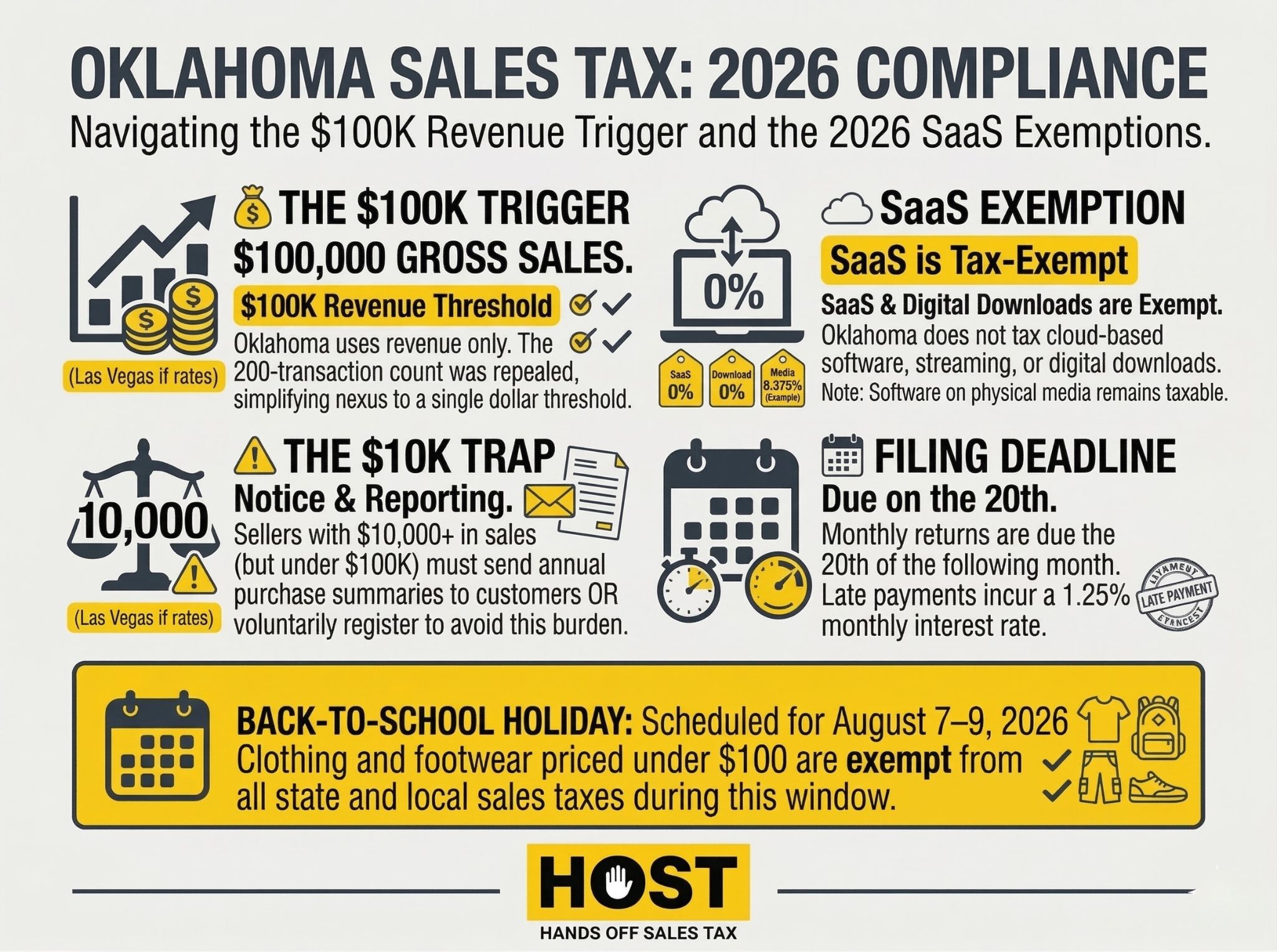
Oklahoma includes retail sales of tangible personal property delivered to Oklahoma addresses. Both taxable and exempt sales count toward the $100,000 threshold, though you only collect tax on taxable transactions. Wholesale sales with valid resale certificates are excluded from threshold calculations.
E-commerce businesses must actively monitor Oklahoma sales throughout the year. Crossing the threshold mid-year requires immediate action. Registration typically takes 5-10 business days, during which you should be collecting tax.
HOST manages threshold monitoring across all states, alerting you when you approach nexus and handling registration before you incur penalties.
Notice & Reporting Requirements: The Compliance Trap
Here’s where Oklahoma catches businesses off guard: Even if you don’t reach the $100,000 economic nexus threshold, selling more than $10,000 in taxable goods to Oklahoma customers triggers onerous notice and reporting requirements.
Under these rules, you must:
- Notify Oklahoma customers at purchase that use tax is due unless an exemption applies
- Send annual purchase summaries to Oklahoma customers
- Report customer information and transaction details to Oklahoma Tax Commission
The penalties for non-compliance are substantial, and the administrative burden is significant for businesses managing compliance across multiple states.
The Workaround: Simply register for an Oklahoma sales tax permit. Once registered and collecting tax, you avoid all notice and reporting requirements regardless of sales volume. For most businesses approaching the $10,000 threshold, voluntary registration proves far simpler than implementing notice and reporting systems.
Marketplace Facilitator Laws and Your Obligations
Oklahoma’s marketplace facilitator law, effective July 1, 2018, shifts collection responsibility to platforms like Amazon, Etsy, eBay, and Walmart Marketplace. When selling through these platforms, the marketplace collects and remits Oklahoma sales tax on your behalf.
This relieves individual sellers from collecting tax on marketplace sales, but creates a critical distinction: you remain responsible for direct sales through your own website or other channels.
If you sell both through marketplaces and via your own website, you need separate tracking. Marketplace sales don’t require your collection. Direct website sales do require collection once you establish nexus.
Common mistake: Assuming marketplace facilitator coverage eliminates all Oklahoma obligations. If your direct sales exceed $100,000 independently, you establish economic nexus and must register for those transactions.
Registration and Compliance Requirements
Once you establish nexus, registration with the Oklahoma Tax Commission becomes mandatory before making your next taxable sale.
Oklahoma offers online registration through Oklahoma Taxpayer Access Point (OkTAP). You’ll need your Federal EIN, business formation documents, and information about your business structure. The application fee is $20, and registration typically processes within 5-10 business days.
After registration, you must collect sales tax on all taxable sales to Oklahoma customers. Oklahoma’s state rate is 4.5%, but local jurisdictions add additional taxes, creating combined rates from 4.5% to 11.5%.
Rate Examples by Location:
- Oklahoma City: 8.625% (4.5% state + 4.125% local)
- Tulsa: 8.517% (4.5% state + 4.017% local)
- Norman: 8.375% (4.5% state + 3.875% local)
Calculating the correct rate requires point-of-delivery accuracy. Sales tax software determines the precise rate based on the customer’s address, including city, county, and special district taxes.
HOST reviews your sales tax software configuration to ensure accurate rate calculation and prevent costly overcharging or undercharging errors.
Filing Frequencies and Deadlines
Oklahoma assigns filing frequencies based on tax liability:
- Monthly: Businesses remitting more than $2,500 annually
- Quarterly: Businesses remitting $100 to $2,500 annually
- Annually: Businesses remitting less than $100 annually
Most e-commerce sellers with economic nexus file monthly. Returns are due the 20th of the month following the reporting period. January sales are due February 20th.
Oklahoma permits electronic filing and payment through OkTAP. Late filing incurs penalties, with interest accruing at 1.25% monthly on unpaid balances.
Sales Tax Holiday: Oklahoma offers an annual back-to-school sales tax holiday on the first Friday, Saturday, and Sunday in August. Clothing and footwear priced under $100 are exempt during this period, which is important for retail businesses planning seasonal promotions.
Common Nexus Mistakes E-Commerce Sellers Make
Ignoring the Current-Year Threshold – Many sellers mistakenly believe economic nexus applies only after a full calendar year of sales. Oklahoma requires compliance the moment you cross $100,000, even mid-year.
Overlooking the $10,000 Notice & Reporting Trap – Businesses selling between $10,000 and $100,000 often don’t realize they face notice and reporting requirements. Voluntary registration eliminates this burden.
Assuming Marketplace Sales Equal Total Compliance – Marketplace facilitator laws cover platform sales only. Direct sales through your website require separate registration once you establish independent nexus.
Missing Affiliate Nexus – Related businesses operating in Oklahoma can create nexus obligations even without direct physical presence. Multi-brand companies must evaluate all Oklahoma relationships.
Delaying Registration After Crossing the Threshold – Some businesses wait until year-end to register, creating months of uncollected tax liability. Oklahoma expects immediate registration once nexus is established.
Incorrect Rate Application – Using the wrong local rate costs you money or underpays Oklahoma. State rate is 4.5%, but combined rates vary significantly by jurisdiction.
HOST’s comprehensive filing service handles all reporting requirements across Oklahoma and 45+ other states, ensuring accuracy and timely submission.
What Happens If You Don’t Comply
Oklahoma Tax Commission has broad authority to pursue non-compliant sellers:
Back Taxes – You owe all uncollected sales tax from the date you established nexus. If you crossed the threshold in 2021 but never registered, you face three years of back tax liability.
Interest – Oklahoma charges 1.25% monthly interest on unpaid tax, compounding to over 16% annually.
Penalties – Late filing without response to written demand results in 25% penalty. Late payment carries 10% penalty if unpaid within 15 days of delinquency. Total penalties cannot exceed 25% of tax due. Willful evasion can result in criminal charges.
Audits – Once flagged for non-compliance, Oklahoma may audit your entire business, examining multiple tax years and all transaction records.
Business Restrictions – Unpaid tax obligations can prevent permit renewals, create liens against business assets, and damage credit ratings.
The financial impact extends beyond the tax itself. Between penalties, interest, audit costs, and legal fees, non-compliance often costs 2-3 times the original tax due.
HOST’s audit defense service protects you during Oklahoma Tax Commission examinations, organizing documentation and representing your interests throughout the process.
How HOST Simplifies Oklahoma Nexus Compliance
Sales tax compliance shouldn’t consume 30+ hours monthly or create constant anxiety about state notices. HOST provides complete Oklahoma sales tax management:
Nexus Analysis – We examine your sales data across all states, determining exactly where you’ve triggered obligations including Oklahoma’s $100,000 threshold and $10,000 notice requirements.
Sales Tax Registration – We handle Oklahoma Tax Commission registration, completing paperwork and navigating state requirements so you receive your permit without delays.
Accurate Collection – We review and optimize your sales tax software configuration, ensuring correct Oklahoma rate calculation across all jurisdictions and preventing costly errors.
Filing Service – We prepare and file Oklahoma returns on schedule (monthly, quarterly, or annually), ensuring timely compliance and accurate reporting.
Notice Management – We interpret and respond to Oklahoma Tax Commission notices, resolving issues before they escalate to penalties or audits.
Voluntary Disclosure Agreements – If you discover past nexus obligations, we file VDAs with Oklahoma to limit lookback periods and abate penalties, minimizing your liability.
We’ve focused exclusively on sales tax since 1999. Over 25 years helping businesses navigate multi-state compliance. Founded by Mike Espenshade with parent company TaxMatrix serving North America’s largest companies, we bring enterprise expertise to growing e-commerce sellers.
Get Oklahoma Compliant Today
Oklahoma sales tax nexus compliance protects your business from penalties, audits, and unexpected tax bills. Whether you’ve just crossed the $100,000 threshold or realized you established nexus months ago, taking action now minimizes liability and creates a foundation for sustainable growth.
Understanding the rules is the first step. Implementation is where most businesses struggle: calculating rates, managing filing deadlines, maintaining documentation, and monitoring ongoing obligations across multiple states.
Professional help eliminates guesswork and prevents costly mistakes. At HOST, we combine deep technical expertise with transparent communication and personalized support, handling the complexity so you can focus on revenue instead of compliance.
When you’re ready to ensure Oklahoma compliance and take sales tax off your plate entirely, we’re ready to help. Contact HOST today to discuss your specific situation or schedule a free consultation.
Want to learn more? Download our free guide: “10 Sales Tax Mistakes E-Commerce Sellers Make” to identify common pitfalls and protect your business.
Frequently Asked Questions
What is the Oklahoma sales tax nexus threshold for remote sellers?
Oklahoma requires remote sellers to collect sales tax once they exceed $100,000 in gross sales to Oklahoma customers during the current or previous calendar year. This economic nexus threshold applies regardless of physical presence in the state.
Do I need to register immediately after crossing $100,000 in Oklahoma sales?
Yes. Oklahoma expects registration and collection from the date you establish nexus, not at year-end. Crossing the threshold mid-year requires immediate action to avoid penalties for uncollected tax.
Does Amazon collect Oklahoma sales tax for me?
Amazon collects and remits Oklahoma sales tax on marketplace sales as a marketplace facilitator. However, you remain responsible for collecting tax on direct sales through your website or other channels if you establish independent nexus.
What are Oklahoma’s notice and reporting requirements?
If you sell more than $10,000 but less than $100,000 in taxable goods to Oklahoma customers, you must notify customers about use tax obligations and report transaction details to the state. However, registering for a sales tax permit eliminates these requirements entirely, making voluntary registration often the simpler choice.
Is SaaS taxable in Oklahoma?
No. Oklahoma does not tax Software as a Service (SaaS) or electronically delivered software. However, software sold on physical media (CD, USB) is taxable as tangible personal property.
What happens if I didn’t know I had Oklahoma nexus?
Lack of knowledge doesn’t eliminate tax obligations. Oklahoma can assess back taxes, interest, and penalties from when you established nexus. A Voluntary Disclosure Agreement can limit lookback periods and reduce penalties if you proactively register.
How often do I need to file Oklahoma sales tax returns?
Filing frequency depends on tax liability. Most e-commerce sellers file monthly (due the 20th of the following month). Oklahoma may assign quarterly or annual filing for businesses with lower tax obligations.
