
Kansas sales tax nexus is the line between running clean or facing penalties you didn’t see coming. Whether you’re shipping from Kansas or selling into it from across the country, understanding when you’ve triggered nexus determines your obligation to collect and remit. Getting it wrong means back taxes, interest, and audit headaches that drain time and money.
Kansas joined 45 other states after the 2018 Wayfair decision, implementing economic nexus rules that shift the burden from physical presence to sales volume. For businesses managing multi-state compliance, Kansas represents another jurisdiction with its own thresholds, rates, and filing requirements demanding attention.
Hands Off Sales Tax (HOST) analyzes your sales footprint to pinpoint exactly where you’ve triggered Kansas nexus, handles registration with the Kansas Department of Revenue, and manages ongoing filing obligations so you stay compliant without diverting resources from growth.
What Is Sales Tax Nexus?
Sales tax nexus is the connection between your business and a state that creates a legal obligation to collect and remit sales tax. Think of it as the threshold that, once crossed, requires registration with state tax authorities and collection from customers in that jurisdiction.
Before 2018, nexus required physical presence like warehouses, offices, employees, or inventory. The Supreme Court’s South Dakota v. Wayfair decision changed everything. States gained authority to impose economic nexus based purely on sales volume, even without any physical presence.
For e-commerce sellers, this multiplied compliance obligations exponentially. A business operating from a single location can now have nexus in dozens of states simply by exceeding economic thresholds through online sales.
Kansas Economic Nexus: A Controversial History
Kansas took an extreme stance from October 2019 through June 2021, requiring even sellers with a single Kansas sale to register and collect tax. No threshold whatsoever. The Kansas Attorney General declared this policy invalid, calling it inconsistent with Wayfair, but the Department of Revenue enforced it anyway, collecting approximately $5 million from small sellers during this period.
This controversy ended July 1, 2021, when the Kansas legislature overrode Governor Kelly’s veto, establishing the current $100,000 threshold and bringing Kansas in line with other states. This history reveals Kansas’s aggressive approach to sales tax enforcement, a posture that continues today.
Current Kansas Economic Nexus Rules:
Remote sellers must collect Kansas sales tax once they exceed $100,000 in gross receipts from sales into Kansas during the current or preceding calendar year.
Unlike many states that use an “or” threshold (either $100,000 in sales OR 200 transactions), Kansas uses only the revenue threshold. Transaction count doesn’t matter. A business making five sales totaling $100,001 has the same obligation as one making 5,000 sales at the same revenue level.
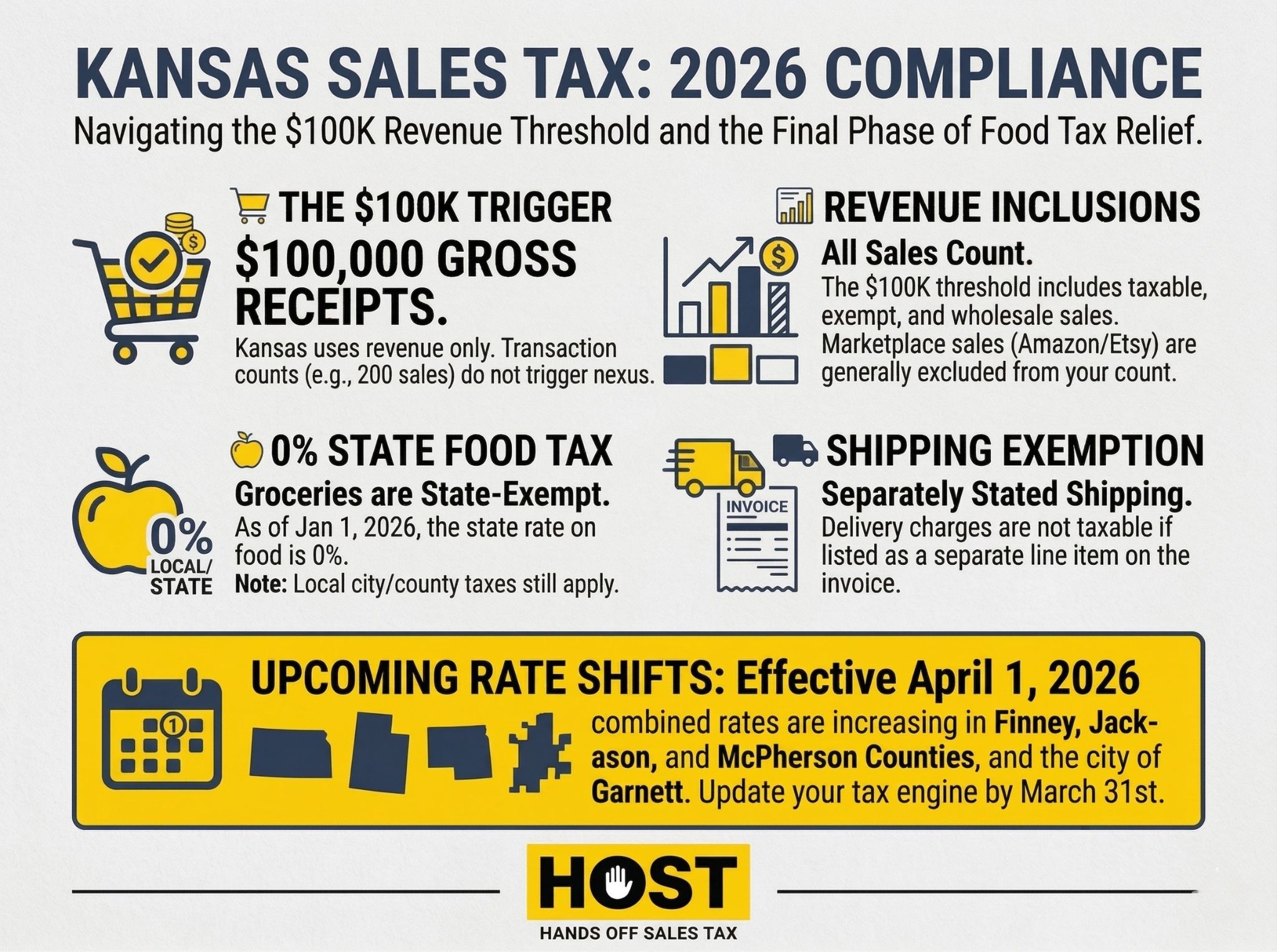
The $100,000 threshold includes all sales delivered into Kansas: taxable sales, exempt sales, even wholesale/resale transactions. When calculating your exposure, count gross revenue from Kansas customers across the entire calendar year, regardless of whether individual sales were subject to tax.
First-Year Safe Harbor: Kansas provides a unique benefit. When you first exceed the $100,000 threshold during a calendar year, you’re only required to collect tax on sales above $100,000 that year. However, you must register immediately and inform customers about their use tax obligations on the first $100,000.
Once you cross the threshold in any calendar year, your obligation to collect begins immediately on future sales. Kansas doesn’t provide a grace period after reaching economic nexus.
Physical Nexus Still Matters
Economic nexus isn’t the only trigger. Physical presence creates nexus obligations, often at lower thresholds than economic rules.
Physical nexus in Kansas exists when your business maintains:
- Inventory in Kansas: Storing products in a Kansas warehouse, fulfillment center, or third-party logistics provider creates nexus. This includes FBA inventory in Kansas Amazon facilities.
- Offices or business locations: Any physical business location in Kansas establishes nexus.
- Employees or contractors: Having employees, salespeople, or independent contractors performing business activities in Kansas triggers obligations.
- Trade show presence: Attending conventions or trade shows in Kansas creates temporary nexus only if you take orders or make sales. Simply displaying products without processing transactions doesn’t trigger obligations.
- Affiliate connections: Related businesses conducting specific activities on your behalf can create nexus, including selling the same products under similar business names, maintaining distribution facilities that facilitate your deliveries, or operating franchises under your trade name.
Note on Click-Through Nexus: Kansas eliminated click-through nexus provisions in 2021. Previously, agreements with Kansas residents who referred customers for commission could trigger nexus. This is no longer a concern for remote sellers using affiliate marketing programs.
If you have any physical presence in Kansas, you have nexus regardless of sales volume. Even businesses well below the $100,000 economic threshold must collect and remit Kansas sales tax.
Marketplace Facilitator Laws and Your Obligations
Kansas enacted marketplace facilitator legislation effective July 1, 2021, as part of Senate Bill 50. This law requires platforms like Amazon, eBay, Etsy, and Walmart Marketplace to collect and remit sales tax on behalf of third-party sellers using their platforms.
When a marketplace facilitator collects tax on your behalf, you’re generally relieved of collection obligations for those specific transactions. However, this simply shifts collection responsibility to the platform.
Critical for marketplace sellers:
- Track which sales are covered: If you sell through multiple channels (your own website plus Amazon), only marketplace sales are covered. Sales through your own site require you to collect Kansas tax if you have nexus.
- File zero returns: Even if marketplaces collect all your tax, Kansas may still require you to file periodic returns showing zero tax due. Operating without filing can trigger penalties.
- Maintain records: Keep documentation showing which sales were processed through marketplace facilitators.
Kansas Sales Tax Rates and Jurisdictions
Kansas operates under destination-based sourcing. You must collect tax based on where the customer receives the product, not where your business is located. If you operate from Wichita (7.5% total rate) but sell to Overland Park (9.125%), you must collect the Overland Park rate, not your home rate.
The Kansas state sales tax rate is 6.5%. However, counties and cities impose additional local sales taxes, creating combined rates ranging from 6.5% to 11.5% depending on jurisdiction. With 536 local taxing jurisdictions, calculating the correct rate requires address-level precision.
For example:
- Overland Park: 9.125%
- Wichita: 7.5%
- Topeka: 9.15%
- Manhattan: 8.95%
- Kansas City, KS: 10.6%
That variation matters. On a $1,000 purchase, the difference between the lowest rate (6.5%) and highest rate (11.5%) costs customers $50.
Charging the wrong rate creates audit liability. Overcharging harms customer relationships; undercharging means you owe the difference plus penalties.
Important for food sellers: As of January 1, 2025, Kansas eliminated the state sales tax on food and food ingredients, though local taxes still apply. This affects sellers in grocery, meal kit, or food supplement categories.
Most e-commerce businesses use sales tax automation software to calculate correct rates at checkout. However, software must be properly configured to avoid costly errors.
HOST offers a Free Sales Tax Software Review to identify configuration mistakes before they become audit problems.
Registration and Compliance Requirements
Once you’ve determined you have Kansas sales tax nexus, registration with the Kansas Department of Revenue is mandatory.
Two Registration Options:
- Kansas Customer Service Center Portal: Direct state registration through the Kansas DOR online system
- Streamlined Sales Tax System: Kansas is a full SST member state, allowing registration through the SST system, which can simplify multi-state compliance
Kansas recommends filing for your license 3-4 weeks before you plan to start making sales. Registration typically processes within 5-10 business days. Kansas issues a sales tax permit and assigns a filing frequency based on estimated tax liability.
Filing Frequencies:
- Monthly: Over $400 in monthly tax
- Quarterly: Between $40-$400 monthly
- Annual: Under $40 monthly
Returns are due the 25th of the month following the reporting period. Kansas requires electronic filing for most businesses.
Common Kansas Nexus Mistakes
Ignoring FBA Inventory: Amazon stores inventory across its fulfillment network. If your products sit in a Kansas warehouse (even temporarily) you have physical nexus. Many sellers don’t realize they’ve triggered obligations until an audit notice arrives.
Monitoring Only Current Year Sales: Kansas looks at both current and prior calendar year sales. A business with $95,000 this year might assume they’re safe, but each year is evaluated independently.
Undercounting Threshold Exposure: The $100,000 threshold includes taxable sales, exempt sales, and wholesale/resale transactions. Businesses that only count taxable retail sales significantly underestimate when they’ve triggered nexus.
Missing Local Taxes: Collecting only the 6.5% state rate while ignoring local jurisdictions results in significant underremittance. With combined rates exceeding 11% in some areas, this mistake compounds quickly.
Failing to File Zero Returns: Even when marketplace facilitators collect all your tax, you may still need to file periodic zero returns. Not filing can trigger penalties despite owing no tax.
Late Registration: Waiting months after crossing nexus thresholds creates retroactive liability. Kansas can assess back taxes, penalties (1% per month up to 24% maximum), and interest from the date you should have begun collecting.
How HOST Handles Kansas Sales Tax Compliance
Managing Kansas sales tax nexus, alongside obligations in 44 other states, creates a compliance burden that drains time without generating revenue. On average, businesses spend 30+ hours monthly on sales tax administration.
What HOST Delivers:
- Nexus Analysis: We analyze your sales data to determine exactly when you triggered Kansas nexus and identify any retroactive exposure.
- Kansas Registration: We handle registration, completing paperwork and following up on processing.
- Automated Filing: We prepare and file your Kansas returns based on state requirements, including all local jurisdictions.
- Rate Management: We ensure you’re charging correct rates by optimizing your software configuration.
- Notice Management: We interpret and respond to Kansas Department of Revenue notices, protecting you from penalties.
- Audit Defense: If Kansas initiates an audit, we organize documentation and defend your position to minimize liability.
We’ve been 100% focused on sales tax since 1999. That’s over 25 years helping businesses navigate compliance across all states, including Kansas.
Ready to Simplify Kansas Sales Tax Compliance?
Kansas sales tax nexus creates real obligations with serious consequences for non-compliance. Whether you’ve just crossed the economic threshold, discovered FBA inventory triggered physical nexus, or simply want confidence you’re handling everything correctly, the right partner eliminates guesswork.
At Hands Off Sales Tax, we combine deep technical expertise with 25+ years of specialized experience, transparent communication, and personalized support. We handle Kansas alongside all your other state obligations, ensuring comprehensive compliance without the administrative burden.
Contact us today to discuss your Kansas sales tax nexus situation or schedule a free consultation. Let us handle the tax so you can focus on sales.
Frequently Asked Questions
What is the Kansas sales tax nexus threshold for remote sellers?
Kansas requires remote sellers to collect sales tax once they exceed $100,000 in gross receipts from Kansas sales during the current or prior calendar year. This includes all sales. Taxable, exempt, and wholesale. Transaction count doesn’t matter, only revenue triggers economic nexus.
Does having inventory in a Kansas Amazon warehouse create nexus?
Yes. Storing inventory in Kansas through FBA or any third-party fulfillment center creates physical nexus, requiring you to collect Kansas sales tax regardless of your sales volume.
Do marketplace facilitators collect Kansas sales tax on my behalf?
Kansas marketplace facilitator laws require platforms like Amazon, eBay, and Etsy to collect and remit sales tax on third-party sales. However, you’re still responsible for collecting tax on sales through your own website or other channels if you have nexus. You may also need to file zero returns even when the marketplace handles collection.
How often do I need to file Kansas sales tax returns?
Kansas assigns filing frequencies based on your monthly tax liability: monthly (over $400/month), quarterly ($40-$400/month), or annually (under $40/month). Returns are due the 25th of the month following the reporting period.
What happens if I don’t collect Kansas sales tax when I should?
Failure to collect and remit Kansas sales tax results in back taxes, penalties (1% per month up to 24% maximum), and interest assessed from the date you should have begun collecting. Kansas can audit multiple years of sales, creating significant retroactive liability.
Can HOST help if I’ve never collected Kansas sales tax but should have?
Yes. We file Voluntary Disclosure Agreements (VDAs) with Kansas to limit lookback periods and abate penalties when you discover past obligations. This resolves liability while minimizing financial impact.
