
Indiana sales tax nexus determines whether your business must collect and remit sales tax in the state. Cross that threshold, and compliance becomes mandatory. Miss it, and you’re facing penalties, back taxes, and audit exposure that can derail growth.
For e-commerce sellers navigating post-Wayfair obligations, Indiana represents both opportunity and risk. The economic nexus threshold is straightforward ($100,000 in sales) but consequences for missing it are severe. Registration requirements, filing deadlines, and physical presence rules create compliance complexity that pulls focus from what matters: growing revenue.
That’s where Hands Off Sales Tax (HOST) delivers value. With comprehensive nexus analysis, registration services, and ongoing filing management, we handle Indiana compliance so you concentrate on sales in this key Midwest market.
What Is Sales Tax Nexus?
Nexus is the connection between your business and a state that creates tax obligations. Think of it as the threshold that transforms you from an out-of-state seller into a business with Indiana tax responsibilities.
Before the 2018 South Dakota v. Wayfair Supreme Court decision, only physical presence created nexus. Wayfair changed everything. States can now require remote sellers to collect sales tax based solely on economic activity.
Indiana adopted economic nexus rules following Wayfair. The state’s Department of Revenue expects remote sellers meeting thresholds to register, collect, and remit just like brick-and-mortar retailers. Missing these obligations exposes you to audits covering years of unreported sales.
Indiana’s Economic Nexus Threshold
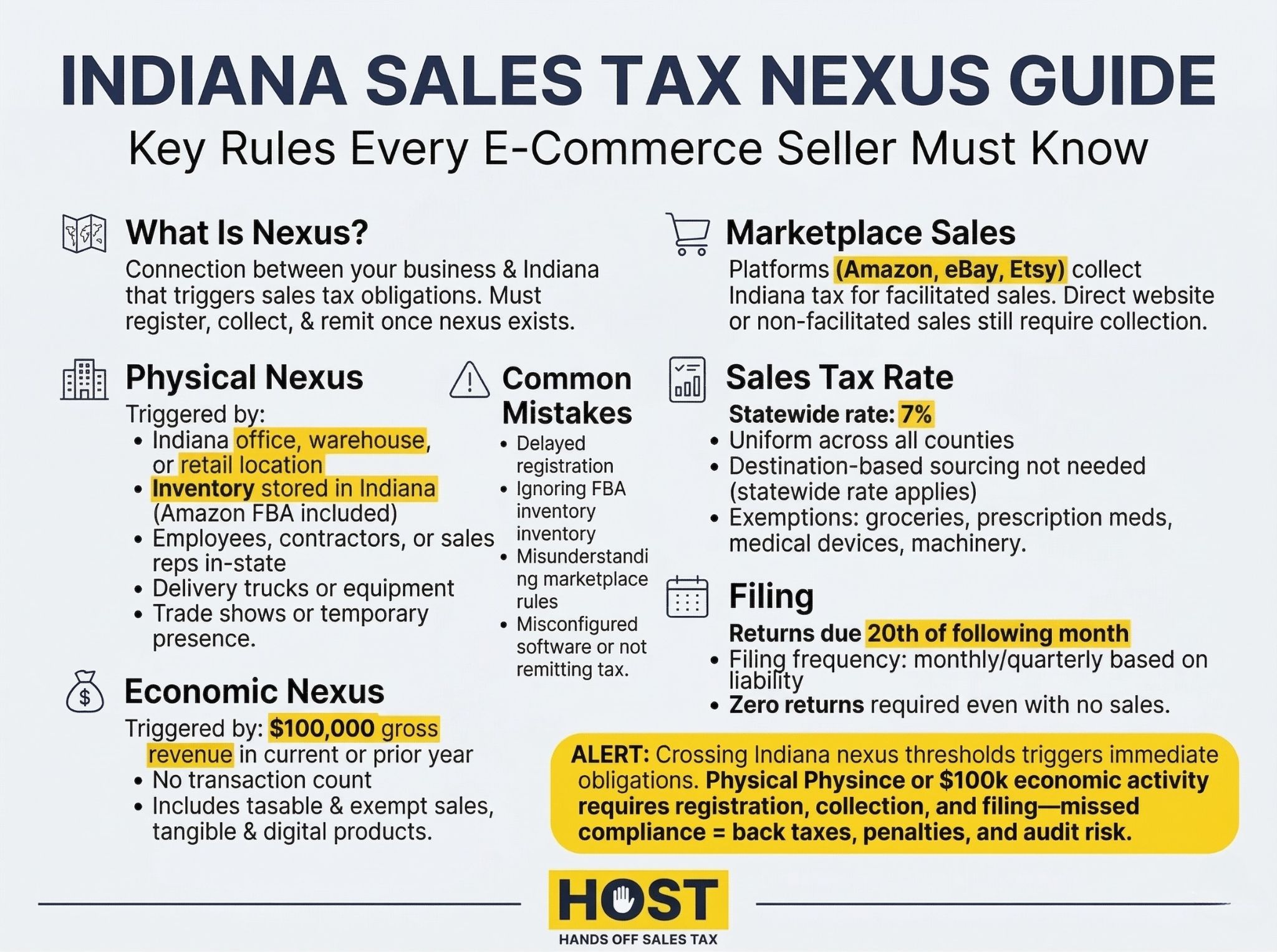
Indiana’s economic nexus threshold is $100,000 in gross revenue from sales into the state during the current or previous calendar year.
The threshold tracks gross revenue from tangible personal property, products transferred electronically, and services delivered in Indiana. Sell $120,000 worth of products to Indiana customers, and you’ve exceeded the threshold regardless of exemptions. Indiana measures this calendar year (January 1 – December 31), applying if you exceeded thresholds in either the current or previous year.
There’s no transaction count requirement. Indiana eliminated its 200-transaction threshold effective January 1, 2024. Unlike states using both dollar and transaction thresholds, Indiana only examines revenue. Even a small number of large sales can trigger nexus.
Service provider exception: If you only provide non-taxable services and don’t sell tangible property, you’re not required to register even if exceeding the $100,000 threshold. Since most services aren’t taxable in Indiana, pure service providers typically have no registration obligation.
Once you exceed $100,000, register immediately. Indiana doesn’t provide a specific grace period, so practical advice is: register once you cross the threshold.
Physical Nexus in Indiana
Physical nexus remains a common trigger. Any physical presence in Indiana creates nexus regardless of sales volume. Even $1 in sales paired with physical presence requires registration.
Physical nexus factors include:
Offices or retail locations: Any business location in Indiana: headquarters, satellite office, retail storefront, even a home office used for business creates nexus.
Warehouses and inventory: Storing inventory in Indiana establishes physical presence, whether in your own warehouse or through third-party logistics. This includes Amazon FBA inventory in Indiana fulfillment centers.
Employees and contractors: Having employees, contractors, or sales representatives working in Indiana creates nexus, including remote employees living in Indiana.
Your own delivery trucks: Delivering goods into Indiana using your own vehicles where title and possession transfer in the state establishes nexus.
Tradeshows and temporary presence: Attending tradeshows or temporarily conducting business in Indiana can create nexus depending on duration and activities.
For Amazon FBA sellers, this creates particular complexity. Amazon operates multiple fulfillment centers across Indiana. Once Amazon stores your inventory in the state, you’ve established physical nexus, regardless of whether you requested that specific location.
HOST’s nexus analysis examines both economic and physical triggers across all states, identifying exactly where you have obligations and prioritizing registration based on exposure.
Registration Requirements and Process
Once you’ve established nexus, Indiana requires registration for a Registered Retail Merchant Certificate (RRMC). This certificate authorizes you to collect sales tax and creates your account with the Indiana Department of Revenue.
Registration steps:
Apply through INTIME, Indiana’s online tax system. You’ll need your federal EIN, business information, and details about nexus-creating activities. Indiana requires standard business details like legal name, ownership structure, addresses, NAICS code, and contact information.
Specify what created nexus (physical presence, economic threshold, or both) and when it was established. Once approved, Indiana issues your certificate with a unique tax ID number. This typically takes 7-10 business days for online applications.
There’s no registration fee. The process is free, though penalties for failing to register when required can be substantial.
Streamlined Sales Tax benefit: Indiana’s membership in the Streamlined Sales Tax program allows multi-state sellers to register simultaneously in multiple member states through a single system, significantly simplifying compliance for businesses operating across state lines.
Timeline matters: Indiana expects prompt registration once nexus is established. Practically, this means within 30 days of crossing the threshold. Delays expose you to penalties and back-tax liability from the date nexus was established.
HOST handles Indiana registration completely. We complete the INTIME application, follow up on any questions from the state, and ensure you receive your certificate without delays.
Indiana Sales Tax Rates and Collection
Indiana’s sales tax rate is 7% statewide. Unlike many states, Indiana has no local sales taxes—the rate is uniform across all 92 counties. This simplifies calculation significantly compared to states where rates vary by city and special district.
What’s taxable: Most retail sales of tangible goods are taxable: clothing, electronics, furniture, appliances, and general merchandise. Food for immediate consumption (restaurant meals) is also taxable at 7%.
What’s exempt: Key exemptions include groceries (food for home consumption), prescription drugs, medical devices, manufacturing machinery, agricultural equipment, and sales to qualifying nonprofit organizations.
Digital products: Indiana taxes certain digital products. Software delivered electronically, digital music, e-books, and streaming services are generally taxable.
Services: Most services in Indiana are not subject to sales tax.
Sales tax automation software like TaxJar or Avalara can handle Indiana’s rate calculation and exemption rules. However, software must be properly configured. Common mistakes include taxing exempt items, failing to apply exemptions when valid certificates are provided, or double-taxing when multiple systems are active.
HOST offers a free sales tax software review to audit your configuration and identify errors before they become problems.
Filing Frequencies and Deadlines
Indiana assigns filing frequencies based on tax liability. New registrants typically start with monthly filing, which can be adjusted after establishing a filing history.
Monthly filing: Returns cover the previous calendar month and are due on the 20th of the following month. January sales tax is due February 20th.
Quarterly filing: Returns are due on the 20th of the month following the quarter end (April 20, July 20, October 20, January 20).
Even with zero sales or collected tax, Indiana requires filing a zero return. Failing to file (even with no liability) triggers penalties and delinquency notices.
Penalties for late filing: Indiana charges penalties of 10% of unpaid tax for late filing, plus interest calculated from the due date. A $1,000 liability becomes $1,100 with just the penalty, before adding daily interest charges.
Statute of limitations: Indiana can audit returns for three years from the filing date. However, if you never registered or never filed, there’s no statute of limitations. The state can go back indefinitely for unfiled returns.
HOST manages all Indiana filing obligations through our comprehensive filing services. We prepare returns, remit payments, handle zero returns, and ensure every deadline is met, eliminating penalty risk while freeing up 30+ hours monthly.
Common Mistakes That Trigger Penalties
Indiana enforcement has increased substantially since Wayfair. The Department of Revenue actively pursues remote sellers who should have registered but haven’t.
Ignoring the threshold: The most common mistake is simply not monitoring sales. Many sellers don’t track state-by-state revenue until they receive a notice. By then, you may owe years of back taxes.
Delayed registration: Even sellers who know about economic nexus often delay registration, hoping to avoid administrative burden. Every day of delay adds to potential liability.
Misunderstanding marketplace facilitator rules: If you sell through Amazon, the marketplace handles collection for those sales. However, if you also have your own website or sell through platforms that don’t collect tax, you’re still responsible for those channels.
Incorrectly configured software: Relying on automation without proper setup causes problems. Software might overtax exempt items (hurting competitiveness) or undertax taxable items (creating liability).
Not remitting collected tax: The most serious mistake is collecting tax from customers but failing to remit it to Indiana. This converts a civil compliance issue into potential criminal fraud, because the money you collected belongs to the state.
Voluntary Disclosure Agreements
If you’ve already established nexus in Indiana but haven’t registered or filed returns, a Voluntary Disclosure Agreement offers a path to compliance with reduced penalties.
Indiana’s VDA program allows businesses to come forward voluntarily, disclose past nexus, and limit the lookback period. Instead of facing unlimited liability for all unfiled years, VDAs typically limit exposure to three or four years. Penalties are often reduced or waived entirely, leaving only the base tax and interest.
How VDAs work: Your tax professional contacts Indiana anonymously, explaining the situation without revealing identity. Indiana evaluates the case and proposes terms. Typically a limited lookback period, reduced penalties, and a payment plan if needed. Once terms are accepted, you register, file returns for the lookback period, and pay the negotiated amount.
VDAs are particularly valuable when you discover nexus through Amazon FBA, inventory stored by third parties, or crossing economic thresholds years ago. The financial savings can be substantial, avoiding penalties on $50,000 in back taxes saves $5,000 immediately.
HOST manages VDAs with states including Indiana, handling the anonymous approach, negotiating favorable terms, and preparing historical returns.
How HOST Handles Indiana Compliance
Managing sales tax in Indiana (and 44 other states) diverts attention from growing your business. HOST provides complete sales tax compliance services specifically designed for e-commerce sellers facing multi-state obligations.
Nexus analysis: We analyze your sales footprint, determining exactly where you’ve established nexus and prioritizing registration based on exposure.
Indiana registration: We complete your INTIME registration, handle communications with Indiana, and secure your certificate without delays.
Ongoing filing: We prepare and file all Indiana returns, remit payments, and handle zero returns when needed.
Multi-state management: Beyond Indiana, we handle registration and filing in every state where you have nexus.
Notice management: If you receive a letter from Indiana, we interpret what it means and respond appropriately.
Audit defense: Should Indiana select you for audit, we organize documentation, communicate with auditors, and defend your position.
Software review: We audit your TaxJar, Avalara, or other automation setup to identify configuration errors.
VDA services: If you’ve operated without registering, we file voluntary disclosure agreements to limit lookback periods.
We’ve focused exclusively on sales tax compliance for over 25 years. Founded by Mike Espenshade, with parent company TaxMatrix serving North America’s largest companies, HOST brings enterprise-level expertise to e-commerce businesses of all sizes.
You handle the sales, we handle the tax.
Take Action on Indiana Nexus Today
Understanding Indiana sales tax nexus is the first step. Taking action to register, collect correctly, and file on time is what prevents penalties and protects your business.
If you’re approaching or have crossed Indiana’s $100,000 threshold, immediate registration eliminates risk. If you’ve already established nexus but haven’t registered, a voluntary disclosure agreement resolves past liability while bringing you into compliance.
Either way, professional sales tax management ensures Indiana compliance supports growth rather than hindering it. At HOST, we combine deep technical expertise with transparent communication and personalized support.
When you’re ready to resolve Indiana nexus obligations and ensure compliant operations across all jurisdictions, we’re ready to help. Contact HOST today to discuss your compliance needs or schedule a free consultation.
Want to learn more? Get our “10 Sales Tax Mistakes E-Commerce Sellers Make” e-book.
Frequently Asked Questions
What is the sales tax nexus threshold in Indiana?
Indiana’s economic nexus threshold is $100,000 in gross revenue from sales into the state during the current or previous calendar year. Once you exceed this amount, you must register and begin collecting sales tax on Indiana sales.
How long does Indiana registration take?
Indiana registration through the INTIME system typically takes 7-10 business days for online applications. However, errors or incomplete information can extend this timeline, which is why professional assistance ensures faster, error-free registration.
What happens if I collect sales tax in Indiana without registering?
Collecting sales tax without registration is illegal and creates serious liability. The tax collected belongs to Indiana, and failure to remit it can result in civil penalties, criminal charges, and personal liability for business owners.
Does Amazon FBA create nexus in Indiana?
Yes. If Amazon stores your inventory in Indiana fulfillment centers, you’ve established physical nexus regardless of your sales volume. Amazon handles collection for marketplace sales under Indiana’s facilitator law, but you’re responsible for sales through other channels.
Can Indiana audit my business if I never registered?
Yes. Indiana can audit businesses that should have registered but didn’t. Without filed returns, there’s no statute of limitations. The state can assess tax, penalties, and interest going back to when nexus was first established.
How does Indiana’s marketplace facilitator law affect my business?
Indiana requires marketplace facilitators (Amazon, eBay, Etsy, etc.) to collect and remit sales tax on behalf of third-party sellers. However, if you sell through your own website or non-facilitator channels, you’re responsible for collecting tax on those sales.
